EV Guides: The Complete Guide to Electric Vehicle Charging in the UK
Making EV Charging Simple for Every Driver
What Is an EV Charging App?
An EV charging app helps electric vehicle drivers find, access and manage public charging. Instead of arriving at a charge point and hoping it is available, working and suitable for your car, a good EV charging app gives you the information you need before you arrive.
For many UK drivers, an EV charging app has become an essential part of electric vehicle ownership. It can help you search for nearby charge points, check connector types, view charging speeds, understand pricing, start and stop a charging session, pay securely and access charging receipts.
The best EV charging apps do more than show chargers on a map. They help drivers make better decisions by showing useful information clearly, reducing uncertainty and making public EV charging feel less complicated.
When choosing an EV charging app, do not just look at how many chargers it shows. Look at whether it helps you charge confidently. Live availability, clear pricing, simple payment and easy receipts are often more important than a long list of charge points.
Why EV Charging Apps Matter for UK Drivers
Public EV charging can feel confusing, especially for new electric vehicle drivers. Different networks, charger speeds, connector types, payment methods and pricing structures can make what should be a simple task feel harder than it needs to be.
An EV charging app helps bring that information together in one place. Instead of switching between different websites, apps or charge point instructions, drivers can use one app to understand their options and manage their charging journey more easily.
This is especially important for drivers who rely on public charging. Not every EV driver has a home charger. Many people live in flats, rented homes, terraced streets or properties without off-street parking. For those drivers, public EV charging is not just for long journeys. It is part of everyday life.
That is why EV charging apps are becoming more important. They help drivers answer practical questions such as where the nearest public EV charger is, whether it is available, whether it is compatible with their vehicle, how fast it can charge, how much it will cost and whether they can start and pay through the app.
How an EV Charging App Works
An EV charging app connects drivers with public charge points. In simple terms, it acts as a digital bridge between the driver, the charge point and the charging network.
When you open an EV charging app, you will usually see a map showing nearby charging locations. From there, you can select a charger, view details and choose the connector you want to use. Depending on the app and the charge point, you may then be able to start the charging session directly from your phone.
Once the session begins, the app may show charging progress, estimated cost, energy delivered and session status. When the session ends, the app should provide payment confirmation and a receipt.
Not every EV charging app works in the same way. Some are mainly map tools, some are network-specific apps, and others, like ONEEV, are designed to help drivers search, start, stop and pay for charging across supported public charge points.
The Main Features to Look For in an EV Charging App
A strong EV charging app should solve real problems for drivers. It should not simply look good on a phone screen. It should make charging easier when you are standing beside a charge point, trying to get moving again.
Public Charger Search
The app should make it easy to find public EV charge points near you or along your route. A clear map, location search and useful filters can help drivers quickly identify suitable charging options.
Live Charger Availability
Availability is one of the most important features. If a charger is already in use, out of service or unavailable, you need to know before you arrive.
Connector Information
Different vehicles use different connector types. The app should show connector information clearly, including whether the charge point supports the connector your vehicle needs.
Charging Speed
Charging speed matters because it affects how long you may need to stop. A good EV charging app should help you understand whether a charger is slow, fast, rapid or ultra-rapid.
Transparent Pricing
Drivers should be able to understand the cost before starting a charging session. Clear pricing helps avoid confusion and gives drivers more control over their EV charging costs.
Secure In-App Payment
Being able to start, stop and pay directly in the app can make the charging experience smoother. It also reduces the need to juggle multiple network apps or payment methods.
Receipts and Charging History
Receipts are especially useful for company car drivers, business users and anyone who wants to track their EV charging costs. A good app should make receipts easy to access after each session.
| Feature | Why it matters |
|---|---|
| Live availability | Helps drivers avoid chargers that are occupied, unavailable or out of service. |
| Clear pricing | Helps drivers understand the cost before they start charging. |
| Connector details | Helps drivers choose charge points that are suitable for their vehicle. |
| In-app payment | Makes public EV charging simpler by allowing drivers to start, stop and pay in one place. |
| Receipts | Helps drivers track charging costs and manage business or company car expenses. |
Why One App Can Be Easier Than Multiple Charging Apps
One of the frustrations many EV drivers experience is having too many charging apps on their phone. Different charge point operators may have their own apps, accounts and payment systems. For drivers, this can quickly become inconvenient.
You might use one app at a supermarket, another at a motorway service station, another at a hotel and another at a destination charger. Each app may have its own sign-up process, payment setup and user experience.
A more convenient EV charging app experience brings more of this together. The aim is to reduce app clutter, simplify public charging and help drivers manage more of their charging journey from one place, especially when planning EV routes.
Charge Smarter with ONEEV
ONEEV helps EV drivers find public charge points, check availability, start, stop and pay directly in the app, with no subscription required.
Download the ONEEV App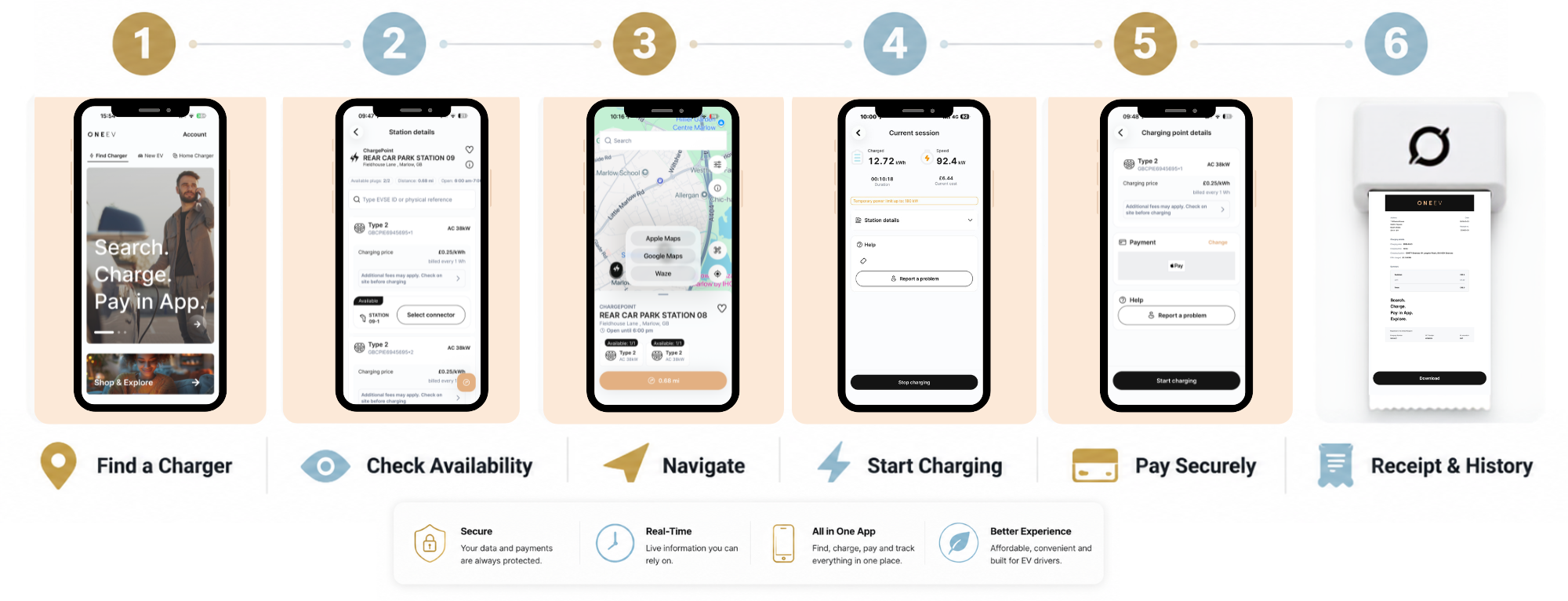
Live Availability: Why It Matters Before You Arrive
Live availability is one of the most useful features in any EV charging app. It helps drivers understand whether a public charge point is available, occupied, unavailable or potentially out of service before they travel to it.
For UK EV drivers, this matters because public charging is not only about finding a charger. It is about finding a charger that is actually usable when you arrive. A map full of charge points is helpful, but it is not enough if the driver cannot tell which ones are free, working or suitable for their journey.
Without availability information, drivers may waste time travelling to a location only to find that the charger is already in use, blocked by another vehicle or not operating correctly. That can be frustrating at any time, but it is especially stressful when battery level is low or when the driver is on a longer journey.
Before setting off to a public charger, always check availability, connector type and charging speed. A charger nearby is not always the best option if it is slower than you need or already occupied.
Understanding Charging Speeds in an EV Charging App
Charging speed is another important part of choosing the right public charge point. EV charging apps often display the power rating of a charger in kilowatts, usually shown as kW. Learn more in our guide to EV charging speeds.
In simple terms, public EV charging is usually grouped into slow, fast, rapid and ultra-rapid charging. Slow and fast chargers are often useful for longer stays, such as parking at work, staying overnight or spending several hours at a destination. Rapid and ultra-rapid chargers are more suitable when you need to get back on the road more quickly.
A good EV charging app should make this easy to understand. Drivers should not need to guess whether a charger is suitable. The app should show the charging speed clearly so drivers can make a sensible decision based on their journey, battery level and available time.
| Charging type | Typical use |
|---|---|
| Slow charging | Useful for long stays, overnight parking or locations where the vehicle can remain parked for several hours. |
| Fast charging | Good for workplaces, hotels, leisure venues, town centres and destination charging. |
| Rapid charging | Useful for longer journeys, motorway stops and drivers who need to charge more quickly. |
| Ultra-rapid charging | Designed for faster top-ups where the vehicle supports higher charging speeds. |
Why the Fastest Charger Is Not Always the Best Choice
Many drivers assume the fastest charger is always the best option. In reality, the best charger depends on your situation. If you are stopping for lunch, visiting a supermarket or staying at a hotel, a fast destination charger may be perfectly suitable. If you are travelling long distance and need a quick top-up, a rapid or ultra-rapid charger may be more appropriate.
Your vehicle also plays a role. Every EV has a maximum charging rate, and that rate can vary depending on battery temperature, state of charge and the vehicle’s own charging management system. This means an ultra-rapid charger will not always deliver its maximum speed to every car.
An EV charging app should help drivers choose based on practical need, not just headline numbers. The right charger is the one that fits your journey, your car and the time you have available, particularly when planning longer EV journeys.
EV charging speed is affected by more than the charger itself. Your vehicle, battery level, battery temperature and charger conditions can all influence the actual speed you receive during a session.
Understanding EV Charging Costs
Cost is one of the biggest questions drivers have when using public EV charging. A clear EV charging app should help drivers understand the price before they start a session. Read our guide to EV charging costs to understand what affects pricing.
Public EV charging is usually priced per kilowatt-hour, shown as pence per kWh. This means you pay for the energy delivered to your vehicle. Some networks or locations may also include additional pricing rules, depending on the operator, location and charging arrangement.
For drivers, the most important thing is clarity. Nobody wants to start a charging session without understanding what they are likely to pay. Transparent pricing helps drivers make better decisions and compare charging options more confidently.
A good EV charging app should present pricing in a clear and simple way, helping users see the cost before they commit to a session. This is especially important for drivers using public charging regularly, where small price differences can add up over time.
Payment Methods and In-App Charging
Payment is one of the areas where public EV charging can become frustrating. Some charge points support contactless payment, some require a specific network app, some use RFID cards and others may allow payment through roaming apps.
For drivers, this can feel inconsistent. One location may work one way, while another location works completely differently. This is one of the reasons EV charging apps are so important. They can help simplify the payment experience by allowing drivers to start, stop and pay in one place where supported.
Secure in-app payment can make charging feel more familiar. Instead of working out the instructions on the charger screen or downloading another app at the roadside, drivers can manage the session from their phone.
Before using a public charger, check how payment works. If you can start, stop and pay directly in the app, it can make the session quicker, simpler and easier to track afterwards.
Why Charging Receipts Matter
Receipts are easy to overlook until you need them. For private drivers, receipts help keep track of charging spend. For company car drivers and business users, they can be essential for expenses, VAT records and mileage-related reporting.
A good EV charging app should make receipts simple. After a charging session, drivers should be able to access the session details, payment record and charging history without searching through emails or logging into multiple network accounts.
This is one of the reasons many drivers prefer using one app where possible. It brings more of the charging record into one place, making it easier to understand how much has been spent and where charging has taken place.
| Driver type | Why receipts matter |
|---|---|
| Everyday EV drivers | Receipts help track charging costs and understand how much public charging is being used. |
| Company car drivers | Receipts can support expense claims and help evidence business charging costs. |
| Fleet users | Charging history can help monitor usage, costs and public charging behaviour. |
| Self-employed drivers | Receipts can support record keeping where charging costs are linked to business use. |
Find, Charge and Pay in One App
ONEEV is designed to make public EV charging easier by helping drivers search for charge points, check availability, start, stop and pay directly in the app where supported.
Get the ONEEV AppUsing an EV Charging App for Route Planning
Route planning is one of the most important reasons drivers use an EV charging app. When you are making a longer journey, it is not enough to know that chargers exist somewhere along the way. You need to know where they are, whether they are suitable for your vehicle and whether they fit naturally into your journey.
A good EV charging app helps drivers think ahead. Instead of waiting until the battery is low, you can identify public charge points before you set off, check nearby facilities and choose charging stops that make sense for the route.
This is especially useful for drivers who are new to electric vehicles. Petrol and diesel drivers are used to finding fuel stations almost anywhere. EV drivers need to think slightly differently, especially on unfamiliar routes or when travelling at busy times.
For longer journeys, do not wait until your battery is very low before looking for a charger. Plan your charging stops early and have a backup location in mind, especially during school holidays, bank holidays and busy travel periods.
How EV Charging Apps Help Reduce Range Anxiety
Range anxiety is the worry that your electric vehicle will run out of battery before you reach a charger. For many drivers, this concern is strongest when they first switch to an EV or when they are driving somewhere unfamiliar.
An EV charging app can help reduce range anxiety by giving drivers more visibility. When you can see public charge points on a map, check charging speeds and understand which locations are available, the journey feels more manageable.
Confidence comes from information. The more clearly an app shows charging options, the easier it becomes to plan ahead and make sensible decisions. Over time, drivers often find that range anxiety reduces as they become more familiar with public charging and their vehicle’s real-world range.
Many EV drivers do not need to charge from empty to full during a journey. A short top-up at the right point can often be enough to complete the trip comfortably.
Public Charging Networks and Roaming
The UK public charging network is made up of many different charge point operators. Some operators run chargers at supermarkets, some at motorway services, some at hotels, some at car parks and others at destination venues.
This variety is useful because it gives drivers more choice. However, it can also create confusion. Different networks may have different apps, different payment systems, different prices and different ways of starting a session.
Roaming is designed to make this easier. In simple terms, roaming allows an EV charging app or mobility service provider to connect drivers with charge points across multiple supported networks. This can help reduce the need for drivers to keep switching between different charging apps.
For the driver, the benefit is convenience. Instead of thinking about which operator owns the charger, the driver can focus on whether the charge point is suitable, available and easy to use.
Why Public EV Charging Can Feel Inconsistent
One of the biggest challenges with public EV charging is consistency. Some charging sessions are simple and smooth. Others can feel more complicated than expected.
This can happen for several reasons. A charger may be occupied, unavailable, offline, blocked, slower than expected or difficult to start. The payment method may be unclear, or the driver may need to use a different app from the one they normally prefer.
This is why the best EV charging apps focus on practical usability. Drivers do not simply want a list of chargers. They want clear information that helps them choose the right charger and avoid unnecessary problems.
| Common issue | How an EV charging app can help |
|---|---|
| Charger already in use | Live availability can help drivers check before travelling to the location. |
| Wrong connector type | Connector details help drivers confirm compatibility before they arrive. |
| Charging speed too slow | Speed information helps drivers choose a charger that suits their journey. |
| Unclear payment method | In-app payment can make it easier to start, stop and pay where supported. |
| Difficult to track costs | Charging history and receipts help drivers manage their public charging spend. |
Common Mistakes Drivers Make When Using EV Charging Apps
EV charging apps are designed to make public charging easier, but drivers can still run into problems if they do not check the right details before starting a journey or session.
Choosing the Closest Charger Without Checking Availability
The nearest charger is not always the best charger. If it is occupied, unavailable or too slow for your needs, it may be better to travel slightly further to a more suitable location.
Ignoring Charging Speed
A charger’s speed can make a big difference to the length of your stop. If you only have 20 minutes, a slower charger may not provide enough energy for your journey.
Not Checking Connector Type
Most modern EV drivers quickly become familiar with their connector type, but it is still worth checking before arrival, especially at unfamiliar charging locations.
Forgetting About Facilities
A good charging stop is not only about the charger. Nearby facilities such as toilets, food, coffee, shops or sheltered waiting areas can make the experience much better.
Waiting Too Long to Charge
Running the battery very low before searching for a charge point can create unnecessary pressure. Planning ahead gives you more choice and more time to respond if your first option is not available.
When planning a long journey, choose your preferred charging stop and a backup stop. This gives you more flexibility if the first charger is busy, unavailable or not suitable when you arrive.
How to Choose a Charging Stop That Works for Real Life
The best charging stop is not always the one with the highest power output. It is the one that works for your journey, your car and your plans.
If you are stopping for a meal, a destination charger may be enough. If you are driving long distance and need to keep moving, a rapid charger near your route may be better. If you are travelling with children, pets or passengers, facilities may matter just as much as charging speed.
An EV charging app should help drivers make these decisions quickly. The more information you have before arrival, the easier it becomes to choose a charging location that fits real life, not just the map.
Plan Your Public Charging with Confidence
Use ONEEV to search for public EV charge points, check availability, compare charging options and manage your charging journey from one simple app.
Start Charging with ONEEVHow to Choose the Best EV Charging App
With so many EV charging apps available, choosing the right one can feel overwhelming. Some apps focus on a single charging network, while others provide access to multiple supported charge point operators. Some simply display charging locations, while others allow drivers to search, start, stop and pay for charging directly from their phone.
The best EV charging app is not necessarily the one with the longest list of features. It is the one that makes public charging easier, saves time and gives drivers confidence every time they plug in.
Before downloading an EV charging app, it is worth thinking about how you actually use your electric vehicle. Do you mainly charge close to home? Do you regularly travel long distances? Do you drive a company car? Do you rely entirely on public charging? The answers to these questions will help determine which features matter most.
Choose an EV charging app based on how you drive, not simply on how many chargers it claims to display. A simple, reliable charging experience is usually far more valuable than having access to unnecessary features.
The Features That Really Matter
Many EV charging apps advertise hundreds of features, but in reality most drivers use the same core functions every week. The best apps focus on making these everyday tasks simple, reliable and easy to understand.
Easy Charger Search
Finding a charger should take seconds, not minutes. A clear map, accurate search results and useful filters help drivers locate suitable charging locations quickly.
Reliable Live Information
Drivers need confidence that the information shown is accurate. Availability, charging speed and connector details should be presented clearly so drivers can make informed decisions before travelling.
Simple Payment
One of the biggest frustrations for many EV drivers is dealing with multiple payment methods. Where supported, the ability to start, stop and pay directly through one app creates a much smoother charging experience.
Transparent Pricing
No driver likes unexpected costs. A good EV charging app should make pricing easy to understand before charging begins, allowing users to compare charging options with confidence.
Charging History
Being able to review previous charging sessions, download receipts and monitor charging costs helps both private and business users manage their EV more effectively.
Many experienced EV drivers value simplicity more than the number of available features. The easier an app is to use during a real charging session, the more likely it is to become part of their everyday routine.
Questions to Ask Before Downloading an EV Charging App
Not every charging app is designed in the same way. Before committing to one, ask yourself a few simple questions.
| Question | Why it matters |
|---|---|
| Can I easily find nearby public chargers? | Quick searching reduces journey planning time. |
| Does it clearly show charger availability? | Helps avoid unnecessary journeys. |
| Can I understand pricing before charging? | Improves confidence and budgeting. |
| Can I pay securely through the app? | Creates a smoother charging experience. |
| Are receipts easy to access? | Useful for business users and expense tracking. |
| Is the app simple to use? | Reduces stress during charging. |
| Does the app receive regular updates? | Shows ongoing support and improvement. |
Why User Experience Is More Important Than Feature Lists
Many technology products compete by adding more features every year. However, public EV charging is different. When drivers arrive at a charge point they usually have one simple goal: start charging as quickly as possible.
An EV charging app should remove complexity rather than create it. Clear navigation, readable information, simple payment and reliable charging management often provide a better experience than dozens of rarely used features.
The most successful apps are those that feel intuitive from the first time they are used. Drivers should not need lengthy instructions or complicated registration processes just to begin charging.
If you ever need to stop and think about how to use a charging app while standing beside a charger, the experience can probably be improved. The best apps feel natural from the moment you open them.
Comparing What Drivers Value Most
| Feature | Why drivers value it |
|---|---|
| Simple navigation | Find chargers quickly with minimal effort. |
| Live availability | Reduces wasted journeys. |
| Clear pricing | Helps drivers budget before charging. |
| Secure in-app payment | Makes charging more convenient. |
| Charging history | Keeps all charging records together. |
| Receipts | Useful for business and personal records. |
| Regular updates | Improves reliability and long-term usability. |
| Responsive support | Provides reassurance when something goes wrong. |
Why the Best EV Charging Apps Continue to Improve
The public EV charging industry is evolving rapidly. Charging networks expand, vehicles become more capable and driver expectations continue to grow. The best EV charging apps evolve alongside these changes.
Regular updates help improve reliability, introduce new features and refine the overall charging experience. Drivers should view ongoing development as a positive sign that an app is continuing to invest in making public charging simpler and more convenient.
Looking for a Simpler EV Charging Experience?
ONEEV has been designed to help UK and Ireland EV drivers find public charge points, check live availability, start, stop and pay for charging in one easy-to-use app, with no subscription required.
Download the ONEEV AppThe Future of EV Charging Apps
Public EV charging has developed rapidly over the past few years, and the technology behind EV charging apps continues to evolve just as quickly. As more drivers switch to electric vehicles, expectations are changing. Drivers no longer simply want to find a charger. They want an intelligent charging experience that is fast, reliable, personalised and effortless.
The next generation of EV charging apps will become much more than digital maps. They will act as intelligent travel companions, helping drivers make better decisions before, during and after every journey.
Many of these technologies are already beginning to appear, while others are expected to become increasingly common over the next few years.
The UK public charging network continues to expand rapidly, while vehicle technology and charging infrastructure are improving every year. Modern EV charging apps are evolving alongside these changes to give drivers more information, greater convenience and a better overall charging experience.
Smarter Route Planning
Future EV charging apps are expected to become increasingly intelligent when planning journeys. Instead of simply showing nearby chargers, they will consider factors such as battery level, weather conditions, traffic, elevation, vehicle efficiency and charging speed to recommend the most suitable charging stops.
This means drivers will spend less time planning and more time enjoying the journey. Rather than asking where to charge, the app will increasingly answer when, where and why a particular charging stop is the best option.
Artificial Intelligence and Personalised Charging
Artificial intelligence is likely to play a much larger role in EV charging over the coming years. By learning from previous journeys and charging habits, AI can help recommend charging locations, predict energy requirements and personalise the charging experience for individual drivers.
For example, an app may learn that a driver regularly charges after work, prefers rapid charging on motorway journeys or frequently visits particular destinations. Over time, this information can help reduce the number of decisions drivers need to make themselves.
The best technology should reduce complexity, not increase it. AI should quietly improve the charging experience behind the scenes while allowing drivers to remain fully in control of their decisions.
Plug and Charge Technology
One of the most exciting developments is Plug and Charge. Instead of opening an app or using a payment card, compatible vehicles and chargers can identify each other automatically. The charging session starts when the cable is connected, while authentication and payment happen securely in the background.
Although this technology is still being introduced across the industry, it has the potential to make public charging feel as simple as plugging in at home.
Even as Plug and Charge becomes more common, EV charging apps are expected to remain important by helping drivers locate chargers, plan journeys, review charging history and manage payments across different charging networks.
Better Integration with Electric Vehicles
Future EV charging apps are also expected to communicate more closely with the vehicle itself. Rather than relying solely on manual information entered by the driver, apps may automatically receive battery status, estimated range, charging limits and vehicle preferences.
This closer integration could allow charging recommendations to become even more accurate, reducing unnecessary charging stops while helping drivers maximise battery efficiency.
Improved Public Charging Information
As charging infrastructure grows, drivers will increasingly expect more than basic availability information. Future EV charging apps are likely to provide richer information about each location, including photographs, accessibility, nearby facilities, parking restrictions, lighting, customer reviews and real-time operational updates.
This additional information helps drivers make better decisions before arriving, particularly when travelling to unfamiliar locations.
| Today's EV charging apps | Future EV charging apps |
|---|---|
| Find nearby chargers | Predict the best charger for your journey. |
| Display charging locations | Recommend charging stops based on your driving habits. |
| Show charging speeds | Estimate charging time using real vehicle data. |
| Provide payment options | Enable increasingly seamless authentication. |
| Store charging history | Provide intelligent charging insights and recommendations. |
Why Simplicity Will Always Matter
While EV charging technology will continue to become more advanced, the most successful apps are likely to remain the simplest to use. Drivers do not want unnecessary complexity. They want confidence, reliability and clear information exactly when they need it.
The best EV charging apps will continue focusing on helping drivers find chargers quickly, understand pricing, manage charging sessions easily and complete journeys with confidence.
Technology should remove barriers, not create them. Whether charging at home, at work or on a motorway journey, the overall experience should feel intuitive from start to finish.
Helping Make Public EV Charging Simpler
At ONEEV, our goal is straightforward: to help EV drivers search, charge, pay and manage public charging through one simple app. As charging technology continues to evolve, we remain focused on delivering an experience that is easy to use today while continuing to improve for tomorrow's drivers.
Discover the ONEEV AppFrequently Asked Questions About EV Charging Apps
What is an EV charging app?
An EV charging app helps electric vehicle drivers locate public charge points, view charging information, understand pricing, start charging sessions where supported, pay securely and access charging history and receipts.
Do I need an EV charging app?
Many public charge points can be accessed more easily using an EV charging app. Apps help drivers find suitable chargers, understand charging costs and manage charging sessions more conveniently.
Can I use one app for every charger?
Not always. Different charging networks operate different infrastructure. However, roaming agreements allow some EV charging apps to provide access to multiple supported charging networks through a single account.
Are EV charging apps free to download?
Most EV charging apps are free to download. Drivers only pay for the charging session itself where applicable.
How do EV charging apps make money?
Different providers use different business models. Some receive revenue from charging transactions, while others offer additional services or partner with charging networks.
Can I pay for charging through an app?
Many public charging networks allow drivers to start, stop and pay directly through a supported EV charging app.
Why do some chargers require a pre-authorisation?
Some payment providers temporarily reserve funds before charging begins. This is usually a temporary authorisation rather than the final charging cost and is released or adjusted once the session is complete.
Can I use Apple Pay or Google Pay?
Many EV charging apps support digital payment methods such as Apple Pay and Google Pay where available.
What information should an EV charging app display?
A useful app should clearly show charger location, connector type, charging speed, availability, pricing and payment options where possible.
How accurate is live charger availability?
Availability depends on the information provided by the charging network. While live data helps drivers make informed decisions, occasional delays or changes can occur.
Can an EV charging app help reduce range anxiety?
Yes. By helping drivers locate suitable public charge points and plan charging stops in advance, EV charging apps can significantly increase confidence during longer journeys.
How do I know which connector my vehicle uses?
Your vehicle handbook and manufacturer specifications will identify the connector type. Most EV charging apps also display compatible connector information for each charger.
Why are charging speeds different?
Charging speed depends on the charger, your vehicle, battery temperature, battery state of charge and the vehicle's maximum charging capability.
Can I use an EV charging app abroad?
Some apps provide access to charging networks in multiple countries through roaming agreements, although coverage varies between providers.
Do I still need RFID cards?
Some charging networks continue to support RFID cards, although many drivers now prefer managing charging directly through an app where supported.
Can I see my previous charging sessions?
Most modern EV charging apps allow drivers to review charging history, receipts and previous transactions.
Are charging receipts available?
Many apps automatically generate digital receipts, making it easier to monitor charging costs and manage expenses.
Can businesses use EV charging apps?
Yes. Business users, fleet drivers and company car drivers often use EV charging apps to manage charging costs and maintain accurate records.
How often should an EV charging app be updated?
Regular updates help improve reliability, security, usability and compatibility with new charging networks and technologies.
What makes a good EV charging app?
The best EV charging apps provide clear information, reliable charger data, transparent pricing, secure payment, intuitive navigation and a simple charging experience.
Public EV charging is constantly evolving. Explore our growing collection of EV Guides to learn more about charging speeds, charging costs, route planning, home charging and choosing the best EV charging app for your needs.
Related EV Guides
- EV Guides Hub
- Public EV Charging Explained
- EV Charging Speeds Explained
- EV Charging Costs
- Route Planning for EV Drivers
- Home vs Public Charging
- EV Charging for Beginners
- Company Car Charging Guide
- How to Choose the Best EV Charging App
Final Thoughts
Choosing the right EV charging app can make a significant difference to your public charging experience. From helping you find compatible charge points and understand charging costs to providing secure payment and charging history, the right app should remove uncertainty and give you confidence every time you plug in.
As electric vehicle ownership continues to grow across the UK, EV charging apps will play an increasingly important role in making public charging simpler, smarter and more accessible. By understanding the features that matter most and choosing an app that suits your driving habits, you can spend less time worrying about charging and more time enjoying the journey.
Ready to Simplify Public EV Charging?
Download the ONEEV app to search for public charge points, check live availability, start, stop and pay for charging in one simple place, with no subscription required.
Download ONEEVExplore More EV Charging Guides
Continue learning with these helpful ONEEV guides for UK electric vehicle drivers.
Understand how public EV charging works across the UK.
EV Charging Speeds ExplainedLearn the difference between slow, fast, rapid and ultra-rapid charging.
EV Charging CostsSee what affects the cost of charging your electric car.
Route Planning for EV DriversPlan EV journeys with fewer charging worries.
Home vs Public ChargingCompare home charging with public charging options.
EV Charging for BeginnersA simple guide for new electric vehicle drivers.
Company Car Charging GuideHelpful guidance for business and company car EV drivers.
Best EV Charging AppFind out what to look for in a reliable EV charging app.