Public EV Charging Explained: Everything UK EV Drivers Need to Know
Making EV Charging Simple for Every Driver
What Is Public EV Charging?
Public EV charging refers to electric vehicle charge points that are available for drivers to use away from home. These can be found at motorway services, supermarkets, hotels, retail parks, car parks, workplaces, leisure venues, town centres and destination locations across the UK.
For many drivers, Public EV charging is an important part of everyday electric vehicle ownership. Some drivers use it occasionally on longer journeys, while others rely on public charge points regularly because they do not have access to a home charger.
Public EV charging gives drivers more flexibility. It allows electric vehicles to travel further, makes charging possible while away from home and supports people who live in flats, rented homes or properties without off-street parking.
Public EV charging is easiest when you plan ahead. Before travelling to a charge point, check the location, connector type, charging speed, live availability and pricing so you know what to expect before you arrive.
Why Public EV Charging Matters
Public EV charging is one of the key foundations of electric vehicle adoption. While home charging is convenient for drivers who have access to a driveway or private parking space, not every EV driver has that option.
Across the UK, many drivers depend on public charge points for regular charging. This includes people living in urban areas, apartment blocks, terraced streets and shared accommodation. It also includes company car drivers, taxi drivers, fleet users and people who frequently travel long distances.
A reliable public charging network helps make electric driving practical for more people. It gives drivers confidence that they can charge when they need to, whether they are commuting, shopping, visiting family, travelling for work or heading away for the weekend.
Public EV charging is not just for emergencies or long journeys. Many drivers use public charge points as part of their normal weekly routine, especially where home charging is not available.
Where Can You Find Public EV Chargers?
Public EV charge points are now available in a wide range of everyday locations. This is important because drivers often want to charge while doing something else, rather than waiting specifically for the vehicle to charge.
Common public charging locations include:
- Motorway service areas
- Supermarket car parks
- Retail parks and shopping centres
- Hotels and hospitality venues
- Public car parks
- Town centres
- Leisure centres and gyms
- Workplace and business locations
- Tourist destinations
- On-street residential charging locations
The best charging location depends on the journey. A motorway rapid charger may be best for a quick stop during a long trip, while a slower destination charger may be ideal if the vehicle is parked for several hours.
How Public EV Charging Is Different from Home Charging
Home charging usually happens overnight or while the vehicle is parked for a long period. It is often predictable because the driver uses the same charger regularly. Public charging is different because the driver may be using unfamiliar locations, different charging speeds, different networks and different payment methods.
This means public charging requires slightly more preparation. Drivers need to understand where the charger is, whether it is available, whether it suits their vehicle and how payment works.
| Charging type | Typical use | What drivers need to check |
|---|---|---|
| Home charging | Regular overnight or daily charging. | Electricity tariff, charger settings and vehicle schedule. |
| Public charging | Charging away from home, during journeys or at destinations. | Location, availability, connector, speed, pricing and payment method. |
Who Uses Public EV Charging?
Public EV charging is used by a wide range of drivers. Some people only use public chargers occasionally, while others use them as their main way of charging.
Drivers who may rely on public charging include people without off-street parking, city drivers, company car users, fleet drivers, taxi and private hire drivers, long-distance commuters and people who regularly travel across different regions.
Public charging also supports drivers who have home chargers but still need flexibility. Even if most charging happens at home, public charge points are essential for longer journeys, unexpected trips and days when the vehicle needs a faster top-up.
Find Public EV Chargers with ONEEV
ONEEV helps drivers search for public EV charge points, check availability, view charging options and manage public charging through one simple app.
Download the ONEEV App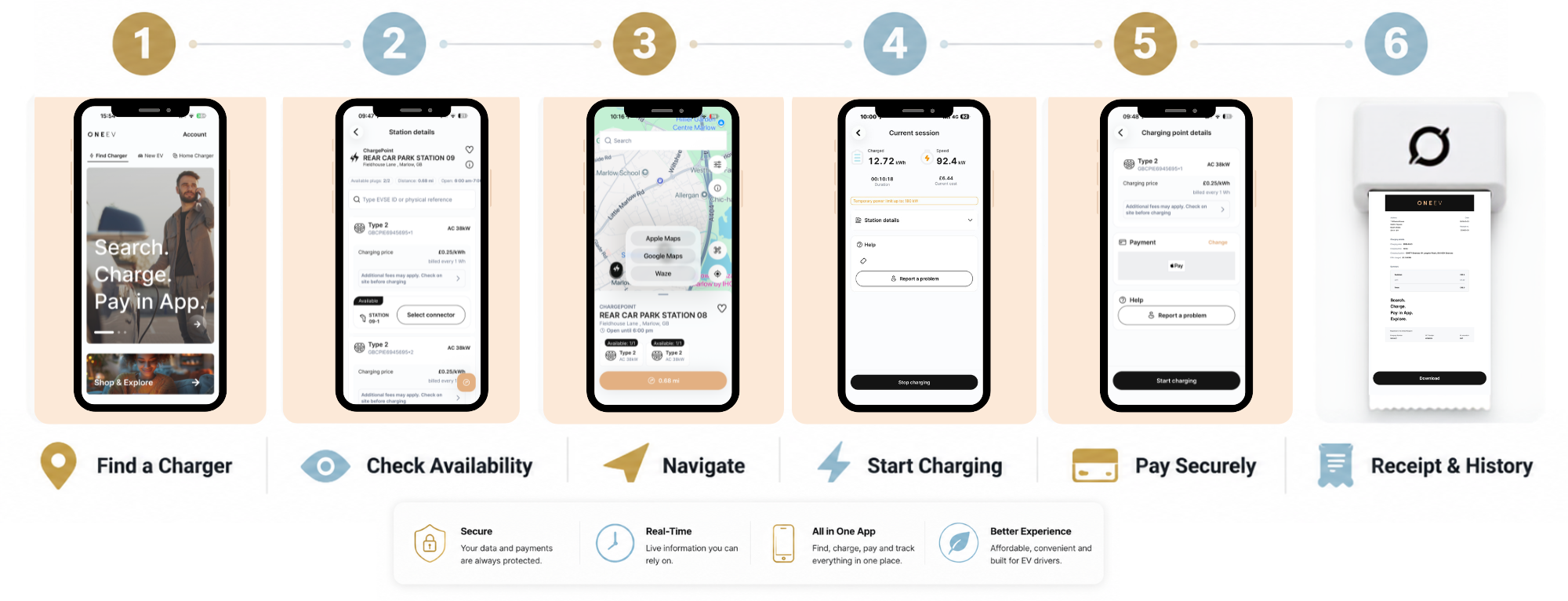
How Public EV Charging Works
Using a public EV charger is much easier than many new drivers expect. Although different charging networks may have slightly different processes, the overall charging journey is usually very similar. Once you understand the basic steps, public charging quickly becomes part of your normal driving routine.
Whether you are charging at a motorway service area, supermarket, hotel or public car park, the process typically involves finding a suitable charger, connecting your vehicle, starting the charging session, monitoring progress and ending the session once you have enough charge.
Before setting off, check that the charger is compatible with your vehicle, supports the charging speed you need and is available before you arrive. A few moments of planning can save unnecessary delays.
Step 1 – Find a Suitable Public Charger
The first step is choosing the right charger for your journey. Rather than simply selecting the nearest charger, consider whether it matches your vehicle, how much battery you need and how long you plan to stop.
A good EV charging app allows drivers to search nearby public charge points, filter results by connector type, charging speed and availability, and compare different charging locations before travelling.
Drivers should also consider nearby facilities. Charging while having a coffee, shopping or eating a meal can make better use of the charging time.
Step 2 – Check Compatibility
Not every public charger is suitable for every electric vehicle. Before travelling, confirm that the connector matches your vehicle and that the charger provides an appropriate charging speed.
Most modern electric vehicles use CCS for rapid DC charging and Type 2 connectors for AC charging, although some older vehicles may use different connector types.
Most public charging issues are not caused by the charger itself but by drivers selecting an incompatible connector or arriving at a charger that does not meet their charging requirements.
Step 3 – Connect Your Vehicle
Once you arrive, park safely within the charging bay and connect the charging cable according to the instructions displayed at the charge point. Some chargers have permanently attached cables, while others require drivers to use their own charging cable.
Most public chargers provide clear on-screen guidance throughout the process. After connecting the cable, the charger will normally wait for authorisation before electricity begins flowing to the vehicle.
Step 4 – Start the Charging Session
Different charging networks offer different ways to begin charging. Depending on the location, drivers may start the session using an EV charging app, contactless payment, RFID card or another approved payment method.
Many drivers prefer using an EV charging app because it allows them to manage charging, make secure payments and access charging receipts from one place.
| Common payment method | Typical experience |
|---|---|
| EV charging app | Start, stop and pay within the app where supported. |
| Contactless payment | Tap a debit or credit card directly at the charger. |
| RFID card | Authenticate using a registered charging card. |
Step 5 – Monitor Your Charging Session
Once charging has started, many EV charging apps display useful information including charging progress, estimated charging time and session status.
You do not always need to charge to 100%. On many journeys, adding enough energy to comfortably reach your destination or next charging stop is often the most efficient approach.
Some rapid chargers naturally reduce charging speed once the battery reaches a higher state of charge to help protect battery health.
For the fastest overall journey, many experienced EV drivers disconnect once they have enough charge to comfortably continue their trip rather than waiting for the battery to reach 100%.
Step 6 – End the Charging Session
When you have finished charging, end the session using the charging app or payment method used to start it, unless the charger ends the session automatically. Disconnect the charging cable safely, return it correctly if required and ensure the charging bay is left ready for the next driver.
Many charging apps automatically generate digital receipts, making it easy to review charging costs and previous sessions.
What Happens If Something Goes Wrong?
Although public charging is becoming increasingly reliable, occasional issues can still occur. A charger may already be occupied, temporarily unavailable or experience a communication problem.
If this happens, most drivers simply move to another nearby charger. Using an EV charging app that displays multiple charging locations can make this process much quicker and less stressful.
Where a payment authorisation has been placed before charging starts, this is usually a temporary reservation rather than the final charging cost and is released or adjusted once the charging session has completed.
Charge Publicly with Confidence
ONEEV helps you find compatible public charge points, view live charging information, manage payments and keep all your charging receipts together in one easy-to-use app.
Download the ONEEV AppPublic Charging Networks, Speeds and Connector Types
Public EV charging can feel confusing at first because there are different charging networks, different charger speeds and different connector types. Once you understand the basics, it becomes much easier to choose the right charger for your vehicle and journey.
The key is to focus on three practical questions: who operates the charger, how fast it can charge and whether the connector is suitable for your vehicle.
What Are Public EV Charging Networks?
Public EV charging networks are companies or operators that install, manage and maintain public charge points. Some networks focus on rapid charging hubs, while others operate destination chargers at hotels, supermarkets, car parks, retail parks or workplaces.
Drivers do not always need to think about the network behind the charger, but it can affect pricing, availability, payment methods and support. This is why EV charging apps are useful, because they can bring information from supported networks into one place.
A charge point operator, often shortened to CPO, is the company responsible for running the charging equipment. An EV charging app can help drivers access supported charge points across multiple operators.
Understanding AC and DC Charging
Public chargers generally use either AC charging or DC charging. AC charging is usually slower and is often used for destination charging, where the vehicle is parked for a longer period. DC charging is usually faster and is often used for rapid or ultra-rapid charging during longer journeys.
With AC charging, the car converts the electricity before storing it in the battery. With DC charging, the charger delivers direct current to the battery more quickly, which is why DC chargers are often used for rapid charging stops.
| Charging type | Best for | Typical locations |
|---|---|---|
| AC charging | Longer stays and destination charging. | Hotels, workplaces, car parks, leisure venues and some supermarkets. |
| DC charging | Faster charging during journeys. | Motorway services, charging hubs, forecourts and high-speed charging locations. |
Slow, Fast, Rapid and Ultra-Rapid Charging Explained
Public chargers are often grouped by charging speed. Although exact definitions can vary slightly, drivers will usually see terms such as slow, fast, rapid and ultra-rapid charging.
Slow and fast chargers are useful when the vehicle will be parked for longer. Rapid and ultra-rapid chargers are more suitable when drivers need to add range quickly and continue their journey.
| Charging speed | What it means for drivers |
|---|---|
| Slow charging | Best for long parking periods where charging time is not urgent. |
| Fast charging | Useful at destinations where the vehicle may be parked for several hours. |
| Rapid charging | Designed for quicker top-ups during longer journeys. |
| Ultra-rapid charging | Best for vehicles that support high charging speeds and drivers who want shorter stops. |
The fastest charger is not always the best charger. If you are parked for several hours, a fast destination charger may be more convenient than a rapid charger. Choose based on your journey, not just the highest power rating.
Understanding EV Connector Types
Connector type is one of the most important things to check before using a public EV charger. If the connector does not match your vehicle, you will not be able to charge from that socket.
In the UK, many EVs use a Type 2 connector for AC charging and CCS for rapid DC charging. Some older vehicles may use CHAdeMO for rapid charging, although CCS is now more common on many newer models.
| Connector type | Common use | Driver note |
|---|---|---|
| Type 2 | AC public charging and many home chargers. | Common across many UK and European EVs. |
| CCS | Rapid and ultra-rapid DC charging. | Widely used by many modern electric vehicles. |
| CHAdeMO | Rapid DC charging for some older EVs. | Still available at some locations, but less common on newer models. |
Why Charging Speed Can Vary
The speed shown on a public charger is usually the maximum output the charger can provide. That does not always mean your vehicle will receive that speed throughout the whole session.
Your actual charging speed can be affected by your vehicle’s maximum charging rate, battery temperature, battery state of charge, charger condition, power sharing and the vehicle’s charging curve.
This is why charging can slow down as the battery fills. Many EVs charge more quickly at lower battery percentages and then reduce charging speed as the battery becomes fuller.
A charger may be advertised as ultra-rapid, but your vehicle will only charge as fast as it can safely accept. The car, battery and charger all influence the final charging speed.
How Roaming Helps Public EV Charging
Roaming allows drivers to access charge points across multiple supported networks through a single app or account. This can make public charging more convenient because drivers do not always need to download a separate app for every charging network they use.
For drivers, roaming can make the public charging experience feel more connected. Instead of thinking about individual networks, drivers can focus on finding a suitable charger and completing the session.
Roaming does not always mean every charger is available in every app, but it can significantly reduce the number of apps, accounts and payment methods drivers need to manage.
Choosing the Right Public Charger
The right public charger depends on what you need at that moment. If you are stopping briefly on a long journey, rapid or ultra-rapid charging may be best. If you are shopping, working or staying overnight, a slower destination charger may be more convenient and practical.
Before choosing a charger, consider the location, speed, connector, price, availability and nearby facilities. A charger that fits naturally into your day will usually provide a better experience than one chosen purely because it is closest.
Find the Right Public Charger Faster
ONEEV helps EV drivers search for public charge points, check connector types, view charging speeds and manage charging through one simple app.
Find Chargers with ONEEV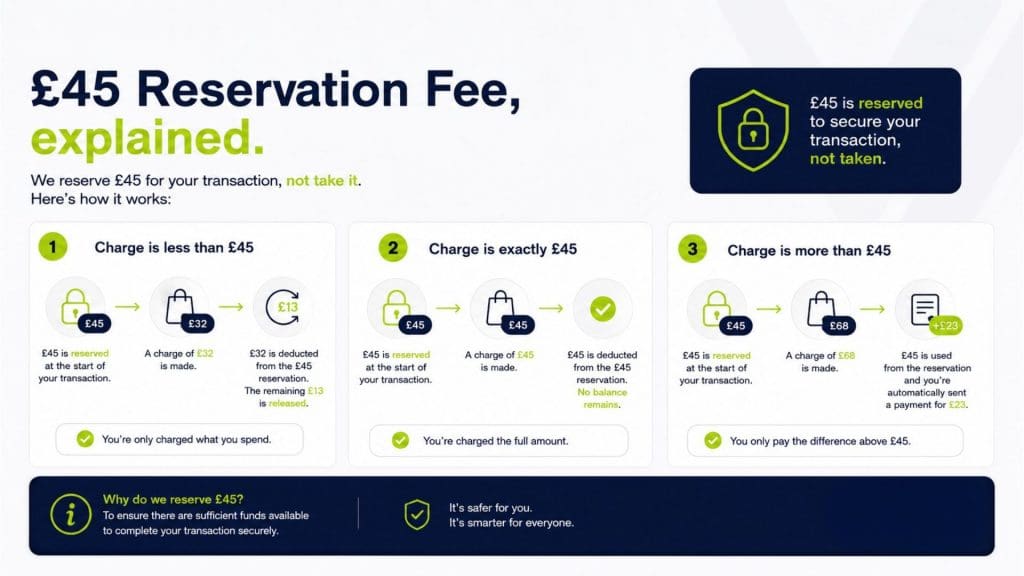
Public EV Charging Costs and Payment Methods
One of the biggest questions new EV drivers ask is how much public charging costs. Unlike filling a petrol or diesel vehicle, there is no single nationwide price for charging an electric vehicle. Costs can vary depending on the charging network, charging speed, location and time of day.
Although pricing varies between operators, public charging gives drivers flexibility. Whether you need a quick top-up during a motorway journey or a slower destination charge while shopping or working, there are charging options available to suit different journeys and budgets.
Always check the charging price before starting a session. Most EV charging apps display pricing information before you begin charging, helping you make informed decisions.
How Public Charging Is Priced
Most public charge points charge drivers based on the amount of electricity delivered to the vehicle. Some locations may also apply connection fees, parking charges or idle fees if a vehicle remains connected after charging has finished.
Pricing structures can differ between charging networks, so understanding the costs before starting a charging session helps avoid surprises.
| Possible charge | What it means |
|---|---|
| Energy cost | The electricity supplied during the charging session. |
| Connection fee | A fixed fee charged by some operators when starting a session. |
| Idle fee | A charge applied if a vehicle remains connected after charging has completed. |
| Parking charge | Some locations may also charge for parking separately from charging. |
How to Pay for Public EV Charging
Public EV charging has become much easier in recent years. Many charging locations now offer several ways to pay, allowing drivers to choose whichever method is most convenient.
Depending on the charging network, drivers may be able to pay using:
- An EV charging app
- Contactless debit or credit card
- Apple Pay
- Google Pay
- RFID charging card
- Business or fleet charging account
Many drivers prefer using an EV charging app because it allows them to manage charging sessions, review charging history and access digital receipts from one place.
Many public charging locations now support contactless payment, making public charging even easier for occasional users and first-time EV drivers.
Understanding Pre-authorisation Charges
Some public charging networks temporarily reserve funds before a charging session begins. This is known as a pre-authorisation and helps verify that the chosen payment method is valid.
Many drivers mistake this temporary reservation for an actual payment. In most cases it is simply a temporary hold placed by the payment provider and is automatically adjusted or released once the charging session has finished.
The final amount charged is normally based on the electricity used during the charging session rather than the temporary reservation.
If you notice a temporary payment reservation before charging starts, do not panic. It is usually not the final charging cost and will normally be updated automatically after the session has completed.
Keeping Track of Charging Costs
Digital receipts make it much easier to monitor charging costs over time. They are particularly useful for company car drivers, business users and anyone claiming charging expenses.
Many EV charging apps automatically store charging history, allowing drivers to review previous sessions without needing paper receipts.
| Benefit | Why it matters |
|---|---|
| Digital receipts | Easy record keeping for personal and business use. |
| Charging history | Review previous charging sessions and spending. |
| Secure payment | Reduces the need to carry multiple payment methods. |
| One account | Manage supported public charging networks in one place. |
Common Public Charging Mistakes
Most public charging sessions are straightforward, but a little preparation can make the experience even smoother.
- Arriving without checking charger availability.
- Selecting the wrong connector.
- Choosing a charger that is slower than required.
- Not checking pricing before charging begins.
- Leaving the vehicle connected after charging has finished.
- Waiting until the battery is almost empty before looking for a charger.
Understanding these common mistakes helps drivers charge more efficiently while making better use of the growing UK public charging network.
Best Practice for Public EV Charging
Public charging is becoming easier every year as charging infrastructure expands and payment systems improve. Following a few simple best practices helps make every charging session smoother.
- Plan longer journeys in advance.
- Check charger availability before travelling.
- Use the correct connector.
- Review pricing before starting the session.
- Move your vehicle promptly once charging has finished.
- Keep digital receipts for future reference.
Public Charging Made Simple
ONEEV helps drivers search public charge points, compare charging options, manage payments and keep charging receipts together in one easy-to-use app.
Download the ONEEV AppThe Future of Public EV Charging
Public EV charging is evolving rapidly. Across the UK, thousands of new charge points are being installed every year as electric vehicle adoption continues to increase. At the same time, charging technology is becoming faster, smarter and easier to use, helping public charging become part of everyday life rather than something drivers need to worry about.
The future of public EV charging is not simply about having more chargers. It is about making the entire charging experience more reliable, more connected and more convenient for every driver.
The UK's public charging network continues to expand every year, with new charging hubs, retail destinations and motorway charging locations opening to support the growing number of electric vehicles on British roads.
More Public Charging Locations
As EV ownership continues to grow, public charging infrastructure is expanding to meet demand. New charge points are appearing at supermarkets, retail parks, hotels, leisure venues, workplaces, public car parks, residential streets and dedicated charging hubs.
The aim is simple: to make charging available wherever drivers naturally spend their time. Instead of travelling specifically to charge, drivers will increasingly charge while shopping, working, eating or enjoying leisure activities.
This wider availability will help reduce range anxiety while making electric vehicle ownership practical for even more households across the UK.
Ultra-Rapid Charging Will Become More Common
Rapid charging has already transformed long-distance EV travel, but ultra-rapid charging continues to improve the experience even further. Modern charging hubs are capable of delivering significantly faster charging for compatible vehicles, allowing drivers to continue their journeys after relatively short charging stops.
As battery technology continues to improve, more electric vehicles will be able to take advantage of these higher charging speeds, helping reduce waiting times and making long-distance travel even more convenient.
Even as charging speeds increase, planning your journey remains important. Choosing the right charger at the right time often makes a bigger difference than simply selecting the highest-powered charger available.
Plug and Charge Technology
One of the biggest developments in public charging is Plug and Charge. Rather than opening an app or tapping a payment card, compatible vehicles and chargers can automatically identify each other when the cable is connected.
Authentication and payment happen securely in the background, allowing charging to begin almost immediately. The result is a charging experience that feels much closer to plugging a device into a socket at home.
Although Plug and Charge is still being adopted across the industry, it represents an important step towards making public charging simpler for drivers.
Smarter EV Charging Apps
Future EV charging apps will become increasingly intelligent. Instead of simply displaying nearby chargers, they will help drivers choose the best charging location based on battery level, journey length, charging speed, traffic conditions and previous charging habits.
Artificial intelligence and improved vehicle integration will allow charging recommendations to become more personalised, reducing unnecessary charging stops and improving overall journey planning.
Rather than searching manually, drivers will increasingly receive recommendations that fit their individual driving patterns.
| Today's charging experience | Future charging experience |
|---|---|
| Search for nearby chargers. | Receive intelligent charging recommendations. |
| Compare locations manually. | Automatic route-aware charging suggestions. |
| Estimate charging time. | Vehicle-specific charging predictions. |
| Separate planning and charging. | Integrated journey planning from start to finish. |
Smart Charging and Renewable Energy
Public charging is expected to become increasingly connected with the wider electricity network. Smart charging technologies can help balance electricity demand while encouraging charging during periods when renewable energy generation is higher.
This creates benefits for both drivers and the wider energy system by helping improve efficiency while supporting the transition towards cleaner transport.
Vehicle-to-Grid Technology
Vehicle-to-Grid, often referred to as V2G, is another exciting development. This technology allows compatible electric vehicles to both receive electricity and, in some situations, return energy back to the electricity grid.
Although still developing, Vehicle-to-Grid has the potential to make electric vehicles an active part of the UK's future energy system while creating additional opportunities for smart energy management.
The future of public EV charging is not simply about faster chargers. It is about creating a connected charging ecosystem where vehicles, charging networks, payment systems and intelligent software work together to provide a seamless experience.
Public EV Charging in the Years Ahead
As charging infrastructure continues to expand, drivers can expect public charging to become faster, easier and more accessible. Improved reliability, better payment systems, greater roaming between charging networks and smarter EV charging apps will continue removing barriers for new and existing EV owners.
Whether charging at home, on a motorway journey or while visiting a destination, public charging will increasingly become an integrated part of everyday driving rather than a separate task that requires careful planning.
The combination of improved charging technology, better infrastructure and intelligent software means the future of electric vehicle charging looks increasingly convenient for drivers across the UK.
Experience Smarter Public EV Charging
ONEEV has been designed to help EV drivers search, charge, pay and manage public charging through one simple app. As public charging continues to evolve, ONEEV will continue helping drivers make every journey simpler, more convenient and more connected.
Start Charging with ONEEVFrequently Asked Questions About Public EV Charging
What is public EV charging?
Public EV charging allows electric vehicle drivers to recharge their vehicle away from home using charge points located at motorway services, supermarkets, hotels, retail parks, public car parks, workplaces and other public locations.
How do I use a public EV charger?
Most public charging sessions follow the same process. Find a suitable charger, connect your vehicle, authorise the charging session using the available payment method, allow the vehicle to charge and end the session once you have enough energy for your journey.
Do I need an app to use a public EV charger?
Not always. Many public chargers now support contactless payment. However, using an EV charging app often provides additional benefits such as live charger availability, charging history, digital receipts and secure in-app payments where supported.
How much does public EV charging cost?
Public charging costs vary depending on the charging network, charging speed, location and pricing structure. Many EV charging apps allow drivers to check pricing before starting a charging session.
Can I pay with a debit or credit card?
Many public charging locations now accept contactless debit and credit card payments. Some also support Apple Pay and Google Pay, making charging more convenient for occasional users.
Why has money been reserved before my charging session?
Some charging providers place a temporary pre-authorisation on your payment method before charging begins. This is usually a temporary reservation rather than the final charging cost and is adjusted or released once the session has finished.
How long does public EV charging take?
Charging time depends on the charger, your vehicle, battery size, battery temperature and current state of charge. Faster chargers can significantly reduce charging times for compatible vehicles.
What is the difference between AC and DC charging?
AC charging is generally used for slower destination charging, while DC charging is designed for faster charging during longer journeys. The most suitable option depends on how long you intend to stay at the location.
Can I charge my EV to 100% at a public charger?
Yes, although many drivers choose to disconnect earlier during longer journeys. Charging speeds often reduce as the battery approaches full capacity, so charging beyond around 80% may take proportionally longer on many vehicles.
How do I know if a charger is compatible with my vehicle?
Before travelling, check the connector type supported by both your vehicle and the charging station. Most EV charging apps clearly display compatible connector information for each charge point.
What are the most common connector types?
Type 2 connectors are widely used for AC charging, while CCS is commonly used for rapid and ultra-rapid DC charging. Some older vehicles may still use CHAdeMO connectors.
What should I do if a public charger is unavailable?
If a charger is occupied or temporarily unavailable, an EV charging app can help you quickly locate alternative nearby charging locations.
Can I leave my vehicle while it is charging?
In many situations, yes. However, always follow any instructions displayed at the charging location and return promptly once charging has finished to avoid possible idle fees and to allow other drivers to use the charger.
Are public EV chargers available 24 hours a day?
Many public charging locations operate 24 hours a day, particularly motorway service areas and dedicated charging hubs. Availability may vary depending on the location.
Can I use the same charging app on different charging networks?
Many EV charging apps support roaming, allowing drivers to access multiple supported charging networks through a single account. Coverage varies between providers.
Are public EV chargers safe to use?
Yes. Public charging equipment is designed with multiple safety systems and should always be used according to the instructions provided by the charging operator.
Can company car drivers use public EV charging?
Yes. Public charging is widely used by company car drivers, fleet operators and business users. Digital receipts and charging history can make expense management much easier.
How do I find public EV chargers before travelling?
An EV charging app allows drivers to search for nearby public charge points, view charging speeds, check availability and compare different charging locations before setting off.
What is the easiest way to manage public charging?
Using an EV charging app helps drivers keep charging information, payment methods, receipts and charging history together in one place, making public charging simpler and more convenient.
Will public EV charging continue to improve?
Yes. The UK public charging network continues to expand while charging technology, payment systems and charging speeds continue to improve, making electric vehicle ownership increasingly convenient.
Public EV charging is just one part of electric vehicle ownership. Visit the ONEEV EV Guides to learn more about charging speeds, charging costs, route planning, home charging, company car charging and choosing the best EV charging app.
Continue Your EV Charging Journey
Understanding public EV charging is only one part of becoming a confident electric vehicle driver. Explore our growing collection of expert EV Guides to learn more about charging speeds, charging costs, route planning, home charging and choosing the right EV charging app.
The Complete Guide to EV Charging Apps
Learn how EV charging apps help you find, charge, pay and manage public charging from one place.
Read GuideEV Charging Speeds Explained
Understand slow, fast, rapid and ultra-rapid charging, and discover which charger is right for every journey.
Read GuideEV Charging Costs
Learn what affects charging costs and how to better understand public EV charging prices.
Read GuideRoute Planning for EV Drivers
Discover how to plan longer journeys confidently using charging stops and smart navigation.
Read GuideHome vs Public Charging
Compare the advantages of charging at home with using the UK's growing public charging network.
Read GuideEV Charging for Beginners
A complete beginner's guide to understanding electric vehicle charging in the UK.
Read GuideCompany Car Charging Guide
Everything company car drivers need to know about charging at home, work and on the road.
Read GuideHow to Choose the Best EV Charging App
Compare the features that matter most when choosing an EV charging app.
Read GuideEV Guides Hub
Browse every ONEEV guide and discover expert advice to help you get the most from your electric vehicle.
View All GuidesMake Public EV Charging Simpler with ONEEV
Find public EV charge points, check availability, start, stop and pay for charging in one simple app. No subscription. No unnecessary hassle. Just smarter public EV charging for UK and Ireland drivers.
Explore More EV Charging Guides
Continue learning with these helpful ONEEV guides for UK electric vehicle drivers.
Understand the differences between charging at home and using the UK's public charging network.
The Benefits of Home EV ChargingDiscover why charging at home is the preferred option for many EV drivers.
The Benefits of Public EV ChargingLearn when public charging offers the greatest convenience and flexibility.
EV Charging for BeginnersA complete beginner's guide to understanding EV charging.
EV Charging Speeds ExplainedLearn the differences between slow, fast, rapid and ultra-rapid charging.
Choosing the Right Public EV ChargerChoose the best charger based on your vehicle, journey and charging needs.
Best EV Charging AppFind out what features make an EV charging app simple, reliable and easy to use.
Company Car Charging GuideEverything business drivers need to know about charging a company EV.