


Britain’s electric vehicle market has reached another significant milestone, with record new EV registrations, continued expansion of public charging infrastructure and a growing selection of more affordable electric cars. The latest industry figures suggest that the transition to electric motoring is gathering momentum, but important questions remain about charging accessibility, infrastructure capacity and the cost of making the switch.
September 2026 proved to be a particularly important month for the UK’s electric vehicle industry.
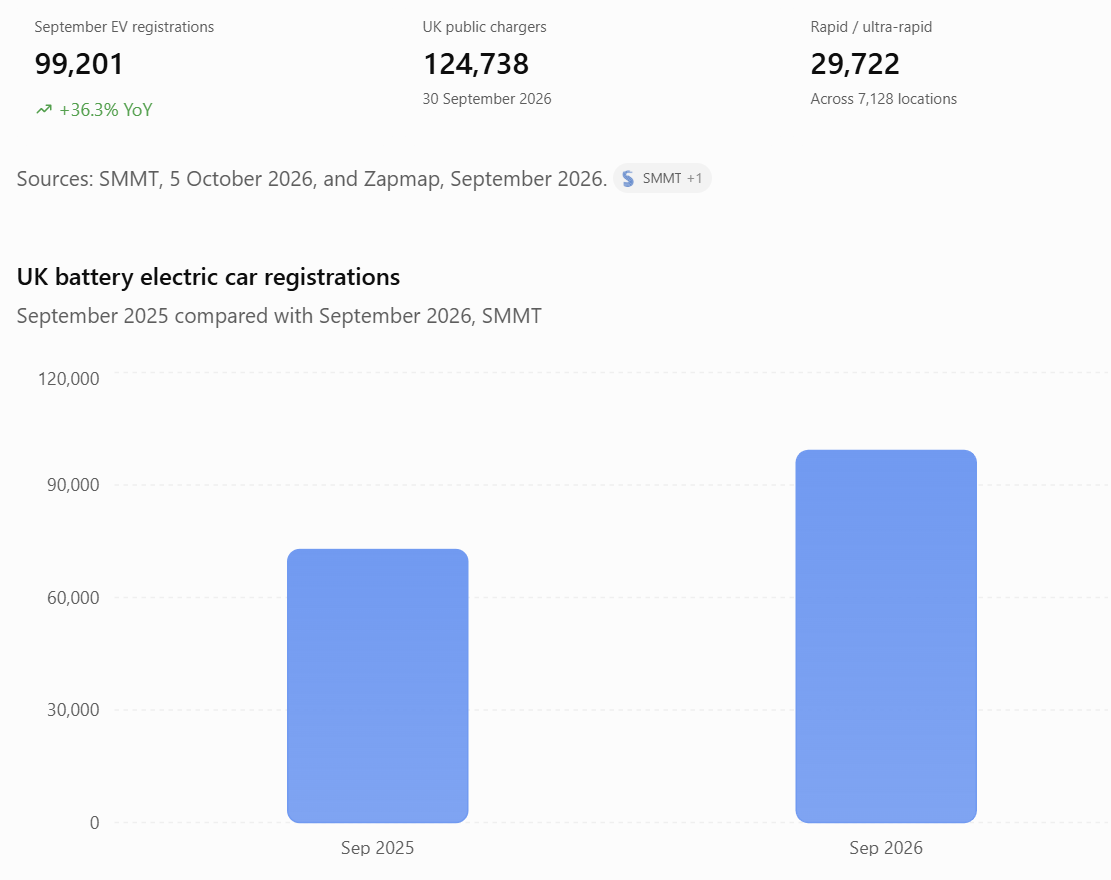
According to the Society of Motor Manufacturers and Traders, 99,201 new battery electric vehicles were registered during the month, representing a 36.3% increase compared with September 2025.
At the same time, industry charging data showed that the UK public charging network had expanded to 124,738 chargers, including 29,722 rapid and ultra-rapid chargers across 7,128 locations.
Together, these developments highlight an increasingly mature electric vehicle market, supported by investment in charging infrastructure and greater choice for motorists.
However, the next stage of Britain’s EV transition will depend on more than record sales and growing charger numbers.
September delivers record electric vehicle registrations
September is traditionally an important month for the UK automotive industry because of the introduction of new vehicle registration plates.
In 2026, the month delivered a particularly strong performance for fully electric vehicles.
The 99,201 new BEV registrations represented an increase of 26,422 vehicles compared with September 2025, demonstrating the growing presence of electric cars in the new vehicle market.
Battery electric vehicles accounted for 28.3% of all new car registrations during September, meaning more than one in four new cars registered was fully electric.
Across the first nine months of 2026, electric vehicles achieved a year-to-date market share of 26.2%.
While this represents meaningful progress, the figure remains below the 33% zero-emission vehicle sales target set for manufacturers under the UK’s 2026 Zero Emission Vehicle mandate.
This difference highlights the challenge facing manufacturers and policymakers as they work to accelerate the transition away from new petrol and diesel cars.
Nevertheless, September’s figures demonstrate that electric motoring is becoming an increasingly mainstream choice for British drivers.
Britain’s public EV charging network passes 124,000 chargers
Alongside the growth in electric vehicle registrations, Britain’s public charging infrastructure continues to expand.
At the end of September 2026, the UK had 124,738 public EV chargers. Of these, 29,722 were rapid or ultra-rapid chargers, distributed across 7,128 locations.
This expansion is particularly important as increasing numbers of motorists rely on public charging for longer journeys, commuting and everyday travel.
Rapid and ultra-rapid charging infrastructure plays an essential role in supporting drivers who need to replenish their batteries during a journey rather than charging overnight at home.
Higher-powered charging stations can significantly reduce charging times for compatible vehicles, making longer-distance electric travel more practical.
The expansion of charging hubs, particularly at motorway services and major transport routes, also provides drivers with more opportunities to charge while travelling.
However, national infrastructure totals do not necessarily tell the complete story. Charging provision can vary considerably between regions, and the number of chargers available at a particular location may be just as important as the overall national total.
For drivers, convenience depends on finding a suitable charger when and where it is needed. Our analysis of the UK EV charging network by region explores those local differences.
Is charging infrastructure keeping pace with EV adoption?
With almost 100,000 new fully electric cars registered in September alone, demand for public charging is likely to continue increasing.
However, the relationship between EV registrations and charging demand is not straightforward.
Many electric vehicle owners charge primarily at home or at work, meaning they may only occasionally use public charging infrastructure. Others, particularly motorists without access to private parking or home charging facilities, depend more heavily on public networks.
This creates different patterns of demand across the country.
Urban areas may require greater investment in residential and kerbside charging, while motorway services and major transport routes need sufficient rapid charging capacity to accommodate longer-distance travel.
The continued expansion of rapid and ultra-rapid charging infrastructure is encouraging, but maintaining convenient access will require careful planning as EV ownership increases.
It will also require attention to charger reliability, accurate availability information and transparent pricing.
After all, a charging station is only useful to a driver if it can be located, accessed and used successfully. Our guide to public EV charging in 2026 explains why location, speed and reliability matter alongside headline totals.
Affordable electric cars are changing the market
One of the most important developments in the UK EV market is the increasing availability of electric vehicles at more accessible price points.
Historically, the higher purchase price of electric cars has been a significant consideration for motorists thinking about switching from petrol or diesel.
Although electric vehicles can offer lower running and maintenance costs in some circumstances, the initial purchase price has remained a barrier for many households.
That picture is gradually changing.
Greater competition between established manufacturers and newer entrants is encouraging the development of smaller, more affordable electric models.
Vehicles such as the Renault 5 E-Tech, Citroën ë-C3 and BYD Dolphin Surf demonstrate how manufacturers are targeting buyers looking for practical electric cars without premium price tags.
Meanwhile, models including the Hyundai IONIQ 3 are increasing competition in the compact electric vehicle market.
For consumers, greater choice could make electric motoring more accessible to a wider range of households.
However, affordability is about more than the price of the vehicle itself. Insurance, depreciation, electricity prices and access to affordable charging all influence the overall cost of ownership.
As a result, transparent public charging prices will remain an important consideration, particularly for drivers who cannot charge at home.
The real cost of EV ownership is becoming more important
As electric vehicles become more widely available, consumers are increasingly looking beyond headline purchase prices.
The cost of charging can vary significantly depending on whether a driver uses domestic electricity, workplace charging, kerbside infrastructure or rapid public chargers.
For example, charging 40kWh at a rate of 25p per kWh would cost £10 in electricity. The same amount of energy at a public charging rate of 75p per kWh would cost £30.
Although these are illustrative prices, they demonstrate how charging choices can influence running costs.
For motorists with access to competitively priced home electricity, electric motoring can offer significant potential savings compared with petrol or diesel. However, drivers who depend primarily on public rapid charging may face a different cost calculation.
This makes clear, accurate and accessible charging price information increasingly important.
As the EV market grows, helping motorists understand charging costs will be essential to maintaining confidence in the transition. Our guide to the cost of charging an electric car in the UK provides a practical way to compare tariffs and estimate a session.
Charging data and reliability will shape the next phase of growth
With more electric vehicles on Britain’s roads and an expanding charging network, the quality of charging information is becoming increasingly important.
Drivers need confidence that the charging locations displayed in their apps are accurate, that equipment is operational and that prices reflect the tariffs they will actually pay.
Inaccurate location details, outdated availability information or incorrect pricing can lead to unnecessary delays and frustration.
These challenges can arise because public charging information is often exchanged between multiple organisations, including charge point operators, roaming platforms and charging service providers.
Ensuring this information remains accurate requires continued cooperation across the industry.
UK regulations have already introduced requirements covering public charging reliability, pricing transparency and access to charging data. However, maintaining a positive customer experience will require more than regulatory compliance alone.
The industry’s longer-term success will depend on making charging easier, more predictable and more convenient for motorists.
The next stage of EV growth will be measured not only by the number of chargers installed, but by how effectively drivers can use them.
For a deeper look at this issue, read our guide to why accurate EV charging data matters.
ONEEV: Supporting Britain’s growing EV community
At ONEEV, we believe that the transition to electric motoring should be supported by a public charging experience that is simple, transparent and accessible.
The ONEEV app provides access to more than 70,000 charge points across the UK and Ireland, helping motorists discover charging locations and manage their public charging sessions.
With features including real-time availability information where supported, transparent pricing, route planning and secure in-app payments, ONEEV is designed to help make public charging more straightforward.
And with no subscription required, drivers can use ONEEV without committing to a monthly membership fee.
As Britain’s electric vehicle market continues to develop, our focus remains on helping drivers make informed charging decisions and improving the everyday charging experience.
What comes next for Britain’s EV market?
September’s record electric vehicle registrations represent another important milestone in the UK’s transition towards cleaner transport.
The combination of increasing EV adoption, expanding charging infrastructure and greater vehicle affordability suggests that electric motoring is entering a new phase of development.
However, continued progress will depend on several factors.
Manufacturers will need to make electric vehicles increasingly competitive on price, charging operators will need to expand infrastructure in the locations where it is most needed, and technology providers will need to ensure motorists can access accurate and dependable charging information.
For consumers, the priorities are straightforward: affordable vehicles, convenient charging, transparent prices and confidence that electric motoring can meet their everyday needs.
Britain’s electric vehicle market is moving forward, and the opportunities are significant.
The question is no longer simply how many people will switch to electric vehicles, but how effectively the industry can support them once they do.
Frequently asked questions
How many battery electric cars were registered in September 2026?
There were 99,201 new battery electric vehicle registrations in September 2026, a 36.3% increase compared with September 2025.
What share of new cars was fully electric in September 2026?
Battery electric vehicles accounted for 28.3% of all new UK car registrations during September 2026.
How large was the UK public charging network in September 2026?
At the end of September 2026, the UK had 124,738 public EV chargers. This included 29,722 rapid and ultra-rapid chargers across 7,128 locations.
What is the 2026 Zero Emission Vehicle mandate target?
The mandate sets a 33% target for zero-emission cars in manufacturers’ UK new-car registrations during 2026, subject to the scheme’s detailed rules and flexibilities.
Why are more affordable electric cars important?
Lower-priced models can make electric motoring accessible to more households. Overall affordability also depends on insurance, depreciation, electricity prices and access to reasonably priced charging.
Find, Start, Stop & Pay, all in ONE app
Whether you are new to electric motoring or an experienced EV driver, ONEEV helps you discover suitable public charging locations and manage your charging experience.
Explore more than 70,000 charge points across the UK and Ireland, with no subscription required.
Visit oneevgroup.com to discover more and download the ONEEV app.
Sources: SMMT September 2026 new-car registration data, published 5 October 2026; September 2026 UK public charging statistics; UK Zero Emission Vehicle mandate targets. Vehicle model information is based on manufacturer information and UK availability as of October 2026.

