

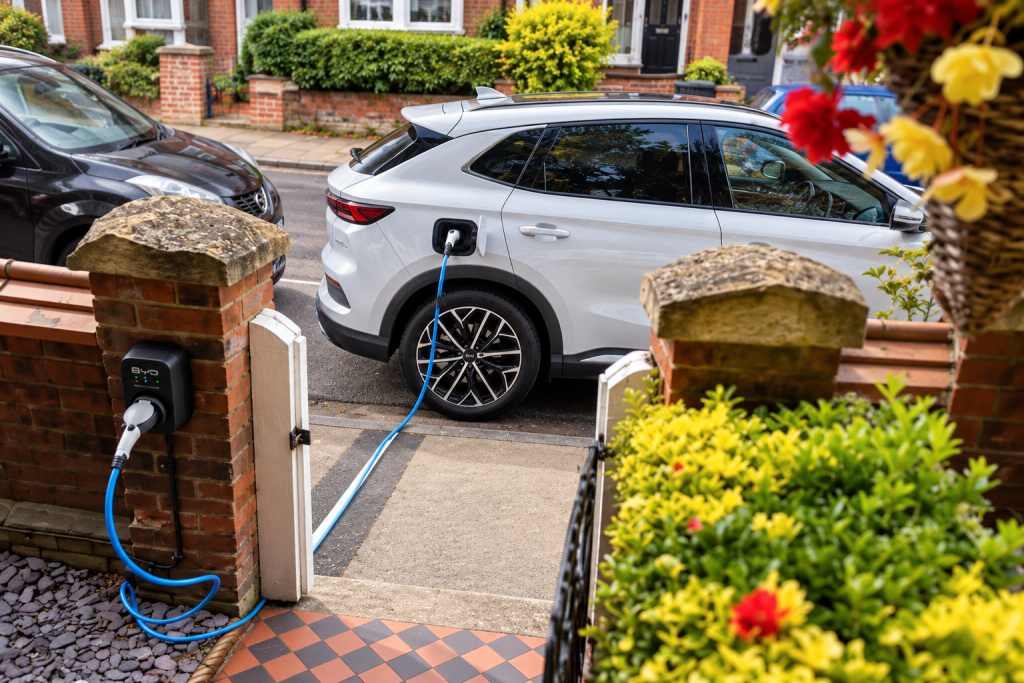
Home charging is one of the clearest advantages of driving an electric car. Plug in overnight, wake up with more range and, with the right tariff, pay considerably less than at many public rapid chargers.
But what if a public pavement separates your home from the road?
On 11 September 2026, the UK Government confirmed that it will proceed with new permitted development rights for qualifying cross-pavement EV charging solutions and associated domestic chargepoints in England. The reform is intended to remove the need for a separate planning application when the qualifying rules are met.
It is an important step, but it is not permission to cut a channel into the pavement yourself or trail a loose cable across a footway. Secondary legislation still needs to be laid before Parliament, and highway-authority approval, safety requirements and relevant street-works permissions will remain.
What has the Government announced?
The Department for Transport has confirmed that it will move forward with changes to permitted development rights for EV charging in England. The proposals cover:
- qualifying cross-pavement charging solutions and their associated domestic chargepoints
- additional supporting electrical equipment for public charging installations in non-domestic, off-street car parks
The official consultation outcome says the next step is to lay secondary legislation before Parliament in autumn 2026, subject to parliamentary time, followed by commencement of the amended rights.
Until that legislation takes effect, drivers should follow the planning and highway rules that currently apply in their area.
What does permitted development mean?
Permitted development rights allow certain building works to be carried out without submitting a full planning application. For qualifying cross-pavement installations, the planned reform should remove one layer of approval and make the process simpler.
It does not remove every permission. The relevant highway authority will still decide whether an installation can be placed in the public highway. Depending on the local scheme and installation model, street-works licences or permits may also be needed.
Think of the change as a streamlined planning route, not a national free-for-all.
Why cross-pavement charging matters
Access to domestic charging is not equal. A driver with a driveway can install a suitable home chargepoint and connect directly to the property’s electricity supply. Someone living in a terraced house may park only a few metres from home, but a public pavement sits between the property and the car.
Government guidance cites English Housing Survey estimates that about eight million households in England—32% of the total—do not have access to off-street parking. Almost four million households may have adequate on-street parking and could potentially benefit from an approved cross-pavement solution.
For a wider look at kerbside, workplace, destination and public options, read our guide to charging an EV without a driveway.
How does cross-pavement EV charging work?
A cross-pavement solution provides a purpose-designed route between a property and an EV parked on the road. Government guidance identifies two main systems currently on the market or in trials.
Cable channels or charging gullies
A narrow channel is installed into the pavement. The charging cable sits inside it during a session and is removed afterwards. The channel must be designed and installed so the pavement remains safe and accessible.
Permanent under-pavement cables
A permanent cable runs beneath the pavement and connects the domestic chargepoint to equipment near the vehicle, such as a removable bollard, lance or connector.
Other technologies, including charging bridges, are emerging. The appropriate system depends on the street, pavement, property and local-authority policy.
Can you simply run a charging cable across the pavement?
No. The proposed changes relate to approved infrastructure, not loose cables placed across public footways.
A trailing cable can create a trip hazard, particularly for wheelchair users, people with limited mobility, people pushing prams and those with visual impairments. The Government’s cross-pavement charging guidance says authorities should consider construction, safety and accessibility before allowing apparatus in the public highway.
Never cut into a pavement or install equipment in the highway without the required approvals and an authorised installation process.
Will you still need council permission?
Yes. Removing the separate planning application for qualifying installations does not remove the highway authority’s role.
The authority may consider:
- pavement width, construction and condition
- pedestrian safety and accessibility
- nearby junctions, crossings and parking restrictions
- underground utilities, access covers and tree roots
- who owns, maintains and insures the equipment
- how the pavement will be reinstated after installation or removal
A Section 50 licence or another street-works permit may be required, depending on who carries out the work and the local authority’s process. Requirements and fees can differ between areas.
Does a charging channel reserve the parking space?
No. Government guidance is explicit that installing a cross-pavement solution does not give a resident ownership of or priority over the parking space outside their home.
If another vehicle is parked there, you may not be able to charge. Local parking rules continue to apply, and residents should not use cones or signs to imply that an ordinary public space is reserved.
This is one reason public charging remains an important part of a practical EV routine.
Is financial support available?
Eligible households with on-street parking can apply for Government support towards an EV chargepoint when an approved permanent cross-pavement solution is also being installed.
Current Government guidance says the grant can cover up to 75% of eligible chargepoint purchase and installation costs, capped at £350. Conditions apply, including local-authority permission and installation by an authorised installer. Check the current on-street parking chargepoint grant guidance before making a commitment.
The total project cost may also include the pavement system, surveys, licences, electrical work, maintenance, insurance or local-authority fees.
Could cross-pavement charging reduce running costs?
Potentially. Because the car uses electricity from the property, an approved installation may give a household without a driveway access to domestic electricity prices.
Some time-of-use tariffs offer cheaper overnight charging, although eligibility, vehicle compatibility and daytime prices vary. Our guide to smart EV tariffs in 2026 explains what to compare.
For a clearer view of domestic, standard public and rapid charging costs, see our guide to the cost of charging an electric car in the UK.
What are the practical limitations?
Cross-pavement charging will not suit every home or street. Before assuming it will work, consider whether:
- your local authority permits or operates a suitable scheme
- on-street parking is regularly available next to the property
- the pavement is wide enough and structurally suitable
- nearby utilities or street furniture affect the installation
- the chargepoint and cable can meet electrical-safety requirements
- you understand installation, maintenance and insurance responsibilities
Drivers should also have a backup charging plan for days when the space outside the property is unavailable.
Home and public charging work together
Cross-pavement charging could make domestic electricity available to more drivers, but it will not replace public charging. Most EV owners use a mixture that fits their routine.
A driver might charge at home for everyday journeys, use destination charging while shopping or working, and choose rapid or ultra-rapid charging on longer trips.
For households without suitable parking, public charging may remain the primary option. The important change is greater choice.
What should you do now?
- Check the legal position. The announced permitted development reform still requires secondary legislation before it comes into force.
- Contact your local council. Ask the highways or transport team whether it accepts cross-pavement applications and what process applies.
- Assess the location. Parking availability, pavement width, utilities and accessibility all matter.
- Use an approved route. Choose a suitable provider and authorised chargepoint installer; do not alter the pavement yourself.
- Check support and total costs. Review grant eligibility, licence charges, maintenance and insurance.
- Keep a public-charging backup. You may not always be able to park beside the channel.
Find public charging with ONEEV
ONEEV helps drivers find participating public chargepoints, review available pricing and charger information, check supported live availability, navigate to a location and manage compatible sessions securely through one app.
There is no ONEEV subscription required. Availability, compatibility and tariffs vary by charger, so review the location details before starting.
Explore the ONEEV app for charging near home, at a destination or on a longer journey.
Frequently asked questions
What is cross-pavement EV charging?
It is an approved system that lets an EV charging cable pass safely across or beneath a pavement between a property and a vehicle parked on the road.
Are the new cross-pavement charging rules already in force?
Not yet. The Government confirmed on 11 September 2026 that it will proceed, but secondary legislation must still be laid before Parliament and commenced.
Will I still need permission from my council?
Yes. The highway authority will retain responsibility for deciding whether apparatus can be installed in the public highway. Other street-works permissions may also apply.
Can I run a loose EV cable across the pavement?
You should not create a trip hazard or install anything in the pavement without approval. The reform concerns qualifying, purpose-designed cross-pavement infrastructure.
Does a pavement charging channel reserve the space outside my home?
No. A cross-pavement installation does not normally give you ownership of or priority over the adjacent public parking space.
Is there a grant for cross-pavement EV charging?
Eligible households may receive support towards an EV chargepoint when an approved permanent cross-pavement solution is being installed. Current guidance provides up to 75% of eligible chargepoint costs, capped at £350, subject to conditions.
Do the announced changes apply across the whole UK?
No. The permitted development announcement and the cited cross-pavement guidance apply to England. Roads and planning are handled differently in Scotland, Wales and Northern Ireland.
The bottom line
The planned reform could make domestic EV charging more accessible to people who have suitable on-street parking but no driveway. It removes a potential planning hurdle, not every approval or safety requirement.
Check the law is in force, speak to your local authority and use an approved installation route. When home charging is not available—or the space outside is occupied—public charging will continue to provide the essential backup.
Find. Charge. Pay. All in ONE app.
ONEEV – Charging Simplified.

