

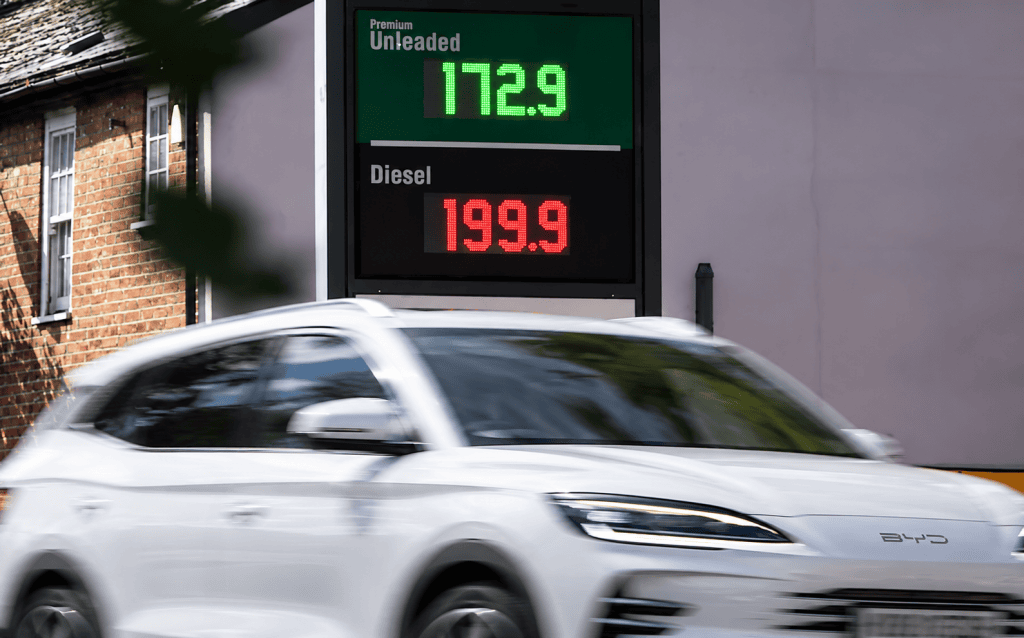
Petrol at around £1.74 a litre. Diesel close to £2 a litre. But is an electric car actually cheaper to run in the UK in 2026?
The fairest way to compare electric, petrol and diesel cars is not the price of a litre against the price of a kilowatt-hour. It is the energy cost of travelling one mile.
Using illustrative vehicle efficiencies and UK energy prices available in September 2026, an EV charged cheaply at home can cost far less per mile than a petrol or diesel car. An EV relying entirely on expensive rapid charging can cost more. Where and how you charge makes the difference.
UK petrol and diesel prices in September 2026
UK fuel-price data published on 25 September 2026 placed the national averages at approximately:
- Petrol: 173.60p per litre
- Diesel: 198.32p per litre
At those prices, a theoretical 55-litre fill would cost approximately £95.48 for petrol or £109.08 for diesel.
Pump prices change frequently and vary between locations. The figures in this guide are a dated comparison, not a prediction of the price you will pay.
Our example vehicles
To make a practical comparison, we will use three simple efficiency assumptions:
- Petrol car: 40 miles per UK gallon
- Diesel car: 50 miles per UK gallon
- Electric car: 3.5 miles per kWh
These are illustrative figures. Real efficiency depends on the vehicle, temperature, speed, traffic, terrain, tyres, load and driving style.
Petrol cost per mile
At 173.60p per litre, one UK gallon of petrol costs approximately £7.89. A petrol car achieving 40mpg therefore costs:
£7.89 ÷ 40 = approximately 19.7p per mile
Over 10,000 miles, the example petrol car would use approximately £1,973 of fuel.
Diesel cost per mile
At 198.32p per litre, one UK gallon of diesel costs approximately £9.02. A diesel car achieving 50mpg therefore costs:
£9.02 ÷ 50 = approximately 18.0p per mile
Over 10,000 miles, the example diesel car would use approximately £1,803 of fuel.
This shows why the price per litre is only part of the story. Better fuel economy can offset some of diesel’s higher pump price.
Electric-car cost per mile
EV efficiency is normally expressed in miles per kilowatt-hour. For an electric car averaging 3.5 miles per kWh, the cost depends almost entirely on the electricity tariff.
Standard public charging at 54p per kWh
The August 2026 weighted average pay-as-you-go price for UK public chargers from 3kW to 49kW was 54p per kWh.
54p ÷ 3.5 = approximately 15.4p per mile
Over 10,000 miles, that would be approximately £1,543—around £430 less than the petrol example and £260 less than the diesel example.
Rapid and ultra-rapid charging at 77p per kWh
The August 2026 weighted pay-as-you-go average for chargers rated at 50kW and above was 77p per kWh.
77p ÷ 3.5 = 22.0p per mile
Over 10,000 miles, that would be approximately £2,200. In this example, exclusive reliance on rapid charging costs more in energy per mile than either petrol or diesel.
Rapid charging remains valuable when time matters, particularly on long journeys. Our guide to rapid and ultra-rapid EV charging explains when higher charging power is useful.
Home charging at 26.11p per kWh
From July to September 2026, Ofgem’s average electricity unit rate under the default-tariff price cap was 26.11p per kWh for Direct Debit customers in Great Britain.
26.11p ÷ 3.5 = approximately 7.5p per mile
Over 10,000 miles, that would be approximately £746 before allowing for charging losses or the household standing charge.
Cheap overnight charging at 8.5p per kWh
Some EV-specific tariffs offer low overnight unit rates. Using 8.5p per kWh as an illustrative example:
8.5p ÷ 3.5 = approximately 2.4p per mile
Over 10,000 miles, that would be approximately £243 before charging losses. Not every household can access a suitable tariff, and some tariffs have higher daytime rates, so compare the complete terms against your actual usage.
See our guide to smart EV tariffs in 2026 for more about overnight charging.
Electric vs petrol vs diesel: cost-per-mile comparison
| Vehicle or charging method | Energy price | Example efficiency | Approx. cost per mile | Approx. cost over 10,000 miles |
|---|---|---|---|---|
| EV – cheap overnight home charging | 8.5p/kWh | 3.5 mi/kWh | 2.4p | £243 |
| EV – home charging | 26.11p/kWh | 3.5 mi/kWh | 7.5p | £746 |
| EV – standard public charging | 54p/kWh | 3.5 mi/kWh | 15.4p | £1,543 |
| Diesel | 198.32p/litre | 50mpg | 18.0p | £1,803 |
| Petrol | 173.60p/litre | 40mpg | 19.7p | £1,973 |
| EV – rapid or ultra-rapid public charging | 77p/kWh | 3.5 mi/kWh | 22.0p | £2,200 |
These figures compare energy only. They exclude charging losses, purchase price, depreciation, finance, insurance, taxation, servicing, repairs and home-charger installation.
There is no single cost of driving an EV
For petrol and diesel drivers, prices may vary by several pence per litre between filling stations. Public EV tariffs can differ much more substantially.
An EV averaging 3.5 miles per kWh would cost around 12.9p per mile at 45p per kWh, but around 22.6p per mile at 79p per kWh. Across thousands of miles, that difference can be significant.
Our guide to the cost of charging an electric car in the UK explains how to calculate full-battery and typical-session costs.
What is the EV break-even charging price?
Our example petrol car costs approximately 19.7p per mile. For an EV achieving 3.5 miles per kWh to match that energy cost, electricity would need to cost about 69p per kWh.
Our 50mpg diesel example costs approximately 18.0p per mile, giving the EV a break-even electricity price of about 63p per kWh.
Below those approximate rates, the example EV costs less in energy per mile. Above them, the corresponding combustion car is cheaper on energy alone. A different vehicle efficiency or fuel price produces a different result.
Most EV drivers have a blended charging cost
Many drivers do not obtain all their electricity from one type of charger. They may charge at home for routine journeys, use destination charging while parked and choose rapid charging on longer trips.
For example, a mix of 70% home electricity at 26.11p per kWh, 20% standard public charging at 54p and 10% rapid charging at 77p produces an average of approximately 36.8p per kWh.
At 3.5 miles per kWh, that is approximately 10.5p per mile. Comparing an EV only with the cheapest overnight tariff can be unrealistic, but using only the highest rapid price can be equally misleading.
What if you cannot charge at home?
Drivers with private parking can often access cheaper home electricity. People living in flats, terraced homes and properties without off-street parking may rely more heavily on public charging, making tariff choice much more important.
That does not automatically make an EV unsuitable. On-street, workplace and destination charging may form part of a practical routine, but the cost needs to be assessed honestly. Read our guide to charging an EV without a driveway.
Do electric cars cost less to maintain?
An electric powertrain has fewer routine service items than a combustion engine. There is no engine oil, traditional exhaust system or conventional clutch to maintain.
EVs still need tyres, brakes, suspension, air-conditioning servicing, cabin filters and other checks. Insurance, depreciation and repair costs can also vary considerably between models.
A fair decision should compare the complete ownership picture:
- purchase price and finance
- depreciation
- insurance
- vehicle taxation
- fuel or electricity
- servicing and maintenance
- home-charger installation, where relevant
These wider expenses should be considered together when comparing the total cost of owning different vehicles.
So, is electric cheaper than petrol or diesel?
For energy costs alone, an efficient EV charged mainly at home—especially on a suitable overnight tariff—can be substantially cheaper per mile than petrol or diesel.
An EV using reasonably priced standard public charging can also remain competitive. However, an EV relying exclusively on expensive rapid and ultra-rapid charging may cost as much as, or more than, an efficient combustion car in energy per mile.
The answer is therefore personal. It depends on the efficiency of the vehicles being compared, the mileage, fuel and electricity prices, access to home or workplace charging and the tariffs available along regular routes.
Find and compare public EV charging with ONEEV
ONEEV is designed to make public EV charging simpler. Drivers can find participating charging locations, review available pricing and charger information, check supported live availability, navigate to a site and manage compatible sessions securely through one app.
There is no ONEEV subscription required. Availability, compatibility and tariffs vary by charger, so review the location details before starting.
Explore the ONEEV app to compare practical charging options around your destination or route.
Frequently asked questions
Is an electric car cheaper to run than a petrol car in 2026?
It can be. In our example, an EV charged at home costs much less per mile than a 40mpg petrol car. An EV using only high-priced rapid charging costs more, so the result depends heavily on the charging mix.
Is an electric car cheaper to run than a diesel car?
An EV charged at home or on many standard public tariffs can cost less in energy per mile than the 50mpg diesel example. Exclusive reliance on expensive rapid charging may reverse that result.
How much does a petrol car cost per mile?
At 173.60p per litre, a petrol car achieving 40mpg costs approximately 19.7p per mile in fuel. Actual cost depends on the pump price and vehicle efficiency.
How much does a diesel car cost per mile?
At 198.32p per litre, a diesel car achieving 50mpg costs approximately 18.0p per mile in fuel.
How much does an electric car cost per mile?
At 3.5 miles per kWh, the example EV costs approximately 2.4p per mile at 8.5p/kWh, 7.5p at 26.11p/kWh, 15.4p at 54p/kWh or 22.0p at 77p/kWh.
What public charging price makes an EV more expensive than petrol?
For the efficiencies and fuel prices used here, the break-even point is approximately 69p/kWh against the petrol example and 63p/kWh against the diesel example. Change the efficiency assumptions and the break-even price changes too.
Do I need home charging for an EV to save money?
No, but home charging usually offers the largest energy-cost advantage. Drivers without private parking should compare the public tariffs available near home, work and regular destinations.
The verdict
Compare cost per mile, not simply the price at the pump or the price per kWh.
Electric driving can be exceptionally inexpensive when charging is planned well. It can also become expensive when a driver relies entirely on premium rapid tariffs. The right answer depends on the car, the journey and the available charging options.
Find. Charge. Pay. All in ONE app.
ONEEV – Charging Simplified.

