How EV Batteries Charge: Everything Every EV Driver Should Know
Whether you are new to electric vehicles or have been driving one for years, understanding how EV batteries charge can help you charge more effectively, protect your battery and get the most from every journey.
Modern electric vehicles are incredibly sophisticated. Behind the simple act of plugging in is a carefully managed charging process designed to maximise battery life, maintain safety and deliver the fastest suitable charging speed.
Drivers who are still getting used to electric vehicle ownership may also find the complete EV beginner’s guide for UK drivers helpful.
The charging point makes electricity available, but your vehicle controls how much energy the battery can safely accept. The car continuously adjusts the charging power according to the battery level, temperature and condition.
How Does an EV Battery Charge?
When you connect your EV to a charging point, electricity does not simply flow straight into the battery. The charger, vehicle, on-board charging equipment and Battery Management System work together throughout the charging session.
Electricity Leaves the Charging Point
The charging station supplies electricity to the vehicle. Depending on the charger, this may be alternating current, known as AC, or direct current, known as DC.
The Vehicle Manages the Incoming Power
During AC charging, the vehicle’s on-board charger converts the electricity into the DC power required by the battery. A DC rapid charger performs this conversion inside the charging station.
The Battery Management System Takes Control
Before and during charging, the Battery Management System checks the battery temperature, state of charge, cell voltage, battery condition and permitted charging limits.
Energy Is Stored in the Battery
The battery stores the incoming DC energy chemically across thousands of individual cells. This stored energy is later used to power the vehicle’s electric motor.
AC Charging and the Vehicle’s On-Board Charger
Home chargers, workplace chargers and many public destination chargers supply AC electricity. Because an EV battery stores DC electricity, the vehicle must convert the incoming AC power before it can be stored.
This conversion is handled by the vehicle’s on-board charger. Its maximum capacity can limit your AC charging speed. For example, a vehicle fitted with an 11 kW on-board charger will normally accept a maximum of around 11 kW from a 22 kW AC charging point.
For more information about home charging equipment, installation and suitable power levels, read the ONEEV home charger guide .
Why DC Rapid Charging Is Faster
A DC rapid or ultra-rapid charger converts electricity before it reaches the vehicle. This allows DC electricity to be supplied through the vehicle’s high-voltage charging system without relying on the car’s AC on-board charger.
This is why rapid charging can deliver much higher power than a typical home wall box. However, the number displayed on the charging point is its maximum available output, not a guarantee that every car will receive that speed.
The ONEEV rapid and ultra-fast charging guide explains charger power, vehicle limits and battery health in more detail.
Watch: The Ultimate EV Battery Masterclass
This ONEEV video explains the golden rules of EV batteries, including how batteries accept power, why charging speeds change and what drivers can do to improve charging performance.
Download the EV Battery Charging Fact Sheet
Keep the essential EV battery charging information close at hand. The ONEEV fact sheet provides a clear visual explanation of the charging process, charging curve and the effect of battery temperature.
Download the EV Battery Fact Sheet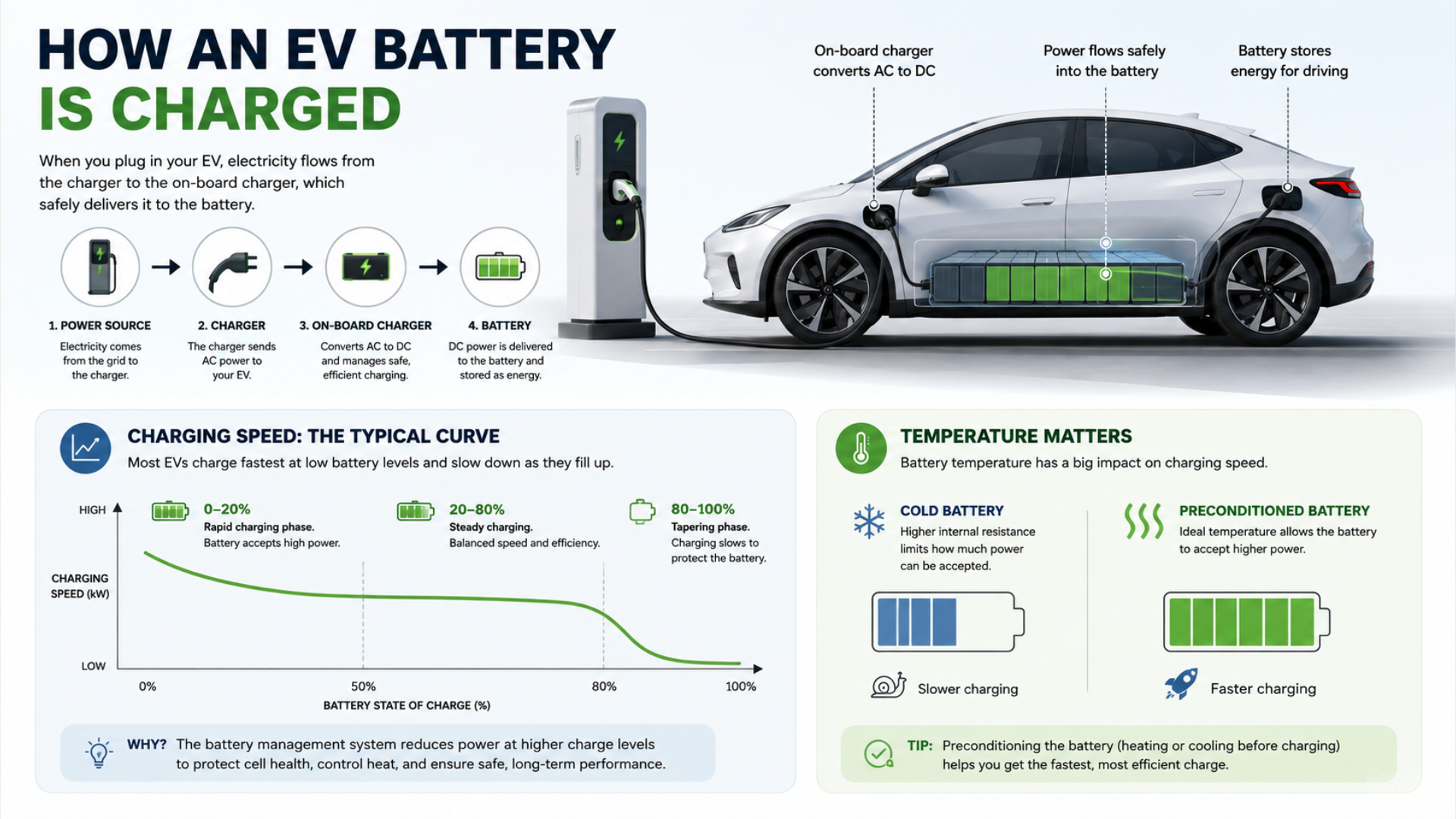
What Does the Battery Management System Do?
The Battery Management System, usually shortened to BMS, acts as the battery’s electronic control centre. It monitors the battery and communicates with the charging equipment throughout the session.
The BMS continuously checks factors including:
- Battery temperature
- Current state of charge
- Individual cell voltage
- Battery condition and health
- Available heating and cooling
- The charging limits set by the manufacturer
The BMS can increase, reduce or stop the incoming power whenever necessary. This is why the charging speed shown on a rapid charger may rise and fall during the session.
The Charger Does Not Decide the Final Charging Speed
The charger makes power available, but the vehicle determines how much power the battery can safely accept. A high-powered charging point cannot force more electricity into the battery than the vehicle permits.
Why Charging Is Not the Same Speed All the Time
One of the biggest surprises for new EV drivers is that charging speed constantly changes. Unlike filling a petrol or diesel vehicle, an EV battery does not usually charge at one constant rate.
Instead, it follows what is known as a charging curve. The exact curve differs between vehicles and can also change according to battery temperature, current charge level and charger performance.
Usually the Fastest Phase
When the battery is low, it can often accept high charging power. Many modern EVs reach or approach their peak charging rate within the lower part of the battery range.
The Practical Sweet Spot
Charging is normally still relatively fast while the Battery Management System balances charging performance with temperature and battery protection.
The Slower Tapering Phase
As the battery approaches full capacity, charging power reduces to control heat, manage cell voltage and protect the battery.
Why Does EV Charging Slow Down After 80%?
As the battery fills, the Battery Management System gradually reduces the amount of power it accepts. This process is commonly called tapering.
The vehicle is not necessarily experiencing a fault. It is protecting the battery cells and carefully managing their voltage. This means the final part of a rapid-charging session can take much longer than the earlier part.
On longer journeys, several shorter charging stops can sometimes be quicker than waiting for the battery to reach 100% at one location. The ONEEV guide to planning an EV journey provides practical advice for choosing charging stops.
Why EV Battery Temperature Matters
Temperature has one of the biggest effects on charging performance. Lithium-ion batteries work most effectively within a suitable operating temperature range.
Cold Batteries Charge More Slowly
During colder weather, the battery’s internal resistance increases and its chemical reactions take place more slowly. The vehicle may therefore limit how much charging power the battery can safely accept.
This can result in:
- Lower initial rapid-charging speeds
- Longer charging sessions
- Reduced winter driving efficiency
- More energy being used to heat the battery and cabin
The effect of cold conditions is explored further in how cold weather affects EV range and charging speed .
A Battery at the Right Temperature Can Charge Faster
A battery within its preferred operating temperature can usually accept higher charging power more consistently. This can improve charging efficiency and reduce the amount of time spent at a rapid charger.
What Is Battery Preconditioning?
Battery preconditioning uses the vehicle’s thermal management system to warm or cool the battery before rapid charging.
By bringing the battery closer to its ideal temperature before arrival, the vehicle may be able to accept higher charging power sooner.
Some EVs activate battery preconditioning automatically when a compatible rapid charger is selected through the built-in satellite navigation system. Other vehicles allow the driver to activate it manually through the vehicle settings or mobile app.
Activation methods vary between manufacturers, so drivers should check their vehicle handbook. Our full guide to EV battery preconditioning explains how the technology works and why it matters.
Preconditioning Tip
When your vehicle supports automatic battery preparation, enter the charging location into the car’s built-in navigation system. Using navigation only through your mobile phone may not trigger battery preconditioning in some vehicles.
AC Charging Versus DC Charging
Both charging methods have an important role in EV ownership. The right choice depends on where you are parked, how long you will be there and how quickly you need additional range.
| AC charging | DC charging |
|---|---|
| Commonly used at homes, workplaces and destination charging locations. | Commonly found at rapid and ultra-rapid public charging locations. |
| Uses the vehicle’s on-board charger to convert AC electricity into DC. | The charging station converts the electricity before supplying it to the vehicle. |
| Commonly available between approximately 3.6 kW and 22 kW. | Commonly available between approximately 50 kW and 350 kW. |
| Ideal for overnight charging or locations where the vehicle will remain parked. | Ideal for longer journeys and quicker charging stops. |
| Speed may be limited by the vehicle’s on-board charger. | Speed is limited by the vehicle, battery conditions and charging curve. |
Drivers using public charging for the first time can also read how to read an EV charging station for a plain-English explanation of connectors, screens and charger information.
How to Charge an EV Faster
You cannot force the battery to accept more power than the vehicle considers safe, but several practical steps can help improve charging performance.
Precondition the Battery
If your EV supports it, prepare the battery before reaching a rapid charger by selecting the charging location through the vehicle’s navigation system.
Arrive with a Lower Battery
Rapid charging is often quickest when arriving with approximately 10% to 20% remaining, although the exact charging curve varies between vehicles.
Do Not Always Wait for 100%
Unless the additional range is needed, leaving at around 80% can avoid the slowest part of the charging session.
Use a Suitable Charger
Choose a charging point that matches the capability of your vehicle. A 350 kW charger will not make a vehicle with a 100 kW maximum charging rate accept 350 kW.
Check for Shared Power
Some charging stations divide their available power between multiple connectors or vehicles, reducing the output available to each car.
Check the Charger Before Travelling
Use live charger information to check availability, connector type and charging power before setting off.
Can Every EV Use a 350 kW Charger?
Yes, provided the charger has a connector compatible with the vehicle. However, the car will only accept the amount of power it is designed to handle.
A 350 kW charger makes up to 350 kW available. It does not mean every vehicle connected to it will receive that power. A car with a maximum DC charging rate of 100 kW will normally draw no more than that, and its real charging speed may be lower because of battery temperature, charge level or its charging curve.
Drivers can compare some of the highest-performing charging models in the ONEEV guide to the fastest-charging electric vehicles .
Does Rapid Charging Damage an EV Battery?
Modern electric vehicles are designed to use rapid charging safely. The Battery Management System monitors battery temperature, voltage and charging power throughout the session.
Rapid charging can generate more heat than slower AC charging, but the vehicle’s cooling system and charging controls are designed to manage this.
Battery ageing is affected by several factors, including temperature, battery chemistry, time spent at very high or very low charge levels and the manufacturer’s battery management strategy.
For most drivers, rapid charging can be used whenever it is needed. Following the manufacturer’s recommendations and avoiding leaving the battery at an extreme charge level for unnecessary periods can help support long-term battery condition.
For a wider explanation of battery longevity and degradation, read the truth about EV battery life .
Understanding Charging Makes You a Better EV Driver
Learning how your battery charges helps you make better decisions on every journey.
Knowing why charging slows above 80%, why temperature affects performance and how preconditioning works can reduce charging time and improve your overall EV experience.
The good news is that modern electric vehicles manage almost everything automatically. The Battery Management System constantly works behind the scenes to deliver the safest and most efficient charging performance available.
As EV battery and charging technology continues to develop, charging speeds and journey planning will become even more convenient.
Frequently Asked Questions
Why does my EV charge slowly after 80%?
The Battery Management System deliberately reduces charging power as the battery fills. This controls heat, manages cell voltage and helps protect the battery.
Is it bad to charge my EV to 100%?
Occasionally charging to 100% is normally fine when the additional range is needed. Everyday charging recommendations vary between manufacturers and battery types, so follow the guidance provided for your vehicle.
Why is my EV slower to charge in winter?
Cold batteries have greater internal resistance and may be unable to accept high charging power safely. The vehicle can therefore reduce the charging rate until the battery reaches a more suitable temperature.
What is battery preconditioning?
Battery preconditioning warms or cools the battery before charging. Bringing it closer to its preferred operating temperature can improve rapid-charging performance.
Can I use a 350 kW charger if my car supports only 100 kW?
Yes. The vehicle will communicate with the charger and draw only the amount of power it can safely accept. The charger cannot force the vehicle to charge above its limit.
What controls an EV’s charging speed?
Charging speed can be affected by the charging point, the vehicle’s maximum charging rate, battery temperature, state of charge, charging curve, power sharing and battery condition.
What battery percentage is best for rapid charging?
Many vehicles charge most quickly at lower battery levels. Arriving with approximately 10% to 20% remaining can often provide access to a faster part of the charging curve, although performance differs between models.
Does the charging point or the car control the charging speed?
The charger and vehicle communicate throughout the session, but the vehicle determines how much power its battery can safely accept.
Find Public EV Charging with ONEEV
Use ONEEV to find public charging locations, check live availability, review connector information and manage supported charging sessions through one simple app.
Explore the ONEEV App