

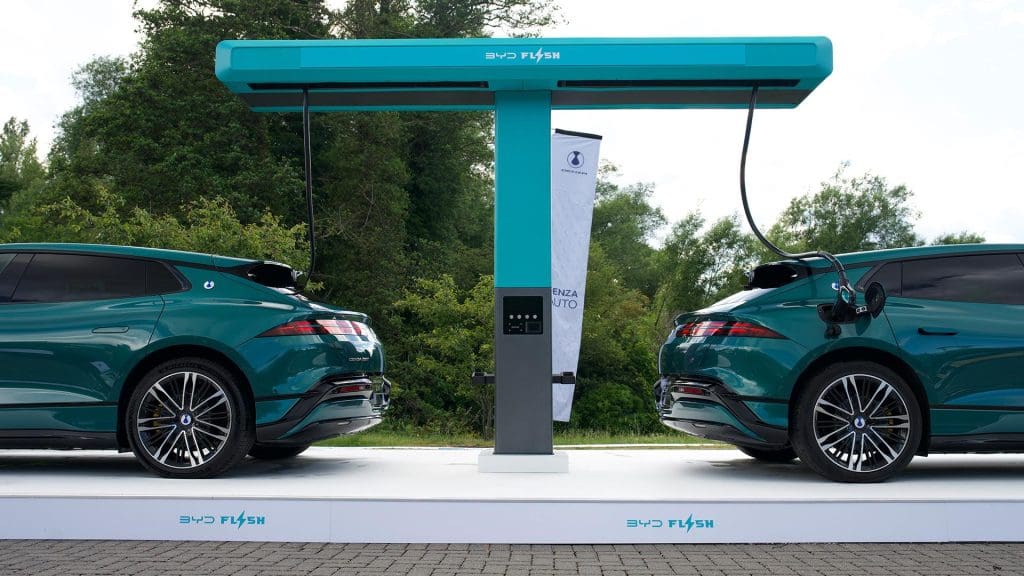
Could an electric car really charge in about the same time it takes to stop for fuel? BYD says its new Flash Charging system can take a compatible vehicle from 10% to 97% in nine minutes, with up to 1,500kW available through a single connector.
That is an extraordinary figure, but it needs context. The charger is only half of the equation: the vehicle, battery temperature, starting charge level and charging curve all determine how quickly energy can be accepted. For most electric cars already on UK roads, connecting to a 1,500kW charger would not suddenly unlock nine-minute charging.
This guide explains what BYD Flash Charging is, what has been demonstrated in the UK, when drivers may be able to use it and what the technology means for the EV they actually drive.
Information checked on 18 October 2026. Rollout plans, site availability and tariffs may change, so drivers should confirm current details before travelling.
BYD Flash Charging UK: the quick answer
- Peak charger output: up to 1,500kW through one connector.
- Claimed compatible-vehicle performance: 10% to 70% in five minutes and 10% to 97% in nine minutes.
- UK demonstration: a Denza Z9 GT reached 97% from 10% in eight minutes and 58 seconds during a controlled demonstration witnessed by Auto Express.
- Vehicle compatibility matters: an EV with a 150kW maximum DC rate will remain limited to 150kW or less.
- UK rollout: BYD has said it plans 300 Flash Chargers nationally, but timing and public site availability remain subject to change.
If you would like a grounding in the numbers first, read our guide to how long it takes to charge an electric car.
What is BYD Flash Charging?
BYD Flash Charging is a high-power DC charging system designed to work with the company’s second-generation Blade Battery. BYD summarises the technology as “Ready in Five, Full in Nine, Cold Add Three”:
- 10% to 70% state of charge in five minutes
- 10% to 97% in nine minutes
- 20% to 97% in 12 minutes at -30°C
According to BYD’s UK technical summary, a Flash Charger can deliver up to 1,500kW through a single connector. Each unit has two connectors; when both are used at once, BYD says each can supply up to 1,000kW.
Those figures describe the capability of the complete Flash Charging system. They are not a promise that every vehicle, session or site will sustain its maximum output.
Has nine-minute EV charging actually been demonstrated?
Yes, under demonstration conditions. In June 2026, Auto Express attended BYD’s UK headquarters in Uxbridge and reported that a Denza Z9 GT charged from 10% to 97% in eight minutes and 58 seconds.
The result is significant because it moves the headline beyond a laboratory claim. However, it remains one controlled demonstration involving a vehicle and charger engineered to work together. Everyday charging performance can vary with battery temperature, starting state of charge, vehicle software, power sharing and site conditions.
For comparison, most public charging sessions are better judged by the vehicle’s realistic 10% to 80% time rather than the charger’s maximum label.
Why a 1,500kW charger will not make every EV charge in nine minutes
A charger offers power; the car decides how much it can safely accept. The vehicle’s battery management system continuously controls that rate.
| Charger capability | Vehicle maximum DC rate | Maximum the vehicle can request |
|---|---|---|
| 1,500kW | 150kW | Up to 150kW |
| 1,500kW | 250kW | Up to 250kW |
| 1,500kW | Flash Charging compatible | Potentially much higher, depending on the car and conditions |
Even a compatible car will not necessarily hold its peak rate throughout the session. Charging power normally rises and falls along a charging curve, often reducing as the battery becomes fuller. That is why a charger’s peak kW figure should never be treated as a guaranteed constant speed.
The Denza Z9 GT is the first UK model built for Flash Charging
The first UK-market vehicle designed to exploit the system is the all-electric Denza Z9 GT. Denza says its 122kWh battery delivers up to 373 miles of WLTP range and can charge from 10% to 70% in five minutes or 10% to 97% in nine minutes on compatible infrastructure.
Denza’s UK announcement equates the nine-minute result to adding approximately 323 miles of WLTP range. That is a manufacturer calculation based on the vehicle’s rated range, not a guarantee of the distance every driver will achieve on the road.
The Z9 GT is a premium vehicle, so its arrival does not mean nine-minute charging will immediately become normal for the mass market. The broader change will depend on whether batteries capable of accepting such power reach more affordable models over time.
When will BYD Flash Charging be available in the UK?
BYD demonstrated the technology in the UK in June 2026. In August, the company said it intended to install 300 Flash Chargers nationally within the following 12 months, prioritising BYD and Denza sites, core towns and cities, motorway service areas and existing charging hubs.
Earlier coverage cited different target dates, showing how quickly a large infrastructure programme can change. At the time of this article’s review, the sources checked did not provide a complete, independently verifiable public list of live UK Flash Charging sites.
Drivers should therefore distinguish between:
- a technology demonstration;
- a charger that has been installed but is not yet available to the public;
- a planned site; and
- a live public charger with confirmed access, availability and pricing.
Reliable location and status information matters just as much as headline power. Our article on why accurate EV charging data matters explains why drivers need more than a pin on a map.
Can any electric car use a BYD Flash Charger?
BYD says its UK Flash Charging equipment uses the CCS2 connector and is intended to be open to vehicles from different manufacturers. Physical compatibility does not mean every car can use the full output.
An existing EV should communicate with the charger and draw no more than its own permitted rate. Actual public access may also depend on the finished site’s operating rules, payment options and tariff structure.
Before choosing any charger, check your vehicle’s connector, maximum DC rate and likely charging curve. These basics make it easier to select a suitable public charger without being distracted by a headline power figure your car cannot use.
How can a site deliver 1,500kW without an enormous grid connection?
The charger is supported by on-site battery storage. BYD says each Flash Charger uses two 185kWh storage units, providing 370kWh in total. The batteries can draw energy from the grid more gradually, then release it at a much higher rate when a compatible vehicle connects.
This approach can reduce the size of the immediate grid supply needed to deliver a short burst of very high power. It does not remove every constraint. A busy location still needs enough incoming energy and recovery time to replenish the storage between sessions.
Real-world success will therefore depend on more than a single peak-speed demonstration. Sites will need to sustain reliable service when multiple drivers arrive, at different battery levels, across the day.
What could Flash Charging cost?
Auto Express reported that BYD was targeting a price of around 50p per kWh for drivers of its vehicles. That was a target discussed during the June demonstration, not a confirmed nationwide tariff.
For context, the UK weighted average pay-as-you-go price for rapid and ultra-rapid public charging was 77p per kWh in August 2026. Individual tariffs can be lower or higher, and parking or overstay fees may apply separately.
| Illustrative energy added | At 50p/kWh | At 77p/kWh |
|---|---|---|
| 60kWh | £30.00 | £46.20 |
This is an energy-only illustration, not a prediction of BYD’s final public pricing. For practical comparisons and calculation examples, see our guide to the cost of charging an electric car in the UK.
Will nine-minute charging end range anxiety?
It could remove one important concern: the length of a long-distance charging stop. For a compatible vehicle at a working, available site, nine-minute charging would feel much closer to conventional refuelling.
But charging confidence also depends on whether the charger is:
- in the right location;
- available and operational;
- compatible with the vehicle;
- clear about pricing; and
- simple to start and pay for.
Many EV owners will still complete most charging at home, at work or while parked for another reason. Ultra-fast public charging is likely to matter most on long journeys, for drivers without dependable home charging and for vehicles that spend much of the day on the road.
What BYD Flash Charging means for current EV owners
For most current EV owners, the immediate effect will be more modest than the headline suggests. Your car’s existing charging limit will not change.
That does not make the development irrelevant. New high-power locations can add capacity to the network and provide more options at busy times. More importantly, the demonstration shows where battery and charging technology may be heading.
For now, make charging decisions around the car you actually drive:
- Know its maximum DC charging rate.
- Understand its typical 10% to 80% charging time.
- Check live availability and the displayed tariff before travelling.
- Choose a charger that fits your route and planned stop, not simply the highest kW number.
If you are new to public charging, our four-step ONEEV charging guide explains the process from searching to secure payment.
The ONEEV view: a breakthrough, with practical questions still to answer
BYD Flash Charging is a genuine technical milestone. A witnessed charge from 10% to 97% in under nine minutes shows that an EV and charger designed as one system can dramatically shorten a high-energy charging stop.
The next test is not a bigger peak number. It is dependable public operation: useful locations, clear tariffs, broad access, accurate live data and consistent performance when sites are busy.
BYD Flash Charging availability through ONEEV has not been confirmed. Drivers should not assume that these chargers can currently be found, started or paid for through the ONEEV app.
As new infrastructure becomes available through supported networks, ONEEV’s role remains straightforward: help drivers find charging locations, review available information and pricing, and manage compatible charging sessions without unnecessary complexity.
Make public EV charging simpler with ONEEV
ONEEV brings access to more than 70,000 charge points across the UK and Ireland into one app. Drivers can discover charging locations, review live information and tariffs where provided, and start, stop and securely pay for compatible sessions.
No subscription. Just charge.
Explore ONEEV and download the app.
Frequently asked questions
What is BYD Flash Charging?
BYD Flash Charging is an ultra-high-power DC charging system designed to work with the company’s second-generation Blade Battery. BYD says it can deliver up to 1,500kW through one connector.
Can BYD Flash Charging charge an EV from 10% to 97% in nine minutes?
BYD claims nine minutes for a compatible vehicle under suitable conditions. Auto Express witnessed a Denza Z9 GT complete a 10% to 97% charge in eight minutes and 58 seconds during a UK demonstration. Everyday results can vary.
Will every electric car charge at 1,500kW?
No. Each EV has its own maximum charging rate. A vehicle limited to 150kW cannot accept 1,500kW simply because the charger can offer it, and its actual rate may be lower during parts of the session.
Which UK car can use BYD Flash Charging at full speed?
The Denza Z9 GT is the first UK-market model announced as capable of using Flash Charging. BYD has said more compatible vehicles will follow.
Where are BYD Flash Chargers in the UK?
BYD has announced a national rollout plan, prioritising brand sites, towns and cities, motorway service areas and existing charging hubs. Drivers should check a current official source before travelling because a complete verified list of live public UK sites was not available when this article was reviewed.
Can I find BYD Flash Chargers in the ONEEV app?
Availability through ONEEV has not been confirmed. Do not assume a BYD Flash Charging site is supported in the app unless it appears with current location, access and charging information.

