For years, the loudest argument against switching to an electric vehicle was always the same. “Where am I going to charge it?” It was the fallback line for the sceptic, the pub-debate closer, the supposed trump card against the entire electric future.
As of spring 2026, that argument is looking increasingly tired. The UK has not just edged past the 100,000 public charger mark. It has flown beyond it. According to the latest live
In other words, the infrastructure story has changed. Decisively.
The 2026 Charging Landscape by the Numbers
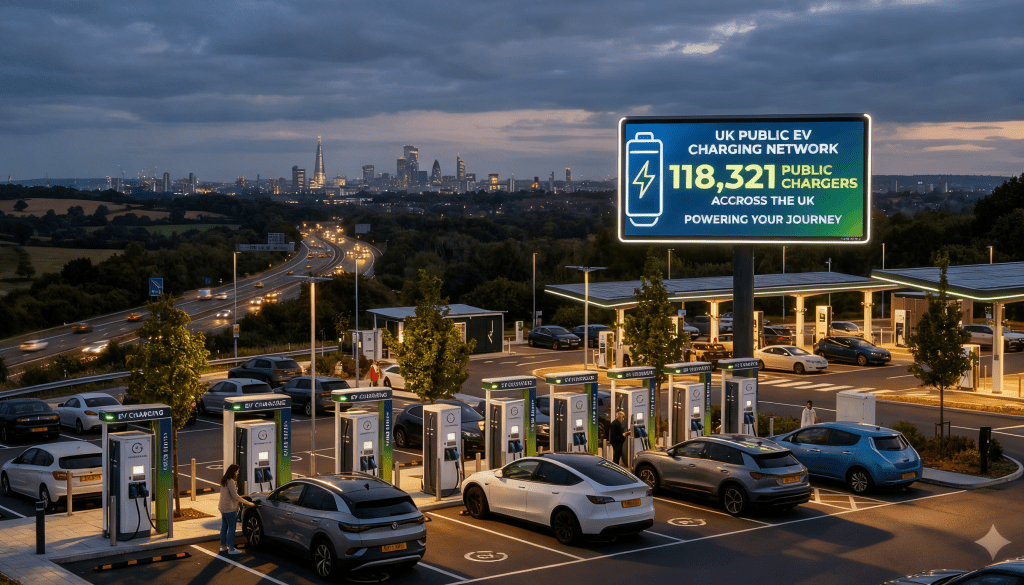
One reason the national picture now looks clearer is that the way the network is measured has improved. As of February 2026, official reporting now includes the number of public EV chargers, or EVSE, rather than relying only on the older device count. That gives drivers, policymakers and the wider industry a more accurate view of the true scale of public charging provision. Zapmap’s latest update shows 118,321 chargers located on 89,842 devices across 45,561 charging locations around the UK, with 1,592 net new chargers added to the database in the last month alone. DfT’s January 2026 release also confirms the methodology change and the shift to charger-level reporting.
That matters because perception tends to lag reality. Many people still picture a thin, patchy network with big gaps between chargers. The current data paints a very different picture. The UK network has expanded rapidly, and not just in one corner of the market. On-street, destination and en-route charging have all grown, meaning the charging ecosystem is now much broader than a simple motorway story.
The Rise of Ultra-Rapid Charging
The really important development is not just volume. It is speed. The UK’s public network is increasingly being shaped by faster charging, particularly for drivers making longer trips or relying on the public network more often. Zapmap reports that in 2025 alone, 3,425 ultra-rapid chargers rated at 150kW and above were added to the public network, representing around 40% year-on-year growth in that highest-power segment. The same source shows there are now 9,893 chargers in the 150kW+ ultra-rapid band.
Official power-band data from DfT also shows how the network is now distributed. As of 1 January 2026, around 50% of chargers were in the standard 3kW to under 8kW band, with another 27% in the 8kW to under 50kW band. That slower infrastructure still matters enormously for overnight and destination charging. But the strategic shift is obvious. High-power charging is scaling, and it is scaling where it matters most for confidence on longer journeys.
Why “Range Anxiety” Looks Increasingly Outdated
The original fear around EV ownership was built in a very different era. Early electric cars offered much shorter range, the charger map was sparse, and reliability and payment simplicity were far less mature than they are now. That legacy still shapes public opinion, even though the market has moved on. Government documentation published in early 2026 states that there are already over one million battery electric vehicles on UK roads, while SMMT reported that almost half a million new BEVs joined the road in 2025 alone.
That does not mean every charging experience is perfect. It plainly is not. Reliability, payment consistency and confidence in finding the right charger remain important. But it does mean the old argument that the infrastructure simply is not there has become much harder to defend. The infrastructure is there, and it is still growing.
It is also getting easier to navigate. That is where platforms such as the ONEEV app matter. For drivers, public charging confidence is not just about the physical charger count. It is about being able to find the right charger quickly, check availability, understand speed, and pay without turning the process into a small administrative crisis in a car park.
The Focus Is Shifting from Growth to Usability
Hitting six figures is a milestone, but it is not the finish line. The conversation is now moving from “how many chargers are there?” to “how easy are they to use?” That means uptime, pricing transparency, payment options and the placement of chargers all matter more than ever. DfT’s updated infrastructure materials note that the current estimated public charging demand range for 2030 is now 250,000 to 550,000 public EV chargers, reflecting the scale of continued rollout still expected over the rest of the decade.
Price also remains part of the story. Zapmap’s February 2026 charging price index shows the weighted average pay-as-you-go public charging price at 54p/kWh for 3kW to 49kW chargers and 76p/kWh for 50kW and above. So yes, infrastructure is growing fast, but the quality of the user experience, and the cost of using it, are still central to making the transition feel genuinely easy.
What It Means for Drivers Without a Driveway
This matters especially for people who do not have home charging. The old assumption was that without a driveway, EV ownership would be awkward at best and impractical at worst. That picture is changing as local authorities, on-street providers and destination charging operators expand access in residential streets, public car parks and everyday stop-off locations. It is not yet perfectly even across the whole country, but the trajectory is clear. Public charging is becoming a mainstream utility, not an enthusiast workaround.
For anyone still learning how to make that work in everyday life, The ONEEV Beginner’s Guide to Effortless EV Charging, How to Find Fast EV Chargers, and How to Find EV Charging Stations Near You in the UK are useful starting points for turning charger statistics into practical confidence.
Verdict
The UK’s public EV charging network has moved well beyond symbolic progress. At 118,321 chargers and counting, the country is no longer in the phase of proving the concept. It is now building depth, density and speed into an infrastructure network that is increasingly capable of supporting mainstream EV ownership.
So if your view of EV charging is still based on a story from three years ago, it may be time for an update. The milestone is not that the UK has just about made it to 100,000 chargers. It is that the network has already surged well beyond that point, and the conversation is now about making charging simpler, faster and more dependable for everyone.