Guest editorial | UK public charging
I spend my working life monitoring the EV industry’s growth, tracking public charging trends, and listening to what drivers say when the marketing noise dies down. Right now, the loudest message I hear is simple.
Charging is starting to feel unfair.
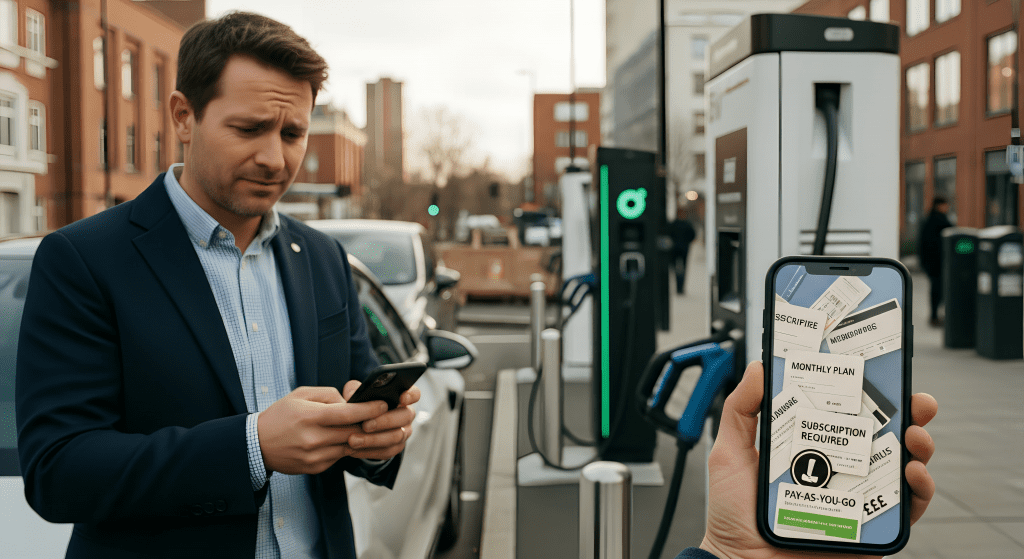
The electric vehicle transition promised something cleaner and simpler. For many UK drivers, the lived reality can feel like the opposite: a fragmented maze of apps, pricing tiers, and subscriptions that quietly add cost and friction to what should be a straightforward moment at the roadside.
Why drivers are calling it a subscription trap
Think back to petrol stations. You drove in, filled up, paid a clearly displayed price, and left. No monthly fees to access a better rate. No “members-only” discounts that punish you for not signing up.
Now imagine if every petrol brand demanded a monthly subscription just to avoid inflated pay-as-you-go prices. That would not last five minutes. Yet, that is increasingly what EV drivers experience across public charging.
“It feels like I’m being punished for going green.” Sarah, EV owner from Manchester
“I bought an electric car to save money and reduce my impact. Instead, I’m juggling memberships just to avoid being stung at the charger.”
“I’ve got six charging apps and three subscriptions.” Mark, taxi driver
“Each one promises a saving, but once you add them all up, I’m not sure what I’m actually saving. It’s not transparent.”
The current landscape: what drivers are paying yearly
Below is a snapshot of subscription pricing and the limitations drivers frequently mention. The key point is not that each plan is “wrong”. It is that drivers often need multiple plans to avoid punitive rates, and each comes with caveats that undermine simplicity.
Subscription costs and key limitations
| Provider | Annual Cost | Key Limitations |
|---|---|---|
| Tesla Supercharge | £131.88 | Not all stations are open to non-Tesla vehicles. |
| Shell Recharge | £119.88 | Discount capped at 1,000 kWh per month and excludes on-street chargers. |
| Fastned | £119.88 | It cannot be combined with other roaming offers, partner networks, or company car driver cards. |
| IONITY (Power tier) | £104.99 | Same network limitations as Motion. |
| Gridserve | £95.88 | Drivers generally need to charge at least 50 kWh per month just to break even. |
| BP Pulse | £94.20 | Discount only applies at participating BP Pulse chargers. |
| Zapmap | £59.88 | Discount capped at 50 kWh per month and primarily a mapping service. |
| IONITY (Motion tier) | £54.99 | Access limited to around 5,000 ultra-rapid chargers across 23 European countries. |
Note: The real pain point for many drivers is not the existence of subscriptions. It is the combined effect of multiple subscriptions, exclusions, and price gaps between member and non-member rates, which can make “opting out” feel like a penalty.
Why this matters: friction kills confidence
New EV buyers are already learning charging etiquette, connector types, reliability differences, and route planning. Layering on a web of memberships, each with its own limitations, can turn an everyday action into an administrative chore.
The market can justify this in plenty of ways. Infrastructure is expensive. Grid connections are complex. Reliability standards take investment. But the customer outcome is what matters, and the customer outcome today often feels like forced loyalty rather than fair access.
A solution-led path: make charging feel like petrol used to
This is not an unsolvable problem. The fix is surprisingly simple, and it aligns with what drivers have always valued. Clarity, predictability, and choice.
What drivers actually want
- One place to see availability and pricing before they plug in.
- One payment method that works widely and reliably.
- Transparent pricing that does not punish non-members.
- Subscriptions that are optional enhancements, not the entry fee to fair charging.
What “fair play” looks like in practice
- Transparent pricing: clear unit rates, clearly displayed before charging starts.
- Simple payment: widespread contactless and in-app payment, without app-hopping.
- Open access: fewer walled gardens and less brand lock-in.
- Better data: reliable “working” and “available” status so drivers stop arriving to disappointment.
Subscriptions can still exist for high-mileage users or drivers loyal to a specific network. The problem begins when a subscription becomes the only realistic route to a fair price.
Signs of progress in the UK
The direction of travel in the UK is already pushing the market towards simpler experiences, including more transparent pricing and easier payment expectations. Regulatory focus is increasingly on reliability, payment accessibility, and the quality of public charge point data.
For readers who want the detail behind the direction of travel, see the UK Government guidance on the Public Charge Point Regulations 2023 and Ofgem’s work on
selling electricity to EV drivers. These are useful reference points for what “good” should look like as the market matures.
Public Charge Point Regulations 2023 guidance (UK Government)
Taking charge: selling electricity to EV drivers (Ofgem)
Can the UK grid cope with extra EV demand? (National Grid)
What to do if you are fed up with subscription charging
If you want a calmer charging life, focus on removing friction first. Choose tools that prioritise real-time availability, simple payment, and wide access so you are not forced into “membership maths” every month.
- Prioritise networks and platforms that show working status and availability clearly.
- Prefer in-app payment or contactless options that reduce failed payments and app switching.
- Only take subscriptions when your monthly usage genuinely benefits, and review them quarterly.
- Keep your setup minimal so charging stays simple, especially for new EV drivers.
Internal reading on ONEEV (optional): How EV charging payments work | Secure in-app payments | Live availability and reliability | EV charging costs explained
Conclusion: the revolution should not feel like an obstacle course
The electric future should not require drivers to become pricing analysts or subscription managers. The technology exists. The infrastructure is expanding. What is needed now is a reset in mindset.
Make charging simple. Make pricing fair. Give drivers real choice.
Guest Editor: Alex Warren, EV market analyst and industry monitor. This editorial reflects observed trends and common driver sentiment across UK public charging.