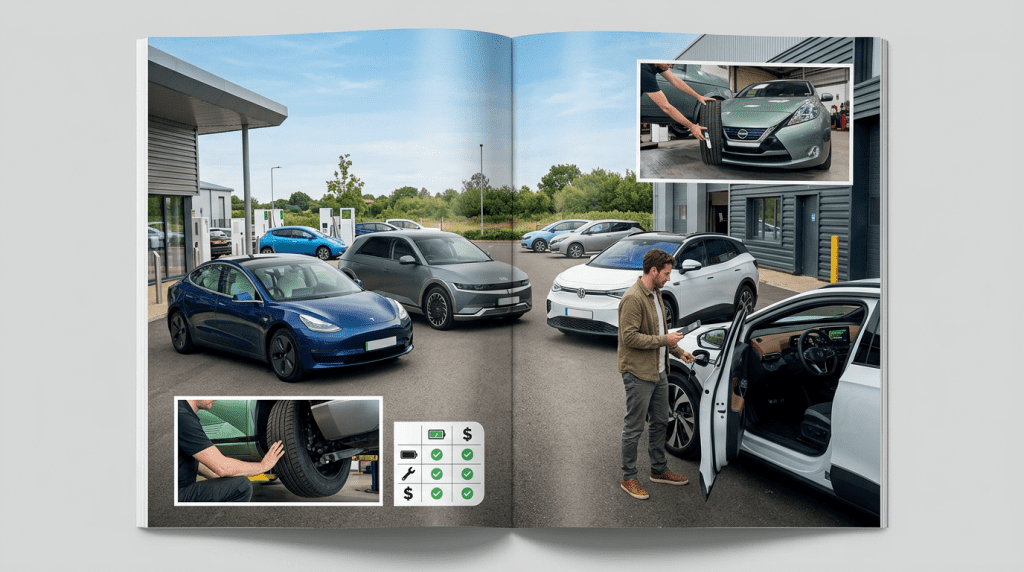
If you have been waiting for the used EV market to stop behaving like a rollercoaster and start behaving like a proper buying opportunity, 2026 is your moment. The great price correction of the mid-2020s has done what all maturing markets eventually do. It has shaken out the hype, widened the choice, and left behind something far more useful for ordinary drivers: genuine value.
This is now the sweet spot. There are more second-hand electric cars on the market, more buyers who actually understand what they are looking at, and far better reassurance around battery condition than the internet panic merchants would have you believe. In other words, the used EV market is no longer the risky corner of the car world. In 2026, it is increasingly the smart one.
Whether you are eyeing up a Tesla Model 3, a Volkswagen ID.3, or a value-first Nissan Leaf, the real story is the same. If you buy carefully, a used EV can now deliver one of the strongest ownership propositions in the entire market.
Why 2026 is the used EV sweet spot
- Used battery electric car sales in the UK jumped strongly in 2025, bringing more stock into the market.
- Battery health checks are becoming easier to access through dealers and specialist tools.
- More buyers now understand that battery condition can be checked rather than guessed.
- Running cost advantages still help used EVs make a strong total cost of ownership case.
- Buyer confidence is growing as EV ownership becomes more normal and less mysterious.
The market has finally moved from curiosity to choice
One of the biggest reasons 2026 looks so attractive for used EV buyers is simple. There is finally enough volume in the market for people to shop properly. That may sound obvious, but it matters. A market with thin stock makes buyers nervous and keeps prices stubborn. A market with wider supply allows comparison, negotiation, and smarter buying.
The used EV segment is no longer an awkward experiment made up of a handful of expensive oddities and a few elderly city cars. It is increasingly a proper category. That means a far broader mix of hatchbacks, family cars, crossovers, and premium models, which in turn makes it easier for buyers to match a used EV to real life rather than trying to force real life around a limited shortlist.
And once a market gets to that point, value starts appearing everywhere for shoppers who know what to check.
Battery fear is fading because buyers can now ask better questions
Let us deal with the old used EV bogeyman straight away. Battery anxiety has lingered for years because too many people assumed they were being asked to buy a car with its most expensive component hidden behind mystery. That is much less true in 2026. Buyers are becoming more aware of battery State of Health, dealers are increasingly offering battery information, and specialist health reports are making the used EV experience look far more transparent.
That matters because battery health is not a vague feeling. It is something you can check. A sensible buyer in 2026 should ask for battery information, review the displayed range and State of Health where available, and treat that as naturally as checking service history or tyre condition. The more the market normalises that behaviour, the more used EV confidence grows.
In other words, the fear does not disappear because everyone suddenly becomes brave. It disappears because the questions become easier to answer.
What to check before buying a used EV
- Battery State of Health or battery information sheet.
- Realistic range for your driving pattern, not just brochure claims.
- Charging speed compatibility for the journeys you actually do.
- Service history, tyres, suspension, and general condition like any other used car.
- Whether the car’s charging cable, software features, and warranty support are all in place.
The best used EV is not always the newest one
This is where smart shoppers can really win. In a maturing used EV market, the sweet spot is often not the nearly-new car sitting at the highest possible price. It is the model that has already taken its biggest early-value hit, still offers strong everyday usability, and fits your routine without unnecessary overkill.
A three-year-old Tesla Model 3 will appeal to buyers who want long-range confidence, software polish, and a modern feel. A used Volkswagen ID.3 can make a lot of sense for buyers who want a practical mainstream hatchback with proper EV bones. And the Nissan Leaf still holds appeal as a value route into electric motoring for the right kind of driving pattern, particularly if you mainly do local or regional journeys and understand the car’s charging profile.
The trick is not to chase a badge or a headline. It is to buy the right used EV for the life you actually live.
Why total cost of ownership still makes used EVs look clever
Used EV value is not just about sticker price. It is about what happens afterwards. This is where electric cars continue to make a persuasive case. Fewer moving parts, no oil changes, no clutch, and a simpler drivetrain all contribute to the idea that a used EV can still be a financially disciplined choice when looked at over the full ownership journey.
That does not mean every used EV will automatically be cheaper for every person in every situation. Public charging habits, insurance, mileage, and home charging access all still matter. But the broad ownership case remains strong enough that buyers should not look only at the asking price. The smarter comparison is overall running cost, maintenance profile, and how neatly the car fits your routine.
That is why a used EV can often look even more attractive after six months of ownership than it did on day one.
Confidence in EV ownership is doing the heavy lifting
Another reason the used market feels stronger in 2026 is that ownership sentiment has become much harder to dismiss. Drivers who have already made the switch overwhelmingly do not seem desperate to run back to petrol and diesel. That changes the tone of the whole market because used buyers are no longer relying only on abstract promises from manufacturers. They are looking at a growing body of lived experience.
Once enough owners say electric works for them, second-hand buyers start to view the category differently. It stops feeling like a gamble and starts feeling like a proven route with some sensible checks attached. That shift in confidence is one of the biggest reasons the used EV segment now feels more settled and more believable.
Put bluntly, it is easier to buy a used EV when millions of people have already helped normalise the experience.
Best-buy mindset for 2026
- Buy on battery condition and suitability, not hype.
- Think about your home and public charging reality before choosing range.
- Do not overpay for features you will barely use.
- Treat a battery report as a confidence tool, not a luxury extra.
- Aim for the point where depreciation has already done most of its dramatic work.
The next risk is not battery fear. It is buying the wrong shape of EV for your life.
The used EV market is now good enough that the main danger has changed. It is no longer simply that buyers are scared of batteries. It is that they buy the wrong car because they chase an idea instead of matching the vehicle to their routine. A commuter with home charging has different needs from a family doing regular long motorway runs. A city-based buyer may value size and ease over outright range. A bargain only stays a bargain if it fits.
That is why practical support matters so much. Useful reads such as how to find EV charging stations near you in the UK, the real cost of charging an electric car in the UK, and five ways ONEEV can help you find and pay for EV charging are valuable because they help a buyer think beyond the forecourt.
The best used EV is not the one that wins the internet argument. It is the one that works brilliantly on your Tuesday.
Final word
2026 looks like the used EV goldmine because the market has finally matured enough for smart buyers to take advantage. Supply is stronger, value is clearer, battery confidence is improving, and the total cost of ownership case still holds serious appeal.
If you buy carefully, ask the right battery questions, and choose a car that fits your routine, the used EV market in 2026 is not something to fear. It is one of the smartest buying opportunities on the road.