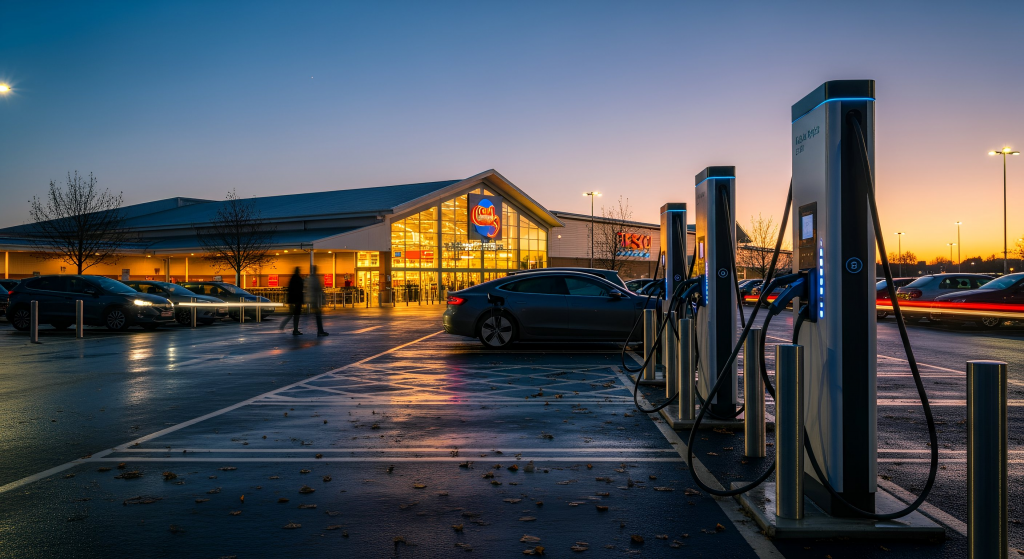
Something quietly decisive happened in 2025. For decades, the motorway service area was unavoidable. The same queues, the same smells, the same feeling that your journey had been paused rather than helped.
Then electric cars arrived and rewrote the rules. By 2025, the centre of gravity had shifted away from the motorway and into the supermarket car park. Not because supermarkets tried to be clever, but because they understood something fundamental about real driver behaviour.
Turning wasted time into useful time
A motorway stop interrupts your journey. You tolerate it so you can leave again. A supermarket stop fits into your life.
An ultra-rapid charge takes roughly the same time as picking up the weekly shop, grabbing a coffee, or sorting dinner. The car charges while you do something you were already planning to do. Once drivers experience that, the logic of the old service station begins to unravel.
The simple shift that changed everything
- Motorway stop: feels like an interruption.
- Supermarket stop: feels like progress, because it stacks with something you already need to do.
- Ultra-rapid charging: stops being an event and becomes background activity.
Sainsbury’s Smart Charge: calm, confident, and ruthlessly well executed
Sainsbury’s did not rush into EV charging. They waited, watched, and then entered with a very clear idea of what good looks like.
By late 2025, Sainsbury’s had scaled to more than 335 ultra-rapid bays across 84 locations, building momentum by focusing on consistency, not spectacle.
Why drivers keep choosing it
- Loyalty integration that turns charging into something you benefit from, not just pay for.
- Premium expectation because the experience feels designed, not bolted on.
- Familiar routine because it fits naturally into an existing shopping habit.
The hardware factor
Using modern 150kW-plus units, with lighter cabling and a more refined user experience, makes a difference. It attracts drivers who have grown tired of bulky, temperamental equipment at older sites.
Fast charging is only “fast” if it starts cleanly and behaves predictably.
Morrisons and MFG: winning through sheer scale and certainty
If Sainsbury’s is measured and polished, the Morrisons play is unapologetically muscular. Through a £2.5bn deal with Motor Fuel Group (MFG), Morrisons accelerated its rollout at a pace few could match.
As of Q4 2025, MFG EV Power had completed rollout across 300 Morrisons locations, contributing to a wider network of more than 1,300 chargers.
Why multi-bay hubs change behaviour
The real advantage is not just numbers, it is design. Multi-bay hubs reduce the one thing drivers hate most: arriving and waiting.
- More bays means a better chance of finding a space at busy times.
- Less gambling because you are not relying on one lonely unit tucked in a corner.
- More confidence because the stop feels planned, not improvised.
Why motorway service areas are losing ground
Traditional motorway operators are not vanishing, but they are no longer the default choice for many EV drivers. There are three clear reasons: price, utility, and trust.
Price
Supermarket pricing in 2025 frequently undercut motorway pricing, which often carried a visible convenience premium. When drivers understand cost per kWh, habits change quickly.
Utility
A 30-minute ultra-rapid top-up aligns neatly with a grocery shop. The supermarket stop replaces something essential. The motorway stop can feel like an extra errand.
Trust
Drivers remember what works. Sites that fail regularly are quietly removed from mental maps, regardless of how convenient they once were. Search behaviour follows lived experience.
The new default
This is not just a battle for electrons. It is a battle for calm, predictable journeys. And supermarkets are winning because they make charging feel like part of normal life.
The halo effect: charging as a footfall engine
This shift is about far more than electricity. In 2025, Sainsbury’s reported its chargers powered 60 million fossil-free miles in a single year, pulling EV drivers into stores while their cars charged outside.
MFG is countering by upgrading amenities, making forecourts feel less like fuel stops and more like places you would actually choose to be.
How ONEEV fits into this new charging reality
Supermarket ultra-rapid charging only feels brilliant when the whole experience stays simple. ONEEV is built around the fundamentals that matter away from home: finding the right chargers, reducing friction, and helping drivers charge with confidence.
- Choice-first discovery so you can find chargers that suit your stop.
- Less friction so you are not juggling apps when you should be getting back on the road.
- Confidence that charging stays calm, predictable, and easy to complete.
The bigger picture
This is what genuine progress looks like. Not slogans. Not shiny promises. Just a better understanding of how people actually live and travel. EV charging has stopped being about stopping. It is now about flow.
And once you have charged your car while doing the weekly shop, standing around at a windswept motorway service area begins to feel like a relic from another era.
Helpful links and references
For readers who want primary sources for the networks and approaches mentioned, these pages provide direct detail on rollout, locations, and charging propositions.