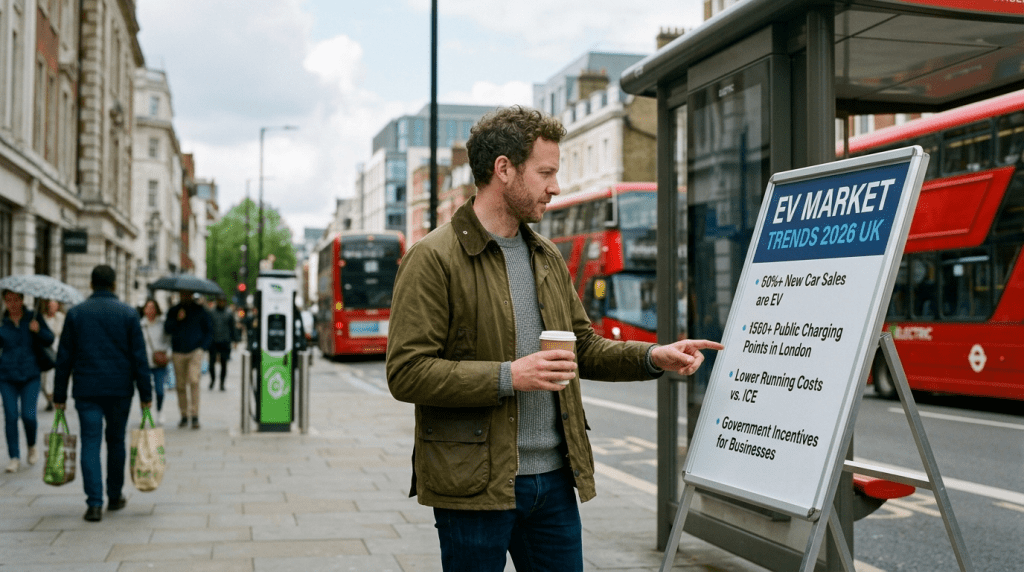
For years, the future of motoring was discussed like it was still waiting politely in the wings. In 2026, that future stopped waiting. Across the UK and Ireland, electric vehicles moved beyond early-adopter territory and into the heart of the mainstream conversation. This is no longer a story about what might happen next. It is a story about what is already happening on our roads, in dealer forecourts, and in the minds of everyday drivers.
In the UK, the market has continued to shift under the influence of regulation, infrastructure growth, and rising consumer familiarity. In Ireland, the momentum has been just as striking, with battery electric vehicles producing headline moments that would have seemed bold only a short while ago. The result is simple. Electric driving is no longer the future of motoring in these markets. It is now part of the present.
The hum of progress is no longer background noise. It is getting louder, more confident, and impossible to ignore.
2026 at a glance
- The UK EV market is projected to push close to 29% battery electric share in 2026.
- The UK already has more than 1.7 million licensed zero-emission vehicles on the road.
- Public charging infrastructure in the UK continues to expand at pace, reinforcing confidence for drivers without home charging.
- Ireland has produced standout monthly EV results, with battery electric vehicles overtaking petrol and diesel individually in key registration data.
- Across both markets, 2026 feels less like an experiment and more like a genuine turning point.
The UK market is no longer asking if. It is asking how fast.
The clearest sign of change in the UK is not simply that electric vehicles are growing. It is that they are now shaping the wider market discussion. The projected battery electric share for 2026 is edging towards 29%, which tells you everything about how serious the transition has become. That level of market penetration does not happen because of trend-driven curiosity. It happens because electric vehicles have become a realistic, repeatable choice for a growing share of drivers.
The ZEV mandate has been one of the major forces behind that acceleration. It has pushed manufacturers to treat EV sales as a structural priority, not a side project. That pressure matters because it changes product strategy, dealer focus, pricing conversations, and the way brands think about their future line-up. The market is no longer drifting towards electric. It is being actively moved there.
More importantly, the scale is now visible in real life. With over 1.7 million licensed zero-emission vehicles already on UK roads, electric driving is no longer something people imagine from headlines. They see it on school runs, at motorway services, outside supermarkets, and parked on the drive next door.
Ireland delivered one of the boldest signals of all
Ireland’s EV story in 2026 has real symbolic weight. This is a market that has delivered one of the strongest signs yet that traditional assumptions are weakening. Battery electric vehicles have, in key monthly registration data, moved ahead of petrol and diesel individually. That is not just a useful statistic. It is a flashing sign that consumer sentiment has shifted.
What makes this so significant is the speed at which perception changes once a market starts to believe the ecosystem is ready. Drivers do not wait for perfection. They wait for enough confidence. Once there are enough vehicles on the road, enough chargers in view, enough stories from friends and colleagues, and enough sense that EV ownership is manageable, the category stops looking brave and starts looking normal.
That is exactly why Ireland matters in the 2026 picture. It shows what happens when the transition stops being theoretical and starts appearing in monthly buying decisions.
Why 2026 feels different from every year before it
Every previous year of EV growth came with a caveat. The cars were improving, but the price question lingered. The chargers were appearing, but confidence lagged behind. Interest was growing, but many drivers still felt they were watching from the sidelines. In 2026, that balance changed. This year feels different because more of the key conditions have started arriving together.
Regulation is pushing harder. Infrastructure is becoming more visible. More mainstream brands are treating EVs as core products. More company car drivers are being introduced to electric through business use. More households know someone who has made the switch and got on with life just fine. Once all of those things happen at the same time, the market mood changes quickly.
That is the real tipping point. Not the moment every driver switches overnight, but the moment electric vehicles stop feeling unusual.
What drivers now expect from the EV market
The modern EV driver is no longer impressed by the idea of electric alone. Drivers now expect the practical experience to work. That means better information, less confusion, and fewer headaches when it comes to charging away from home.
- Clear, reliable public charging information
- Simple payment without unnecessary friction
- Confidence that charging can fit everyday journeys
- More transparent pricing and fewer nasty surprises
- An ownership experience that feels easy, not technical
Infrastructure growth matters, but ease of use now matters more
Public charging growth remains one of the most important signals in the UK and Ireland story. A stronger charging network helps reduce doubt, supports drivers without off-street parking, and reinforces the idea that EV driving is viable beyond the driveway. But this stage of the market is no longer just about adding more dots to a map. It is about making the overall experience feel straightforward.
That is why the next phase of adoption will be shaped by usability. Drivers want to know where to charge, whether the charger is likely to be available, how much it will cost, and how quickly they can get started. They want the practical side of EV life to feel simple. That is where strong platforms, accurate information, and clean user journeys begin to matter just as much as the hardware itself.
Helpful guides such as how to charge your EV in 4 easy steps, how to find EV charging stations near you in the UK, and the real cost of charging an electric car in the UK are becoming more valuable because they speak to what drivers actually care about now.
The old certainty of ICE is fading
Petrol and diesel have not vanished from the market, and nobody sensible would claim they have. But what has changed is the old certainty that internal combustion is the obvious default. That certainty has weakened. When more drivers naturally include an EV on the shortlist for their next car, the balance of power begins to shift.
That is what the tipping point really looks like. It is not dramatic in a cinematic sense. It is more powerful than that. It shows up in ordinary behaviour. It shows up when buyers ask practical questions about charging rather than dismissing the category outright. It shows up when businesses rethink their company car choices. It shows up when the used market becomes more relevant. And it shows up when an EV no longer feels like a statement piece, but simply like the right tool for the job.
In 2026, the centre of gravity has clearly started moving.
What this means for the next stage of adoption
The next stage of the EV market will not be won by whoever talks most loudly about the future. It will be won by whoever makes the present feel easiest. That means practical value, not jargon. Clear charging experiences, not complexity. Real confidence, not wishful marketing.
For drivers, that is good news. The market is becoming easier to understand, and the support around it is growing stronger. For brands, operators, and platforms, it is a reminder that adoption now depends on execution as much as ambition. People want to go electric without friction. They want fewer headaches, fewer apps, and less uncertainty.
In other words, the EV market in 2026 is no longer being judged on promise alone. It is being judged on everyday usefulness.
Final word
The UK and Ireland have not completed the transition to electric motoring, but 2026 looks increasingly like the year the old assumptions finally began to crack in full public view. In the UK, EV share is moving deeper into the mainstream. In Ireland, the numbers have already delivered a historic shift in how the market looks month to month.
This is the electric tipping point. Not perfection. Not the end of every challenge. Just something much more important: visible momentum, growing confidence, and a mainstream market that has finally started to sound unmistakably electric.