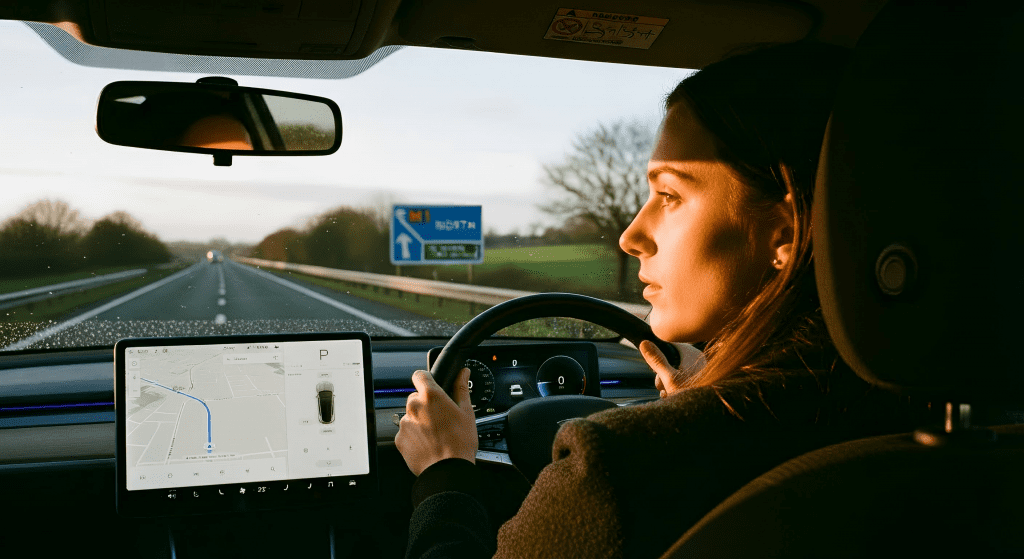
For years, one question has hovered over electric driving. Not how far an EV can go on paper, but how far it can go in real life.
In 2026, the benchmark commuter challenge is clear. Can a modern electric car realistically drive from :contentReference[oaicite:0]{index=0} to :contentReference[oaicite:1]{index=1} on a single charge, without special conditions, drafting lorries, or white-knuckle hypermiling?
With the arrival of multiple 400-mile range EVs, the answer is finally moving from “sometimes” to “yes, for most drivers”.
If you are still building confidence with motorway charging and planning, start with: how to find reliable EV charging .
The Distance: Why This Route Matters
The London to Manchester drive covers roughly 210 miles, depending on route choice. On paper, that should be trivial for a 400-mile EV.
In reality, this journey is a perfect stress test. It combines sustained motorway speeds, elevation changes, traffic variability, and often unpredictable weather.
If an EV can complete this run comfortably, it can handle the vast majority of UK intercity driving without relying on public charging mid-journey.
What “400 Miles” Really Means in 2026
Range figures have matured significantly.
In 2026, a 400-mile rating no longer represents an optimistic edge case. Advances in battery chemistry, thermal management, and drivetrain efficiency mean real-world motorway ranges of 300 to 340 miles are now achievable without compromise.
This is the critical shift. The buffer is large enough that drivers no longer need to plan charging defensively for journeys under 250 miles.
The Motorway Reality Check
Motorway driving remains the most demanding scenario for any EV.
At sustained speeds, aerodynamic drag becomes the dominant energy drain. Even so, modern EVs manage this far better than earlier generations.
- Stable cruising at legal motorway speeds delivers predictable efficiency
- Improved heat pump systems reduce winter range penalties
- Advanced navigation adjusts energy predictions dynamically
For drivers who do choose to top up en route, understanding charger availability is still important: EV charging near me .
Driver Behaviour Matters More Than Ever
One of the most overlooked aspects of long-distance EV driving is consistency.
Rapid acceleration, aggressive lane changes, and fluctuating speeds all eat into range more than steady cruising. In contrast, EVs reward calm, predictable driving styles.
The difference between an anxious journey and an effortless one is often not the car, but the driver’s habits.
When Would You Still Stop?
Even if a car can complete the journey on one charge, that does not mean drivers always should.
Many commuters still choose a short stop for comfort, food, or flexibility. The key change in 2026 is that charging is optional rather than necessary.
This shift removes psychological pressure and transforms long-distance EV driving into something that feels normal.
For drivers concerned about payment simplicity when charging on the road, see: EV charging payment safety .
The Bigger Picture for UK Commuters
The London to Manchester test is symbolic.
It marks the point where EVs stop being “good enough” and start being unquestionably capable. For company car drivers and frequent motorway users, this removes one of the last remaining mental barriers to switching.
In 2026, range anxiety on core UK routes is no longer a technical issue. It is a legacy perception.
FAQs
Can most 400-mile EVs really do London to Manchester on one charge?
Yes. In normal conditions, many modern EVs can complete the journey comfortably without recharging.
Does weather still affect motorway range?
Yes, but far less than before. Improved thermal systems have significantly reduced winter range loss.
Is motorway charging still useful on this route?
Yes. Many drivers still stop briefly for convenience or flexibility, even if charging is not strictly required.
What speed is best for EV efficiency?
Consistent speeds within motorway limits generally deliver the best balance of time and efficiency.
Do I need special planning tools?
Modern EV navigation systems handle most planning automatically, but charging apps remain useful for reassurance.