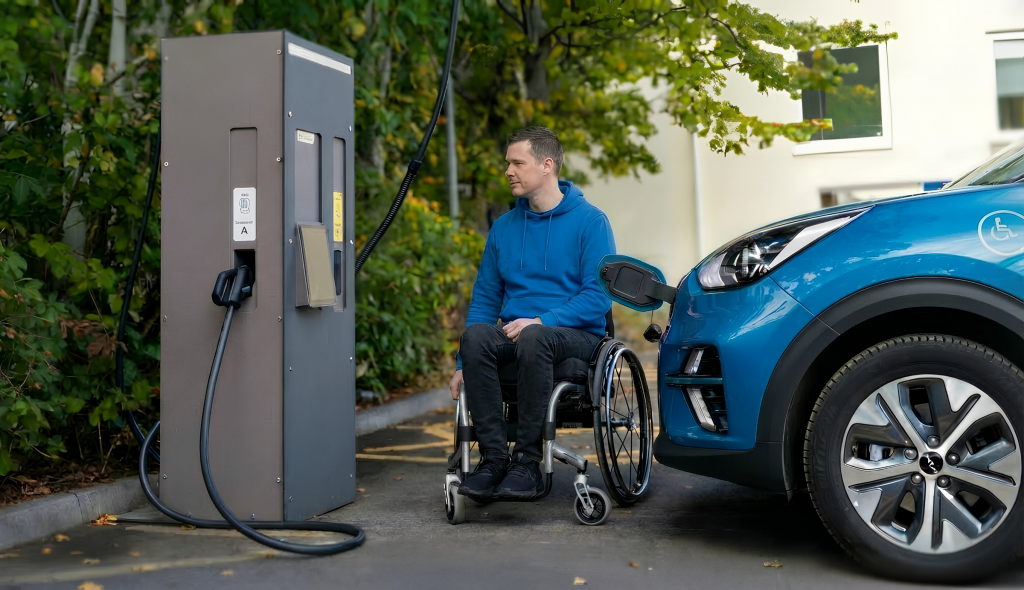
In 2026, the UK’s public charging network is bigger than it has ever been, but size is not the same thing as usability. For disabled drivers and passengers, and for anyone with limited mobility, pain, reduced strength, or fatigue, charging can still be shaped by physical barriers that many non-disabled drivers never notice.
Multiple UK organisations have highlighted recurring issues such as tight bays, raised kerbs, poorly placed equipment, and difficulty handling charging kit. The “accessible charging” conversation is now moving from a niche topic to a mainstream adoption requirement.
Why accessibility is a mainstream EV issue
The UK has more than 14 million disabled people. A growing number of disabled drivers and passengers are expected to rely on public charging at least some of the time, so the transition to electric vehicles must work for everyone.
What PAS 1899 is, and why it matters in 2026
PAS 1899 is an accessible charging specification published by the British Standards Institution (BSI) in 2022. It sets out minimum requirements and recommendations for accessible public chargepoints, covering the physical environment, placement, and information provision. Guidance to help interpret and implement PAS 1899 is also available, including illustrated examples for on-street and off-street locations.
PAS 1899 has historically been voluntary, but there has been growing public discussion about strengthening expectations and using new powers if voluntary progress remains too slow. This sits alongside ongoing review work intended to improve how accessible charging is delivered in practice.
The real barriers drivers report
Built environment barriers
- Tight bays that do not allow safe door opening or wheelchair transfer.
- Raised kerbs, plinths, awkward surfaces, or indirect routes to the unit.
- Bollards and street furniture positioned in ways that block access.
- Poor location planning that makes the wider site difficult to use safely.
Equipment and interface barriers
- Heavy and cumbersome charging cables and connectors that require significant force.
- Lack of cable management systems, which increases lifting and handling effort.
- Payment systems and interfaces that are hard to reach, read, or operate.
What “good” looks like for low-effort charging
Accessible charging is often won or lost on simple design choices: space, geometry, kerbs and surfaces, cable management, and reachable controls. The goal is to reduce physical strain and remove unnecessary obstacles.
- Space and geometry: bay size, clearances, and turning space that allows safe approach and manoeuvring.
- Kerbs and surfaces: step-free access, flush transitions, and sensible ground surfaces.
- Cable management: systems that reduce the need to lift and hold cable weight.
- Reachable controls: payment terminals and screens positioned for usability.
Is the UK network improving in 2026?
There is evidence of progress, including the existence of PAS 1899, implementation guidance, ongoing research and innovation, and some local authority planning guidance referencing accessibility principles. However, credible watchdog and evidence sources still describe a real gap between standards and widespread delivery.
How to find disabled-friendly, low-effort charging today
- Know the checklist: wide bays, step-free access, sensible surfaces, reachable controls, and cable management that reduces effort.
- Prefer newer sites: older layouts are more likely to have tight bays and awkward kerbs.
- Remember needs vary: “accessible” can mean space for some drivers and low-handling effort for others.
- Use credible design references: Design guidance exists to translate standards into practical site expectations.
The ONEEV integration
Accessibility is about site attributes, not just dots on a map. ONEEV can support “low-effort” charging through an Accessibility Filter that helps drivers search for features that matter in practice, such as PAS 1899-aligned design claims, step-free routes and flush kerbs, and cable management systems that reduce handling effort. An app cannot fix a poorly designed bay, but it can reduce wasted journeys by making the right information easier to find.
Bottom line
The UK is moving in the right direction, with shared standards and rising pressure to deliver accessible charging at scale. At the same time, real-world barriers remain common enough that disabled drivers still need planning support and better information to avoid unusable sites. In 2026, the most honest view is that progress is real, but consistency is not here yet.
FAQs
What is PAS 1899 for EV charging?
PAS 1899 is a BSI specification published in 2022 that sets out minimum requirements and recommendations for accessible public EV chargepoints, covering areas such as the physical environment, placement, and information provision.
Is PAS 1899 mandatory in the UK?
PAS 1899 has historically been a voluntary standard. There has been growing public discussion about strengthening government powers to require accessibility measures if voluntary progress is too slow, alongside review work intended to improve delivery.
What makes a charger “low-effort” to use?
Low-effort charging usually means enough space to manoeuvre, step-free access, sensible surfaces, reachable controls and payment, and cable management that reduces lifting and handling effort.
What are the most common accessibility barriers at public chargers?
Commonly reported barriers include tight bays, raised kerbs and plinths, obstructive bollards, heavy cables, poor cable management, and interfaces that are hard to reach or operate.
How can ONEEV help disabled drivers plan charging?
ONEEV can help by surfacing accessibility-related site features through an Accessibility Filter, so drivers can plan around known barriers and reduce wasted trips to unusable chargepoints.
Helpful links
External references: Energy Saving Trust: PAS 1899 guidance, BSI: PAS 1899 overview, Motability Foundation: accessible EV charging, Transport Focus: accessibility gap warning, Designability: accessible EV charging guidance.