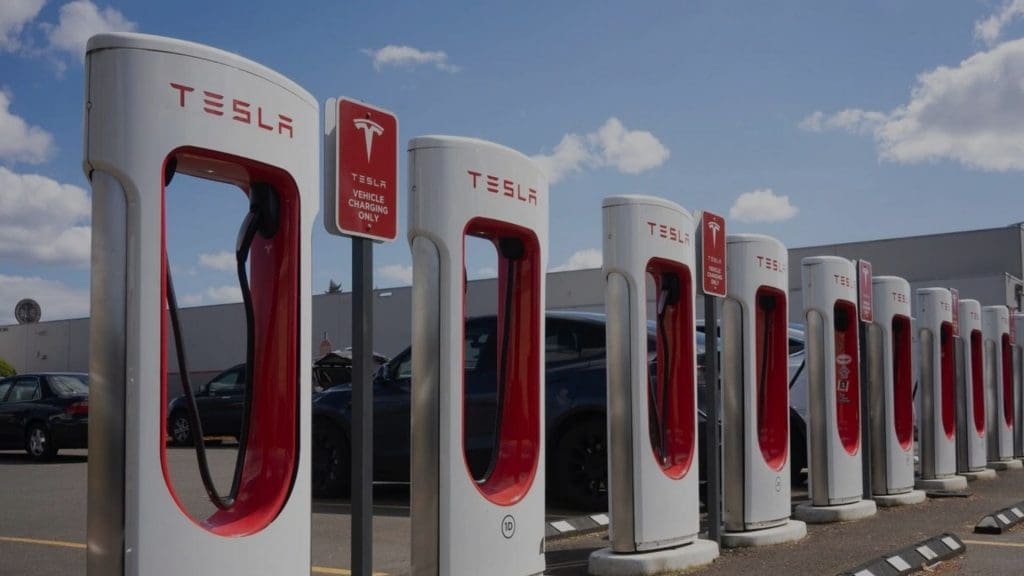
For a long time, the Tesla Supercharger network was the “walled garden” of the electric vehicle world, renowned for its reliability and speed, but restricted only to Tesla owners. However, that has changed. Tesla has opened hundreds of Supercharger stations across the UK, Europe, and North America to “Other EVs.”
If you drive a Ford, Hyundai, Volkswagen, or any other electric car, here is everything you need to know about accessing the world’s most reliable charging infrastructure.
- CCS Connection: Your car must have a CCS (Combined Charging System) port, which is the standard for most modern EVs in Europe and the UK.
- The App: You must use the Tesla smartphone app to initiate the session.
Step-by-Step: How to Charge Your Non-Tesla at a Supercharger
Charging a non-Tesla is slightly different than the “plug-and-play” experience Tesla owners enjoy. Follow these steps:
1. Download the Tesla App
Before you head to a station, download the Tesla app (available on iOS and Android) and create an account. You will need to add a valid payment method (credit or debit card) to your profile.
2. Locate a Compatible Station
Open the app and select “Charge Your Non-Tesla.” This will show you a map of Supercharger sites that are open to all vehicles. Do not simply drive to the nearest Tesla station, as many remain exclusive to Tesla vehicles.
3. Park and Plug In
Once you arrive, park at an available stall.
Pro Tip: Tesla’s charging cables are notoriously short because Tesla cars all have charging ports in the same location (rear-left). If your car’s port is in a different spot, you may need to park creatively. Be careful not to block adjacent stalls if the station is busy.
4. Initiate the Charge
In the Tesla app:
- Select the correct Supercharger site.
- Find the Stall Number (located at the base of the charger).
- Select that stall in the app and tap “Start Charging.”
- Plug the CCS cable into your car.
5. Monitor and Stop
You can track your charging speed and battery percentage directly in the Tesla app. To finish, simply tap “Stop Charging” in the app and return the cable to the holster.
How Much Does it Cost?
Tesla Supercharging for non-Tesla owners is generally more expensive than for Tesla owners. This “premium” helps Tesla maintain the network while managing the extra demand.
- Pay-as-you-go: You pay a higher rate per kWh.
- Membership Option: If you charge frequently, you can pay a monthly subscription fee (approx. £10.99/€12.99). This lowers the price per kWh to the same rate Tesla owners pay, which can save you significant money on long road trips.
The V3 and V4 Difference
Most open stations use V3 Superchargers (up to 250kW). However, Tesla is now installing V4 Superchargers. These are even better for non-Tesla owners because they feature:
- Longer cables: Easier to reach charging ports on the “wrong” side of the car.
- Contactless payment screens: Allowing you to tap a card without using the app.
Common Etiquette and Issues
- Cable Reach: If your charging port is on the front-right or front-left, you might find the cable barely reaches. Always try to park in a way that uses only one bay.
- Charging Speeds: Some 800-volt cars (like the Hyundai Ioniq 5 or Kia EV6) may charge slower at Tesla Superchargers than they do at other ultra-rapid chargers due to how the Tesla hardware interacts with their battery systems.
Summary
The opening of the Tesla Supercharger network is a game-changer for EV adoption. It provides non-Tesla drivers with a massive safety net of reliable, high-speed chargers. By downloading the app and planning your route, you can significantly reduce “range anxiety” on your next long journey.
Frequently Asked Questions (FAQs)
Which non-Tesla cars can use Superchargers?
Any EV with a CCS charging port can use the “Open to Non-Tesla” stations. This includes models from Audi, BMW, Ford, Hyundai, Kia, Mercedes, Polestar, Peugeot, and Vauxhall.
Do I need an adapter?
In the UK and Europe, no adapter is needed as Tesla uses the standard CCS2 plug. In North America, some older sites require a “Magic Dock” adapter, which is built into the Tesla stall.
Is Tesla charging cheaper than IONITY or BP Pulse?
With a monthly membership, Tesla Superchargers are often among the cheapest ultra-rapid charging options available. Without a membership, the prices are competitive with other major networks.
Related on ONEEV:
External references: