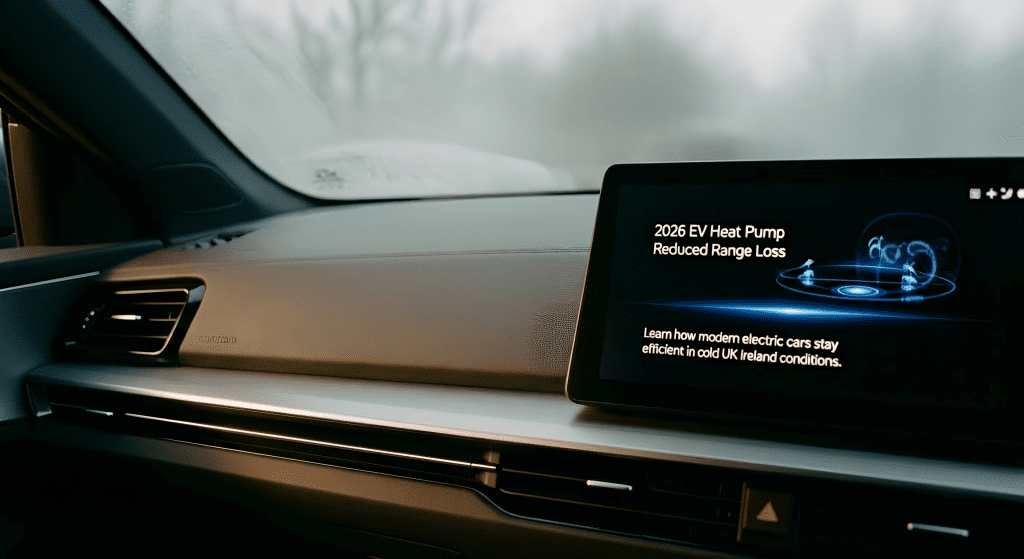
February in the UK and Ireland brings a familiar EV moment. Frost on the windscreen, cold air biting, and a dashboard range figure that looks far less optimistic than it did in July.
In the early days of electric motoring, winter was a season of compromise. Cabin heat came at the expense of miles, and “winter range anxiety” was a real thing. As we move through 2026, that problem is quietly disappearing thanks to one unsung technology hero: the heat pump.
If you are driving a 2026 model-year electric vehicle, you are already benefiting from an efficiency revolution that keeps you warm without draining your battery. Here is how it works, and why it matters more in the UK and Ireland than almost anywhere else in Europe.
What Is a Heat Pump, and Why Should EV Drivers Care?
Early electric cars relied on resistive heating to warm the cabin. In simple terms, this worked like an oversized hair dryer, pulling large amounts of electricity directly from the driving battery. The result was instant warmth, but at a heavy range cost.
A heat pump works very differently. It operates like a refrigerator in reverse, scavenging waste heat from the battery, electric motors, and power electronics. Even in cold conditions, it can extract thermal energy from outside air and move it efficiently into the cabin.
The 2026 efficiency leap is significant. Modern EV heat pumps now operate at around 300 to 400 percent efficiency. For every 1 kW of electricity consumed, they generate between 3 kW and 4 kW of heat.
The real-world result is a winter range improvement of roughly 5 to 12 percent on cold UK mornings compared with EVs that still rely on resistive heating alone.
The 2026 Heat Pump Heroes
By 2026, heat pumps are no longer niche add-ons or part of expensive “winter packs”. Most major manufacturers now fit them as standard equipment, and some systems have become genuine benchmarks.
- :contentReference[oaicite:0]{index=0} and :contentReference[oaicite:1]{index=1} (2026 refresh)
Tesla’s Octovalve thermal system remains an industry reference point, intelligently shuffling heat between the drivetrain, battery, and cabin to minimise energy waste. - :contentReference[oaicite:2]{index=2}
Already famous for its aerodynamics, the 2026 update improves battery thermal management, keeping cells close to their optimal temperature even when parked overnight in cold Irish suburbs. - :contentReference[oaicite:3]{index=3}
One of the strongest performers in recent UK winter testing, the EQE loses only around 20 percent of its range in sub-zero conditions, an impressive figure in the luxury EV segment.
Why UK and Irish Winters Are a Special Case
In much of the UK, Ireland, and the west of England, winter range loss is rarely caused by deep freezing temperatures alone. Instead, it is the combination of damp air, wind, and moderate cold that creates the biggest efficiency drain.
High humidity means more energy is needed to demist windscreens and maintain visibility. Wind chill increases thermal losses, especially on motorway journeys.
Practical 2026 tip: If you commute alone, use your vehicle’s “Driver Only” climate mode. This focuses the heat pump’s output on the driver’s seat and footwell, reducing overall energy consumption while keeping comfort high.
Pre-Conditioning: The Software Advantage
The most powerful winter range tool in 2026 is not just hardware. It is software.
Pre-conditioning allows you to warm both the cabin and the battery while the vehicle is still plugged into your home charger. This uses grid electricity rather than stored battery energy.
When you set off, the heat pump only needs to maintain temperature rather than generate heat from cold components. The result is stronger initial efficiency, better regenerative braking, and noticeably improved winter range.
Is a Heat Pump Worth It in 2026?
If you are buying a used EV or a lower-cost model where a heat pump is still optional, the answer for UK and Irish drivers is clear.
With average winter temperatures sitting between 2°C and 10°C for nearly half the year, a heat pump pays for itself through reduced charging costs, improved winter usability, and stronger resale value. In most cases, the financial break-even point arrives well within three years.
More importantly, it removes one of the last psychological barriers to electric driving. Winter no longer means compromise. It simply means switching on the heater and carrying on as normal.
Watch: Your EV video hub from youtube