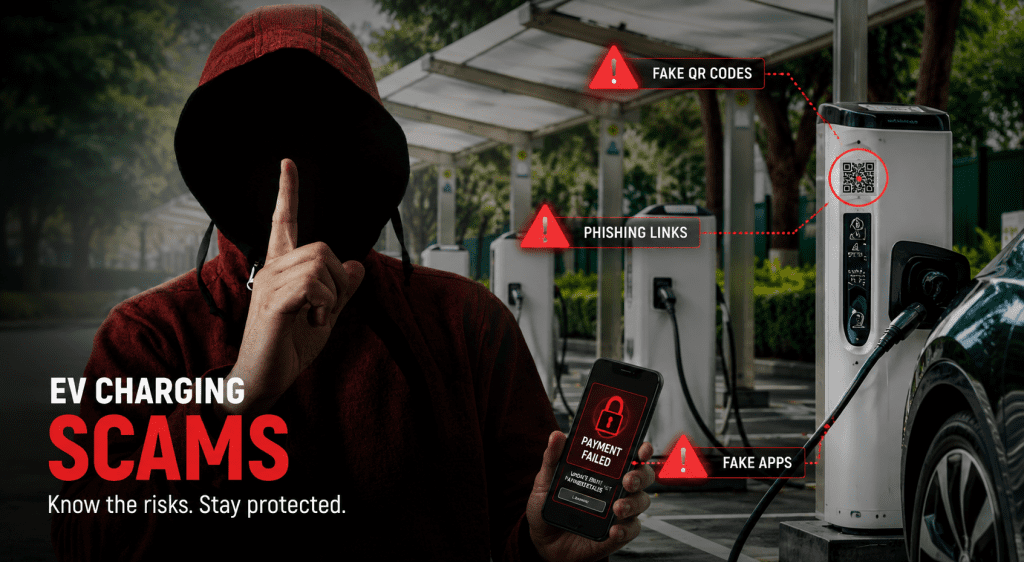
Public EV charging should feel simple, safe and stress-free. You find a charger, plug in, start your session and get back on with your day. Unfortunately, as EV adoption grows across the UK, fraudsters are also looking for new ways to target drivers who rely on apps, QR codes, payment links and digital charging accounts.
Most public charging sessions are completely safe. The risk usually appears when drivers are pushed away from trusted apps and official payment routes towards fake QR codes, cloned websites, suspicious messages or unrealistic membership offers.
This guide explains the main EV charging scams UK drivers should know about, how to spot the warning signs, and how to protect your money, personal data and charging account before you plug in.
Why EV charging scams are becoming more common
EV charging now combines public infrastructure, mobile payments, digital wallets, location services, user accounts and connected technology. That creates convenience for drivers, but it also gives scammers more opportunities to imitate trusted brands or trick people into entering payment details on fake pages.
Many scams also rely on urgency. You may be parked at a charger, running low on battery, trying to get home, or dealing with children, work or travel plans. That is exactly when a fake QR code, suspicious payment page or cloned app can catch people out.
1. Fake QR codes on EV charge points
One of the most common risks for EV drivers is QR code tampering. This is sometimes known as “quishing”, which means phishing using a QR code.
Fraudsters may place a fake QR code sticker over the genuine one on a charge point. When a driver scans it, they are taken to a fake website that looks like a real charging payment page. The page may ask for card details, account information or personal data, but the money and information go to the scammer instead.
Warning signs to look for
- The QR code looks like a sticker placed over another label.
- The edges are peeling, uneven or poorly aligned.
- The website address looks unusual, misspelt or unrelated to the charging network.
- The payment page asks for more information than seems necessary.
- The branding looks low quality or slightly different from the operator’s normal branding.
How to stay safe
Before scanning any QR code on a public charger, check the label carefully. If it looks tampered with, avoid using it and report it to the charge point operator. Where possible, use a trusted EV charging app instead of relying on a QR code stuck to the charger.
With ONEEV, drivers can find chargers, start and stop supported sessions, and pay securely in-app. That helps reduce reliance on unknown QR codes and unfamiliar payment pages.
2. Fake EV charging apps
Another risk is the cloned app. Scammers may create an app that looks similar to a genuine EV charging app, using copied logos, familiar colours or similar wording. The aim is to get drivers to enter login details, payment information or personal data.
Some fake apps may also ask for unnecessary permissions, such as access to contacts, files or other sensitive areas of your phone. A legitimate EV charging app should only request permissions that are relevant to charging, location, payment and app functionality.
How to stay safe
- Download EV charging apps only from the Apple App Store or Google Play Store.
- Check the developer name before installing.
- Read recent reviews and look for warning signs from other users.
- Avoid downloading apps from links in unsolicited emails, adverts or text messages.
- Be cautious if an app asks for permissions that have nothing to do with EV charging.
3. Phishing emails and text messages
Scammers may send emails or text messages pretending to be from an EV charging provider. These messages often create urgency by claiming that your account has been suspended, a payment has failed, your card needs updating, or you have won free charging credit.
The message usually includes a link to a fake website. Once there, you may be asked to enter your login details, bank card information or personal data.
Warning signs to look for
- Unexpected messages asking you to act immediately.
- Spelling mistakes, poor grammar or unusual formatting.
- Links that do not match the official website of the company.
- Messages asking for card details, passwords or security codes.
- Offers that seem too good to be true.
How to stay safe
Do not click links in unexpected emails or text messages. Open the official app or website directly instead. If you are unsure, contact the company through its official support channel.
Suspicious emails can be forwarded to report@phishing.gov.uk. Suspicious text messages can be forwarded to 7726, which is the free UK reporting number used by most mobile providers.
4. Fake charging station listings
Some scams involve fake or misleading charging station listings. A driver may see a charger listed online, follow directions to the location and then be pushed towards a payment page, website or app that is not genuine.
In other cases, the charger may exist but the payment method being promoted nearby is not connected to the legitimate operator.
How to stay safe
- Use trusted EV charging apps to confirm charger locations.
- Check recent driver feedback where available.
- Look for clear operator branding on the charger.
- Be cautious if a charger has no support number, no operator name or unclear pricing.
- Avoid any charging point that asks for unusual payment methods such as gift cards, crypto or bank transfer.
5. Fake subscription or membership offers
Fraudsters may advertise fake EV charging memberships that promise huge discounts, exclusive access or unusually cheap charging. These offers may appear on social media, in search ads, by email or through cloned websites.
The real aim is usually to collect your personal details or card information. Once submitted, those details can be used for unauthorised payments or sold to other criminals.
How to stay safe
Be careful with offers that rely on pressure tactics, unrealistic savings or immediate payment. Always verify the company before signing up and avoid using links from unsolicited adverts or messages.
ONEEV is subscription free. Drivers can use the app without being pushed into a monthly charging membership.
6. RFID card risks
RFID cards can be convenient, but they are still physical access tools. If a card is lost, stolen or misused, it may create an opportunity for unauthorised charging activity depending on the network and account controls in place.
Drivers who use RFID cards should treat them carefully, just as they would treat a bank card or fuel card.
How to stay safe
- Keep RFID cards secure.
- Report lost or stolen RFID cards immediately.
- Review your charging history regularly.
- Use secure app-based payments where available.
Why secure in-app payment matters
A trusted EV charging app can reduce several common scam risks because the driver does not need to rely on unknown QR codes, unfamiliar payment pages or multiple charger-specific accounts.
With ONEEV, drivers can search for charge points, check key charger information, start and stop supported charging sessions, pay securely in-app and view their receipts and charging history in one place.
That does not mean drivers should stop being cautious. It means the charging experience becomes more controlled, more transparent and less dependent on risky workarounds.
EV charging scam safety checklist
- Inspect QR codes before scanning.
- Do not use QR codes that look like stickers placed over another code.
- Check the website address before entering payment details.
- Use official apps and trusted charging platforms.
- Download apps only from Apple App Store or Google Play Store.
- Be wary of emails or texts asking you to update payment details urgently.
- Never pay by gift card, crypto or bank transfer for public EV charging.
- Check charger pricing before starting a session.
- Review receipts and payment history after charging.
- Report suspicious activity to the operator and relevant fraud reporting services.
What to do if you think you have been targeted
If you think you have scanned a fake QR code, entered details into a suspicious website or downloaded a fake app, act quickly.
- Contact your bank immediately if payment details were entered.
- Change your password if you entered login details.
- Remove any suspicious app from your phone.
- Report suspicious emails to report@phishing.gov.uk.
- Forward suspicious text messages to 7726.
- Report fraud or attempted fraud through the official UK fraud reporting routes.
- Tell the charge point operator if you suspect a charger has been tampered with.
Final thought: charge smart, not scared
EV charging scams are a real risk, but they should not make drivers afraid of public charging. The best protection is awareness. Take a few seconds to check the charger, verify the payment route and use trusted apps wherever possible.
Public charging should be simple, secure and transparent. That is exactly why ONEEV is built around secure in-app payments, clear charging information, no subscriptions and a better experience for UK EV drivers.
Charge with more confidence using ONEEV
Find EV chargers, start and stop supported sessions, pay securely in-app and keep your charging history in one place. No subscriptions. No unnecessary RFID cards. Just simpler EV charging.