Quick Summary
Switching to an electric vehicle is one of the biggest changes many UK drivers will make this decade. Modern EVs offer lower running costs, quieter driving, instant torque and access to a rapidly growing charging network.
However, the first year of ownership comes with a learning curve. New charging habits, new terminology and new technology can feel unfamiliar at first.
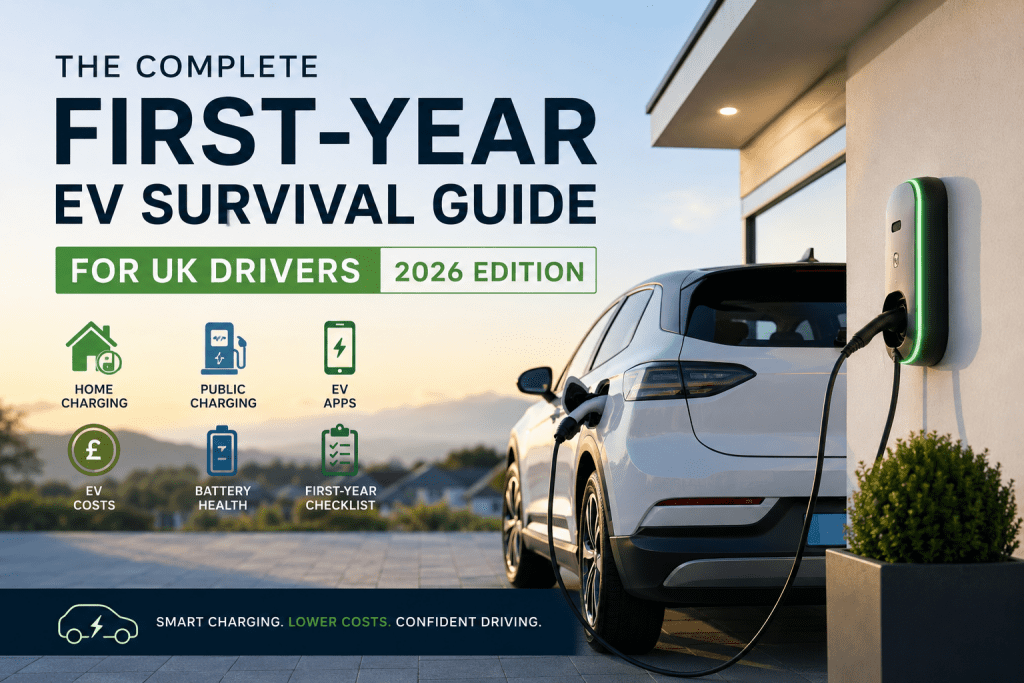
This guide covers:
- Home charging
- Public charging
- The apps you actually need
- The real costs of EV ownership
- Battery health and longevity
- Your first-year EV checklist
Whether you have just collected your first EV or are considering making the switch, this guide will help you avoid common mistakes and gain confidence quickly.
Chapter 1: Home Charging – The Foundation of EV Ownership
The single most important thing to understand about EV ownership is that most charging happens at home.
For many UK EV drivers, between 80% and 90% of charging takes place overnight while they sleep. Get home charging right and the rest of EV ownership becomes significantly easier.
Three-Pin Plug vs Dedicated Home Charger
Although it is possible to charge an EV from a standard three-pin socket, it should only be considered an emergency or occasional solution.
A standard domestic socket delivers around 1.4kW of power. Charging a typical 60kWh battery from near empty can take more than 40 hours.
A dedicated 7kW home charger dramatically improves the experience. Most EVs can be charged from 20% to 80% overnight, meaning you start every day with a practical driving range and minimal effort.
Understanding OZEV Grants
Government support remains available for some drivers.
As of 2026, homeowners with private driveways generally fund installations themselves. However, renters, flat owners and landlords may still qualify for support through the OZEV EV Chargepoint Grant scheme.
Always check the latest eligibility requirements through official government guidance before installation.
The Tariff Matters More Than The Charger
One of the biggest surprises for new EV drivers is that choosing the right electricity tariff often saves more money than the installation grant itself.
Many EV-specific tariffs offer overnight charging rates significantly below standard electricity prices. This can reduce charging costs to only a few pence per mile.
Over a full year of driving, those savings can easily exceed the value of the charger installation itself.
What To Look For In A Home Charger
- 7kW charging capability
- Smart scheduling functionality
- Tariff integration
- OZEV approval where applicable
- Tethered or untethered configuration depending on preference
Home charging remains the cheapest and most convenient way to own an EV.
Chapter 2: Understanding Public Charging
Even if most charging happens at home, understanding the public charging network is essential.
Public charging enables longer journeys, supports drivers without home charging and provides reassurance when travelling.
The UK now has more than 119,000 public charging devices across more than 46,000 locations, making it easier than ever to drive electric.
Understanding Charger Types
Slow & Fast Chargers (3–22kW)
Typically found at supermarkets, workplaces, hotels and public car parks. Best suited to longer stays.
Rapid Chargers (50–150kW)
The workhorses of the public charging network and ideal for long-distance travel.
Ultra-Rapid Chargers (150kW–350kW+)
The fastest chargers available today. Often found at motorway services and dedicated charging hubs.
The Networks You Will Encounter
UK charging remains fragmented across multiple operators including:
- BP Pulse
- InstaVolt
- Osprey
- Gridserve
- Shell Recharge
- Pod Point
- Believ
- Mer
- Blink
- Char.gy
The Reliability Reality
Modern regulations require rapid charging networks to achieve high reliability standards.
However, network-wide averages do not guarantee that a specific charger will be operational when you arrive.
This is why checking live availability before travelling is so important.
Platforms such as ONEEV help drivers verify charger status before setting off, reducing uncertainty and helping drivers charge with confidence.
Reliability Anxiety vs Range Anxiety
Many drivers no longer worry about whether their battery will get them to a charger. Instead, they worry about whether the charger will work when they arrive.
This shift from range anxiety to reliability anxiety is one of the biggest changes in EV ownership today.
Accurate charger information, live status updates and transparent pricing all help solve this challenge.
Chapter 3: The Apps You Need – And The Ones You Do Not
Many new EV drivers start by downloading multiple charging apps. Before long they have numerous accounts, passwords and payment methods spread across several charging networks.
There is a simpler approach.
Using A Unified Charging Platform
Rather than maintaining multiple charging network accounts, many drivers prefer a platform that combines charging locations, live availability, pricing and payment into a single experience.
ONEEV provides:
- Thousands of UK and Ireland charge points
- Live charger availability
- Transparent pricing
- Secure in-app payment
- Automated charging receipts
- No subscription fees
Learn more about the ONEEV App.
Your Vehicle Manufacturer App
Your vehicle manufacturer’s app remains useful for:
- Battery monitoring
- Vehicle status
- Pre-conditioning
- Charging schedules
- Remote climate controls
Your Home Charger App
If you own a smart home charger, the accompanying app will help manage charging schedules and optimise costs using off-peak tariffs.
For most drivers, those are the only apps they genuinely need.
Chapter 4: The Real Costs Of Going Electric
One of the most common questions prospective EV buyers ask is whether they will actually save money.
For most drivers, the answer is yes. However, where and how you charge makes a significant difference.
Home Charging vs Public Charging
Home charging on an EV tariff remains the cheapest way to power an electric vehicle.
Public rapid charging costs more but remains highly convenient for occasional long-distance journeys.
The key lesson is straightforward:
The cost of EV ownership depends heavily on where you charge.
Maintenance Costs
Electric vehicles have fewer moving parts than petrol or diesel vehicles.
- No oil changes
- No clutch replacements
- No exhaust systems
- Reduced brake wear due to regenerative braking
As a result, servicing costs are often lower than equivalent combustion vehicles.
Insurance
Insurance premiums vary significantly between models.
While EV insurance was historically more expensive, increased competition and wider insurer experience have narrowed the gap considerably.
Always compare quotes rather than accepting automatic renewals.
Road Tax
Vehicle Excise Duty rules for EVs continue to evolve. Always check current government guidance when calculating ownership costs.
Chapter 5: Battery Health – The Truth About EV Batteries
Battery degradation remains one of the most misunderstood topics in electric vehicle ownership.
Many prospective buyers worry that the battery will quickly become unusable. Real-world evidence shows the opposite.
Most modern EV batteries degrade gradually and remain highly usable for many years.
How To Protect Battery Health
- Avoid charging to 100% every day unless needed for a journey.
- Keep the battery between 20% and 80% for routine use where practical.
- Avoid unnecessary repeated rapid charging.
- Use scheduled charging where possible.
- Pre-condition the battery before rapid charging when your vehicle supports it.
Understanding Battery Warranties
Most manufacturers provide battery warranties covering eight years or more, typically guaranteeing a minimum percentage of battery health.
This provides reassurance for new EV buyers and demonstrates manufacturer confidence in battery technology.
The Future Of EV Batteries
Battery technology continues to improve rapidly. Energy density, charging speeds, thermal management and durability all continue to advance.
For most drivers, battery longevity should not be a major concern during ownership.
Chapter 6: Your First-Year EV Checklist
Before Delivery
- Arrange home charging.
- Research EV electricity tariffs.
- Download the ONEEV app.
- Install your vehicle manufacturer’s app.
- Understand your vehicle’s charging speeds.
First Month
- Complete your first public charging session.
- Test route planning.
- Learn how charging speeds change as the battery fills.
- Set up charging schedules.
- Review your charging costs.
First Six Months
- Optimise charging habits.
- Understand your real-world range.
- Become familiar with longer journeys.
- Review electricity tariff options.
- Monitor tyre pressures regularly.
By The End Of Year One
Most drivers report that EV ownership becomes second nature. Charging becomes routine, range confidence improves and many wonder why they waited so long to make the switch.
Final Thoughts
The first year of EV ownership is largely about building confidence and developing new habits.
Once drivers understand home charging, public charging, charging costs and battery care, electric driving becomes remarkably straightforward.
The UK’s charging network continues to expand, EV technology continues to improve and ownership is becoming easier every year.
If you are beginning your EV journey, focus on learning the fundamentals, choose reliable charging solutions and remember that the vast majority of EV drivers would choose electric again.
To simplify public charging across the UK and Ireland, explore the ONEEV App, designed to help drivers find chargers, check live availability, see transparent pricing and pay securely in one place.
Frequently Asked Questions
What should a new EV driver know first?
The most important first step is understanding how you will charge. For most UK drivers, home charging is the cheapest and most convenient option, while public charging is mainly used for longer journeys or when home charging is not available.
Do I need a home charger for an electric car?
You do not legally need a home charger, but a dedicated 7kW charger makes EV ownership much easier, faster and more convenient than relying on a standard three-pin plug.
How much does it cost to charge an EV in the UK?
The cost depends on where you charge. Home charging on an EV tariff is usually the cheapest option, while rapid and ultra-rapid public charging normally costs more because it offers faster charging and greater convenience.
Do I need lots of EV charging apps?
No. Many drivers start with several apps, but a unified charging platform such as ONEEV can help reduce the need for multiple network accounts by bringing charger search, live availability, pricing and payment into one place.
How do I protect my EV battery?
For everyday use, avoid charging to 100% unless needed, keep the battery within sensible charge ranges where practical, avoid unnecessary repeated rapid charging and use scheduled charging when available.
Is public EV charging reliable in the UK?
The UK public charging network is expanding quickly, but reliability can vary by location and operator. Checking live charger availability before travelling helps reduce the risk of arriving at a charger that is unavailable or out of service.