The UK Government has published its response to the consultation on Electric Vehicle Excise Duty, commonly known as eVED.
Often described as an EV pay-per-mile tax, eVED is intended to introduce a mileage-based charge for fully electric and plug-in hybrid cars from April 2028.
However, electric car drivers should understand an important distinction. The government has confirmed its intention to introduce eVED and has outlined how it expects the system to operate, but several parts of the detailed design are still being developed.
Draft legislation has been published for technical consultation, while further work is continuing on the supporting DVLA systems, refunds, enforcement, appeals and optional connected-vehicle technology.
This guide explains what has been announced, how the proposed system could work and which important details are still subject to further development.
What is Electric Vehicle Excise Duty?
Electric Vehicle Excise Duty is the government’s proposed mileage-based tax for fully electric and plug-in hybrid cars.
The government says the current motoring tax system needs to change as more drivers move from petrol and diesel vehicles to electric alternatives. Petrol and diesel drivers currently contribute through fuel duty, with the amount paid broadly linked to the quantity of fuel they use.
In its official consultation response, the government states:
“As the transition to electric vehicles accelerates, fuel duty receipts are set to decline to near zero by 2050.”
The government’s current position is that eVED will take effect from April 2028.
How much will electric car drivers pay?
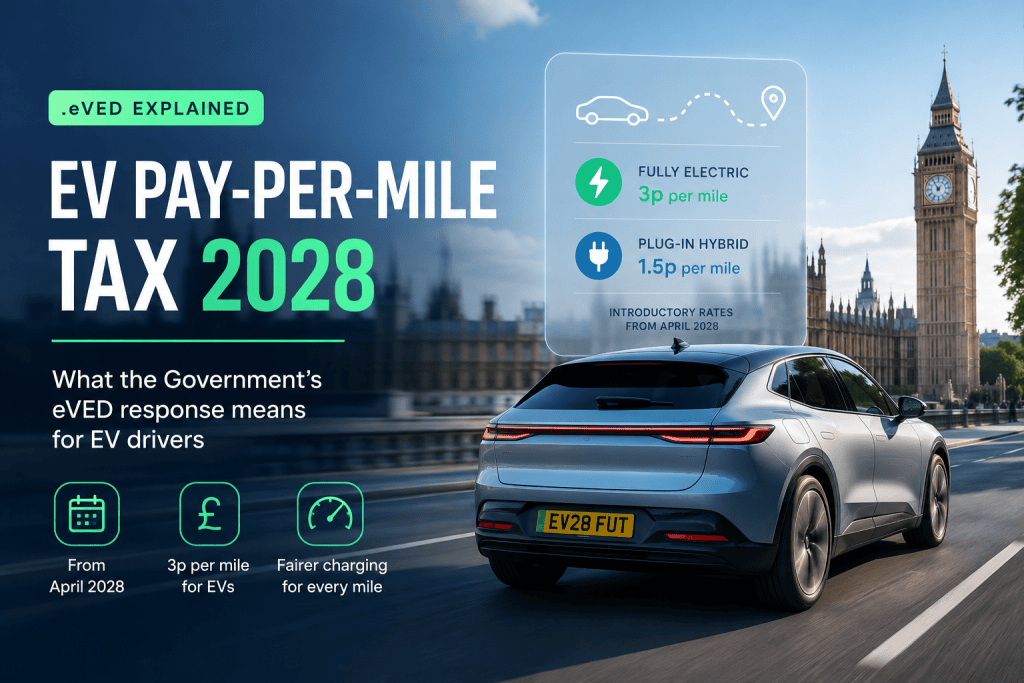
The proposed introductory rates are:
- 3 pence per mile for fully electric cars
- 1.5 pence per mile for plug-in hybrid cars
The government says the fully electric rate will initially be half the equivalent rate of fuel duty, while plug-in hybrids will pay a lower rate because their drivers may also pay fuel duty when using petrol or diesel.
The table below provides some simple examples based on the proposed introductory rates.
| Annual mileage | Fully electric car at 3p per mile | Plug-in hybrid at 1.5p per mile |
|---|---|---|
| 5,000 miles | £150 | £75 |
| 7,500 miles | £225 | £112.50 |
| 10,000 miles | £300 | £150 |
| 15,000 miles | £450 | £225 |
These examples show the proposed eVED charge only. They do not include existing Vehicle Excise Duty, charging costs, insurance or other vehicle expenses.
The government has also said that eVED rates will be increased in line with inflation from 2029–30, meaning the cost per mile is not expected to remain permanently fixed at the introductory rates.
Is the EV pay-per-mile tax definitely happening?
The government has clearly stated its intention to introduce eVED.
Its consultation response says:
“The government remains committed to introducing eVED from April 2028.”
However, this does not mean every detail has been finalised or that the complete system is already in law.
The government also states:
“The government will introduce eVED from April 2028 and will continue to develop the detailed design of the system ahead of implementation.”
Draft legislation has been published for technical consultation. The government must also build the necessary DVLA systems and finalise areas including refunds, penalties, appeals, dispute resolution and connected-car mileage reporting.
The most accurate description is therefore that the government has confirmed its intention and proposed framework, but several operational details remain subject to further development.
How is eVED expected to work?
Under the current proposal, eVED would operate through the existing Vehicle Excise Duty system.
When renewing their vehicle tax, the registered keeper would provide:
- the vehicle’s current odometer reading;
- an estimate of the mileage expected during the next licensing period; and
- payment for the estimated eVED liability.
The DVLA would calculate the amount due by multiplying the estimated mileage by the applicable eVED rate.
The government explains:
“At each VED renewal, registered keepers will be required to provide an up-to-date mileage reading and estimate their mileage for the year ahead so that DVLA can calculate an estimated eVED liability.”
The government says it will provide guidance and tools to help motorists estimate their annual mileage.
How will drivers pay eVED?
The government intends to offer the same general payment frequencies currently available for Vehicle Excise Duty.
Drivers are expected to be able to pay:
- monthly;
- every six months; or
- annually.
Existing payment channels, including the Electronic Vehicle Licensing service and participating Post Office branches, are also expected to be available.
Drivers paying monthly by Direct Debit should be aware that the government’s worked example refers to the existing 5% Direct Debit surcharge being applied.
What happens if you drive more miles than estimated?
Estimating future mileage will not always be straightforward. A driver’s circumstances can change because of a new job, relocation, family responsibilities, business travel or other unexpected events.
Under the government’s proposed system, drivers who expect to exceed their original estimate would be able to purchase additional mileage during the year.
The government states:
“Where motorists expect to exceed their original mileage estimate they will be able to top up their eVED mileage balance during the year at the prevailing eVED rate.”
This is intended to help drivers manage changes in their circumstances and reduce the possibility of facing a large balancing payment at the end of the licensing period.
Any additional mileage would be purchased at the rate applying when the top-up is made, rather than necessarily at the rate that applied at the beginning of the year.
What happens if you drive fewer miles than estimated?
If a driver covers fewer miles than they paid for, the government’s current proposal is for the unused mileage credit to normally be transferred to the next licensing period.
The consultation response states:
“Where motorists drive fewer miles than estimated, any resulting mileage credit will ordinarily be carried forward into the next licensing period and offset against future eVED liabilities.”
This means a routine overpayment may not automatically result in a cash refund.
The government has proposed a limited refund route where:
- the refund requested exceeds £100;
- the applicant has experienced an unforeseen change in financial circumstances; and
- the applicant declares that they are at risk of financial hardship.
The applicant would self-certify that the criteria have been met through an online DVLA application form.
Further refund arrangements are still being developed, including refunds connected with a change of keeper and other events during a vehicle’s lifecycle. The government has said that another update will be provided by the end of 2026.
Will new electric cars need separate mileage inspections?
This is one of the most significant changes made following the consultation.
The original proposal considered requiring vehicles below MOT age to attend additional mileage checks. Respondents raised concerns about the cost, inconvenience and administrative burden this could create for motorists, garages, fleets and leasing companies.
The government has now decided not to proceed with routine separate mileage checks for cars under three years old.
It states:
“The government has decided not to proceed with a requirement for vehicles under three years old to attend separate mileage checks.”
Instead, the keeper of a newer vehicle would provide the current odometer reading and estimate the coming year’s mileage at each VED renewal.
When the vehicle reaches its first MOT, the verified odometer reading could be compared with the mileage information previously submitted.
In Northern Ireland, the relevant period is four years because vehicles generally receive their first MOT later.
Will MOT mileage records be used?
Yes. Under the proposed system, mileage recorded during an MOT would support the verification and reconciliation process.
The government says:
“When a vehicle has an MOT, a verified odometer reading will be taken, which can be reconciled with the mileage readings provided by the vehicle keeper.”
The government expects motorists to provide accurate readings and reasonable estimates.
Where there is a reasonable suspicion of fraud or non-compliance, the DVLA would be able to require an official mileage inspection outside the normal MOT cycle, including for vehicles that have not yet reached MOT age.
Could your car automatically send its mileage to the DVLA?
Potentially, although the government says using connected-car data would be optional.
Many modern electric cars can transmit data through built-in 4G or 5G connectivity. The government intends to explore whether this existing technology could make mileage reporting quicker and more convenient.
Its response states:
“Making use of mileage data that cars already report will be optional.”
Drivers who choose to opt in could benefit from a quicker and more flexible process.
The government says it would only seek information required to administer eVED and that any connected-vehicle solution would need to comply with data protection requirements.
A further update on the proposed opt-in functionality is expected by the end of 2026.
Will the government track where EV drivers travel?
The proposed system is based on overall mileage rather than individual journey locations.
The government has ruled out charging different amounts based on where a person drives, citing privacy and administrative complexity.
Its response states:
“The government has ruled out charging tax based on where people drive, to protect motorists’ privacy.”
This means the proposed system would not routinely need to record whether a journey took place on a motorway, local road, private road or within a particular region.
However, it also creates an issue for motorists who drive outside the UK.
Will drivers pay eVED on miles travelled abroad?
Under the government’s current design, mileage travelled abroad in a UK-registered vehicle would still count towards the vehicle’s eVED liability.
The government argues that excluding overseas journeys would require additional location tracking or a separate system for proving where particular miles were travelled.
It estimates that overseas mileage represents only a small proportion of total UK car mileage and considers privacy and simplicity more important than establishing a process to deduct foreign travel.
This is likely to remain one of the more controversial parts of the proposed scheme, particularly for motorists who regularly drive between the UK and continental Europe.
What happens when an electric car is sold?
The treatment of eVED when a car changes ownership was a major concern during the consultation.
Under the government’s current proposal, the outgoing keeper would be able to settle an outstanding liability by purchasing additional mileage before transferring the vehicle.
Where the car has unused prepaid mileage, the credit would remain with the vehicle and pass to the new keeper.
The government states:
“Where there is a pre-paid mileage credit, this will transfer with the vehicle and the government expects the value of the credit to be reflected in the sale price of the vehicle.”
The DVLA Vehicle Enquiry service is expected to show whether a vehicle is subject to eVED and how much mileage has already been paid for.
A prospective buyer could then compare the paid mileage balance with the odometer reading before completing the purchase.
Automatic refunds when a car changes keeper will not be available when the system first launches under the current design. The government says it intends to support refunds in additional vehicle lifecycle situations in the future.
Which vehicles will be covered by eVED?
The proposed scheme will initially apply to UK-registered electric and plug-in hybrid cars.
The current vehicle categories include:
- fully electric cars, charged at 3p per mile;
- plug-in hybrid cars, charged at 1.5p per mile;
- hydrogen fuel-cell electric cars, charged at the fully electric rate; and
- range-extender electric vehicles, charged at the plug-in hybrid rate.
At launch, the government says vans, buses, coaches and heavy goods vehicles will be outside the scope of eVED.
Internal combustion engine cars that have subsequently been converted to electric power are also expected to be outside the initial scheme.
Will existing electric cars have to pay?
Under the government’s current proposal, eVED will not apply only to newly registered electric cars.
UK-registered electric and plug-in hybrid cars already on the road are expected to become liable from April 2028, subject to the final legislation and any stated exemptions.
This means motorists who bought an electric car before eVED was announced are not currently expected to be protected by a general exemption.
What support has the government announced for EV drivers?
The government says the wider package associated with the transition to electric vehicles includes more than £7.5 billion of investment over the next decade.
Measures identified in the consultation response include:
- additional funding for the Electric Car Grant;
- an increase in the threshold for the VED Expensive Car Supplement from £40,000 to £50,000 for new electric cars;
- additional investment in EV charging infrastructure;
- business rates relief for eligible charge points; and
- further support for the UK automotive industry.
The government says around 80% of the revenue raised during the first three years of eVED will underpin its package of measures supporting consumers and the automotive sector.
Why was the original proposal changed?
The consultation ran from 26 November 2025 until 18 March 2026 and received 5,133 responses.
The majority of responses came from individuals, alongside contributions from businesses, academics, automotive organisations, charities and public-sector bodies.
There was some support for the general principle that motorists who drive more should contribute more. However, respondents also raised concerns about:
- the potential effect on electric vehicle adoption;
- the additional tax burden on EV drivers;
- the difficulty of predicting annual mileage;
- administrative complexity;
- the treatment of plug-in hybrids;
- mileage travelled outside the UK;
- the effect on high-mileage and rural drivers;
- odometer tampering and fraud;
- refunds and vehicle sales; and
- the fairness of penalties and dispute processes.
The decision to remove routine additional mileage checks for cars below MOT age is one of the main changes resulting from the consultation.
Separate arrangements are also being developed for fleet, leasing and rental businesses, including bulk licensing, centralised mileage estimation and more flexible payment processes.
What details are still being developed?
Although the government has confirmed the intended start date and proposed introductory rates, several important areas have not yet been fully completed.
The next phase of government work includes:
- finalising the legislation;
- building the supporting DVLA systems;
- developing mileage estimation tools and guidance;
- finalising mileage verification arrangements with MOT garages;
- developing additional refund scenarios;
- confirming penalties, appeals and dispute procedures;
- creating processes for fleet and leasing companies; and
- exploring optional connected-car mileage reporting.
Drivers should therefore be cautious about reports suggesting that every part of the pay-per-mile system is already final.
The government has established a clearer proposed framework and remains committed to an April 2028 introduction, but some details remain subject to technical consultation, legislation and system development.
What does ONEEV think about eVED?
A sustainable and fair approach to motoring taxation is an important national discussion as the number of electric vehicles on UK roads continues to increase.
However, clarity, accessibility and simplicity must remain central to the development of eVED.
Estimating future mileage will not always be straightforward. Employment, commuting, family circumstances, health and business travel can all change during a vehicle’s licensing period.
The removal of separate mileage inspections for newer electric cars is a welcome reduction in the potential administrative burden. The ability to update mileage estimates during the year should also help drivers avoid unexpectedly large balancing payments.
Nevertheless, important questions remain around unused mileage credits, vehicle sales, overseas mileage, privacy, refunds and how easily drivers will be able to check and manage their eVED position.
The government must also ensure that the introduction of eVED does not undermine confidence in the transition to electric vehicles, particularly while many motorists who rely on public charging already pay more for energy than drivers with access to home charging.
ONEEV will continue to monitor the development of eVED and provide clear information as further legislation, guidance and technical details are published.
Preparing for the future of electric driving
There is no requirement for EV drivers to submit mileage information for eVED today. The proposed system is not expected to begin until April 2028.
For now, electric car owners should continue to follow the normal Vehicle Excise Duty and MOT requirements that apply to their vehicle.
Drivers can also keep up to date with the latest electric vehicle developments through the ONEEV Insights section.
For easier access to public EV charging, drivers can download the ONEEV app and find available charge points across the UK through one simple platform.
Frequently asked questions about eVED
When will EV pay-per-mile tax begin?
The government intends to introduce Electric Vehicle Excise Duty from April 2028. Draft legislation and detailed system development are still continuing ahead of implementation.
How much will fully electric cars pay per mile?
The proposed introductory rate is 3 pence per mile for fully electric cars. The government has said the rate will later be increased in line with inflation.
How much will plug-in hybrid cars pay?
Plug-in hybrid cars are expected to pay 1.5 pence per mile when eVED is introduced. Their reduced rate reflects the fact that drivers may also pay fuel duty when using petrol or diesel.
Will eVED replace normal road tax?
No. Under the current proposal, eVED will operate alongside the existing Vehicle Excise Duty system rather than replacing the standard VED charge.
Will I need a mileage tracker fitted to my electric car?
The government has not proposed a mandatory location-tracking device. Drivers are expected to provide odometer readings and mileage estimates. Connected-car reporting may be offered as an optional service.
Will cars under three years old need a separate mileage check?
No routine additional mileage check is currently planned for cars under three years old. Drivers would self-report their mileage until it can be verified through the first MOT. In Northern Ireland, the relevant period is four years.
What happens if I drive more than my estimate?
Drivers are expected to be able to top up their paid mileage during the year. Any additional mileage would be purchased at the eVED rate applying at that time.
What happens if I drive fewer miles than estimated?
Unused mileage credit would ordinarily be carried into the next licensing period and offset against future eVED liability. Wider refund arrangements are still being developed.
Will miles driven outside the UK count?
Yes. Under the current proposal, mileage driven abroad in a UK-registered car would still count because the government does not intend to track where individual journeys take place.
Will existing electric cars have to pay eVED?
Yes, under the current proposal. The scheme is expected to apply to UK-registered electric and plug-in hybrid cars, including vehicles registered before the tax was announced.
Sources and further reading
This article is based principally on the UK Government’s July 2026 response to the consultation on the introduction of Electric Vehicle Excise Duty.
- EVA England: The Drivers’ View on eVED
- Transport + Energy: Government Response to the eVED Consultation
Information was correct at the time of publication. The detailed eVED design remains under development and may change before the proposed April 2028 implementation date.