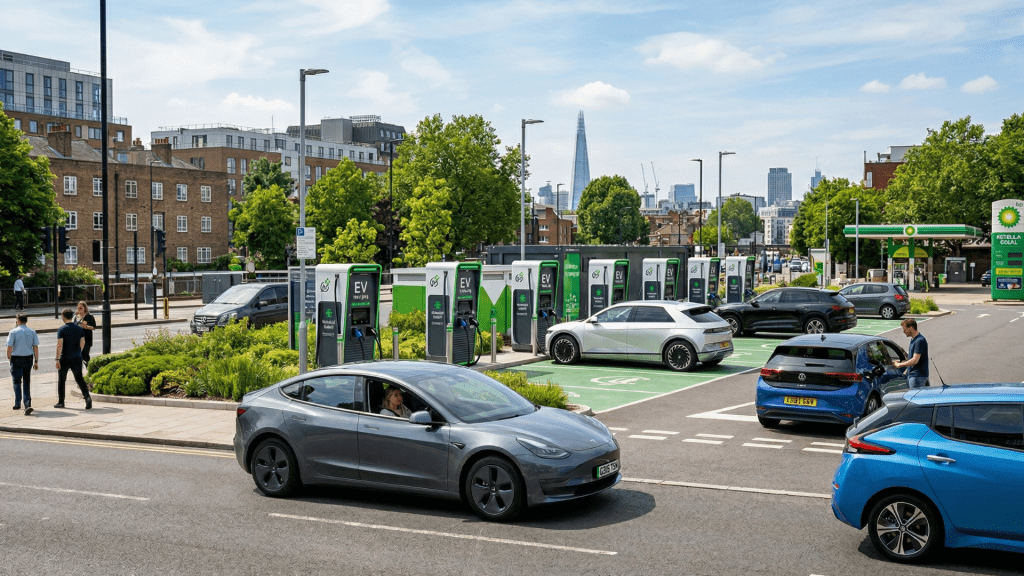
At some point in 2026, the UK passed a milestone that would have seemed extraordinary just a few years ago: there are now more public electric vehicle charge points than petrol station forecourts in the country.
It is a headline that should, in theory, close the conversation on EV charging anxiety. The infrastructure is there. The network has arrived. And yet many drivers still worry about charging, especially those who have never owned an EV.
That gap is revealing. The anxiety about charging infrastructure is real, but it is often decoupled from the reality of using it. Understanding why, and what genuinely fixes it, is what this guide is about.
Key point: the UK charging conversation in 2026 is no longer mainly about whether charge points exist. It is increasingly about whether drivers can trust the information they see before they arrive.
The state of the UK charging network in 2026
The numbers matter because they show just how quickly the public network has matured. As of early 2026, the UK had more than 118,000 public charge points installed, with the network continuing to expand across cities, towns, motorway services, retail destinations, workplaces, and on-street locations.
118,000+ public charge points across the UK in early 2026
22% increase since October 2024
Around 22% classed as rapid or ultra-rapid
13% network growth during 2025 alone
More public charging locations than petrol station forecourts in the UK
That final point is worth pausing on. Petrol stations have defined British road travel for generations. The EV charging network has reached comparable national coverage in a much shorter period, and it is still expanding.
The government’s longer-term target remains 300,000 public charge points by 2030. That means the network is still in a major build-out phase, but it is already far beyond the early-adopter stage that many people still imagine. For a wider look at where public charging is heading, see our guide to how to find EV charging stations near you in the UK.
So why are so many drivers still anxious?
Here is the paradox. The infrastructure is genuinely there, and the data supports that. Yet charging anxiety remains one of the most persistent barriers to EV adoption among non-EV drivers.
The reason is not simply the number of charge points. It is trust. Drivers do not just want a pin on a map. They want confidence that the charge point is really there, really available, correctly priced, and actually working when they arrive.
When drivers are let down by bad information, they do not blame the data feed. They blame EV charging itself. That is why charging anxiety can survive even while the network grows at pace. The problem is no longer just network size. It is information quality.
What EV owners know that non-EV drivers do not
The 2026 data shows a sharp confidence divide between people who own EVs and people who do not. The more direct experience someone has with the public charging network, the more confident they become.
94% of EV drivers say public charging access in their area is good
63% of people who have test-driven an EV say the same
32% of non-EV drivers say the same
In other words, real experience closes the anxiety gap. Once drivers start using the network rather than imagining worst-case scenarios, confidence rises sharply.
That pattern also shows up in breakdown data. The fear of running out of charge gets far more media attention than its real-world frequency justifies. That does not mean planning no longer matters. It means the everyday ownership reality is calmer than the myth.
The real problem: data quality, not network size
This is where the conversation becomes more useful. The strongest barrier to charging confidence is often not whether a charger exists. It is whether the information about that charger can be trusted.
ONEEV was built around that exact problem. Founders Lyndon and Tim understood early that drivers were being frustrated by stale locations, broken units shown as live, and pricing information that did not reflect reality. They focused on building better data systems, stronger verification, and more dependable real-time charging information.
That is the difference between a network that looks good on paper and one that actually feels usable in day-to-day life. If a driver can trust what they see in the app, confidence rises. If they cannot, anxiety remains, regardless of how many charge points have been installed.
Regional variation: is the network spread evenly?
One fair criticism of the UK charging network is that coverage is not uniform. Major cities including London, Manchester, Birmingham, and Edinburgh generally have stronger density than many rural areas across England, Scotland, Wales, and Northern Ireland.
However, that gap is narrowing. Government investment through the Local Electric Vehicle Infrastructure fund is aimed specifically at underserved areas and places where on-street charging matters most.
For rural drivers and people making longer trips, route planning still matters more than it does in a dense urban network. That is why tools that show live availability and real-time pricing are more valuable than static maps. If you want a practical view of planning charging away from home, read five ways ONEEV can help you find and pay for EV charging.
The motorway network: meeting long-distance demands
Motorway services remain the most scrutinised part of the charging network, because this is where drivers feel most exposed if a charger is unavailable. That is also why motorway charging has improved so visibly.
Major service operators have invested heavily in multi-bay rapid and ultra-rapid hubs designed to serve multiple cars at once. That has helped reduce the queuing and single-point failure problems that defined earlier years of the network.
The shift towards 150kW and 350kW charging also changes the psychology of long-distance driving. Public charging no longer needs to feel like a prolonged stop. Increasingly, it feels like a practical pause in the journey.
Charge points that work: what to look for
1. Check the connector type
Most modern EVs in the UK use Type 2 for AC charging and CCS for DC rapid charging. Make sure your car matches what the charger offers before travelling, especially on longer journeys.
2. Understand pay-as-you-go versus member pricing
Some networks offer cheaper tariffs for registered users, while others operate more simply on a pay-as-you-go basis. Drivers should know the likely price before they plug in, not after.
3. Look for contactless and app flexibility
Public charging has become easier as payment rules have improved. Drivers should not feel trapped into creating unnecessary accounts just to access a public charger.
4. Report broken chargers when you find them
Broken units affect more than one journey. Reporting issues helps operators improve reliability and helps other drivers avoid unnecessary frustration.
The future of UK charging infrastructure
The direction of travel is strongly positive. Higher-powered charging, broader regional coverage, easier payment standards, and continuing private investment all point towards a network that will be faster, more visible, and easier to trust.
More drivers are already relying on public charging every month, and a growing share of sessions now happen at rapid and ultra-rapid sites. The future is not just more chargers. It is a better charging experience.
That matters because the shift to EVs will not be won purely by infrastructure headlines. It will be won by everyday confidence, and that comes from accurate information, smoother payments, and fewer unwanted surprises.
Frequently asked questions
How many public charge points are there in the UK in 2026?
There are more than 118,000 public charge points installed across the UK in early 2026, and the government’s long-term target remains 300,000 by 2030.
Are there more EV charge points than petrol stations in the UK?
Yes. In 2026 the UK reached the milestone of having more public EV charge points than petrol station forecourts.
How do I find working EV charge points near me?
The best approach is to use a charging app that shows live availability, real-time pricing, and dependable location data rather than relying on static listings alone.
Is the UK charging network reliable?
Overall, reliability has improved significantly. The main frustration for many drivers is now inconsistent information rather than the absence of charge points altogether.
Do I need a membership to use public charge points in the UK?
No. Many public chargers now support simpler payment options, including contactless on qualifying sites, though some networks may still offer lower member rates.
Conclusion
The UK’s EV charging network in 2026 is bigger, faster, and more accessible than at any point in its history. The headline is real: there are now more public charge points than petrol stations. That is not a future promise. It is the current reality.
The anxiety that persists among non-EV drivers is understandable, but it is increasingly a trust problem rather than an infrastructure problem. Drivers want confidence that the charger they choose is available, accurately priced, and ready to work when they arrive.
That is exactly the role ONEEV is built to play. Download ONEEV free on iOS and Android for live pricing, real-time availability, and a simpler charging experience across the UK and Ireland.