For years, family motoring carried an awkward assumption. If you needed proper space, proper seats, and proper practicality, you were expected to end up in something diesel, bulky, and about as emotionally inspiring as a garden shed. In 2026, that assumption looks properly dated. The electric family car has grown up, stretched out, and learned how to carry seven people without feeling like a compromise on wheels.
This is the year the big electric family car became a real category rather than a brave niche. There is now genuine choice for households that need more than five seats, more than token practicality, and more than a polite promise that the third row is “best for occasional use”. Some models are still better than others, of course, but the point is that the market has finally started taking larger families seriously.
In other words, the school run has been recharged. And for many families, the old diesel MPV now looks less like a necessity and more like an ageing habit.
Why 2026 matters for bigger electric families
- Kia’s EV9 has made the idea of a mainstream electric 7-seater feel properly normal.
- Hyundai’s IONIQ 9 brings lounge-like design and long-range confidence into the same conversation.
- Volvo’s EX90 shows that premium safety-focused families now have a genuine electric flagship.
- Peugeot’s E-5008 proves electric seven-seat practicality is moving beyond luxury-only territory.
- The segment now offers real variety in size, style, price, and family use case.
The family EV has finally become a proper size
One of the biggest reasons this segment feels so important in 2026 is that it kills off an old criticism in one blow. Electric no longer automatically means compact, cramped, or compromise-heavy. That stereotype belonged to an earlier phase of the market, when EVs were often designed to prove a point rather than support a busy household.
Today’s larger electric SUVs and people-carrying EVs are doing something much more useful. They are treating space as a core part of the product, not an apology. That means more realistic third rows, better access, more sensible luggage solutions, and interiors that feel designed around family life rather than around a press release.
For parents, that changes everything. You are no longer choosing between going electric and staying practical. You can increasingly have both.
Kia EV9: the one that changed the conversation
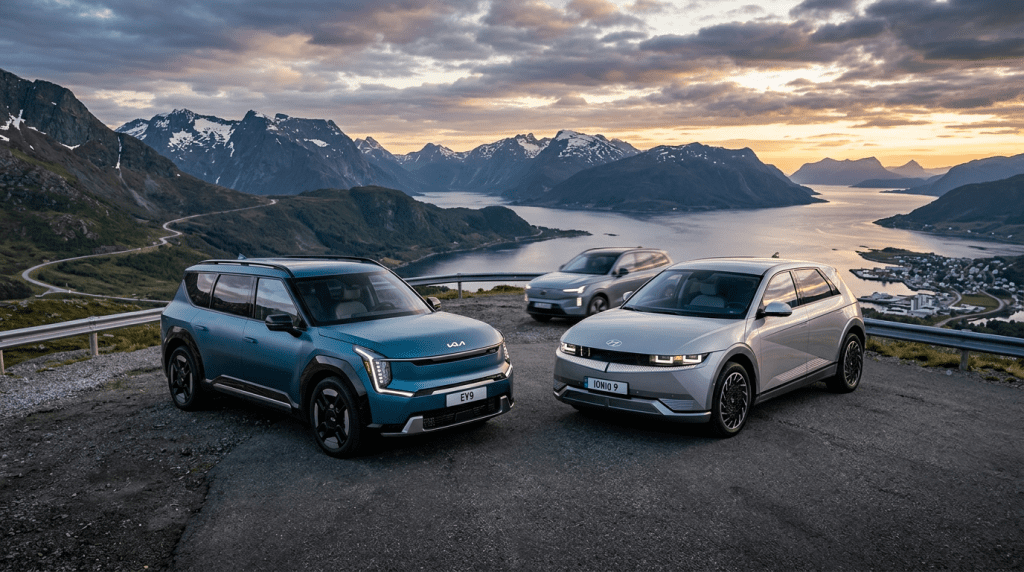
If there is a poster car for the rise of the electric 7-seater, it is the Kia EV9. Not because it was the first large electric SUV on the planet, but because it made the concept feel genuinely mainstream. Kia presents it in the UK as a three-row EV with seven seats as standard, and that matters. This is not some niche six-figure curiosity. It is a visible signal that the family EV market has stepped into a new phase.
The EV9 works because it understands what families actually need. Space, flexibility, and ease matter more than theatrical gimmicks. A roomy third row, sensible boot capacity, and a cabin that feels built for real people rather than design awards all help it land properly. It looks substantial, but it is the usability that gives it staying power.
In short, the EV9 is the car that stopped large electric family motoring from sounding like a future promise and made it feel like a present-day purchase.
Hyundai IONIQ 9: the lounge on wheels
Hyundai’s IONIQ 9 takes the family EV idea and gives it a more relaxed, more premium, almost lounge-like flavour. Hyundai quotes it at up to 385 miles in the UK, which immediately gives it the kind of long-range credibility big-family buyers want. Because once you are carrying children, bags, sports kit, and the general noise of family life, the last thing you want is a car that makes every weekend trip feel like a strategic exercise.
What makes the IONIQ 9 interesting is that it does not simply try to be huge. It tries to feel calm. That matters more than it sounds. Family cars spend a lot of time doing unglamorous work, and the best ones make that work feel easier. A strong range figure, a modern EV platform, and a cabin designed around comfort all help the IONIQ 9 feel less like a people bus and more like a genuinely desirable place to spend time.
For modern families, that combination of room, refinement, and range is exactly what makes the segment feel grown-up.
What families should really look for in an electric 7-seater
- Genuine third-row usability, not just emergency seats.
- Boot space that still works when all seats are in use.
- Range that fits weekends away as well as school-day routine.
- Easy access for children, grandparents, and all the usual family chaos.
- Charging speed and simplicity, because bigger family cars should reduce stress, not add to it.
Volvo EX90: premium family safety with serious range
For families who want something more premium and more safety-led, the Volvo EX90 deserves to be high on the shortlist. Volvo quotes the seven-seat EX90 at up to 383.4 miles WLTP in Twin Motor form, which is a serious number for a big three-row SUV. It means the car is not relying only on design or badge prestige to justify itself. It has the touring range to back up the family promise.
The EX90 feels important because it pushes the segment upwards without making it feel detached from family life. This is not simply a luxury object that happens to have seven seats. It is a car built around the idea that larger households may want electric space and Scandinavian calm without giving up long-distance confidence or a strong sense of safety.
That makes it one of the most complete premium family EVs currently shaping the conversation.
Peugeot E-5008: a sign the segment is broadening
The Peugeot E-5008 matters because it shows this market is no longer just a playground for premium-branded giants. Peugeot positions it as an all-electric large SUV with seven seats as standard, and quotes up to 347 miles WLTP. That makes it a very interesting option for families who need proper size but want something that sits outside the highest end of the price ladder.
This is how categories mature. They stop being defined by one or two halo products and start offering a proper spread of choices. The E-5008 helps make the seven-seat electric story look broader, more accessible, and more relevant to normal family budgets than it did a few years ago.
And that, frankly, is when a segment starts to become truly useful.
Other names families should not ignore
Not every family needs the biggest electric SUV on the market. Some will prefer a more compact footprint, a more premium badge, or a different shape altogether. Mercedes still offers the EQB with up to seven seats, which gives buyers a smaller electric SUV route into seven-seat ownership. Volkswagen’s longer-wheelbase ID. Buzz also continues to make a compelling case for families who want van-like roominess with a more playful personality.
Those alternatives matter because family life is not one-size-fits-all. Some households need an everyday urban-friendly footprint. Others want maximum luggage flexibility. Others still care as much about the feel of the cabin as they do about how many seats are technically available.
The important thing in 2026 is that you now have real options instead of one awkward electric compromise.
Why diesel family buses are losing their grip
- Modern electric 7-seaters now offer genuine space and long-distance credibility.
- Cabin design has improved dramatically, making these cars feel calmer and more premium.
- Charging networks and fast-charging capability reduce the stress of bigger journeys.
- Families can now choose electric without feeling forced into a tiny vehicle.
- The category now feels like a lifestyle upgrade, not a sacrifice.
The next challenge is not space. It is simplicity.
Once you can get the seats, the room, and the range, the conversation changes. Bigger families do not just need a large EV. They need an EV that is easy to live with. That means dependable route planning, simple charging, clear pricing, and less friction when life is already full of enough moving parts.
That is why practical charging support matters so much in this segment. Useful reads such as how to find EV charging stations near you in the UK, how to charge your EV in 4 easy steps, and five ways ONEEV can help you find and pay for EV charging become even more valuable when you are juggling a full family schedule.
The best family car is the one that takes strain out of life. In 2026, the best electric 7-seaters are finally starting to understand that.
Final word
The electric family car has grown up because it has finally learned the lesson big families always knew: space is not a luxury, it is the starting point. In 2026, the rise of the electric 7-seater means buyers no longer have to settle for diesel simply because they need room, flexibility, and everyday sanity.
From the Kia EV9 and Hyundai IONIQ 9 to the Volvo EX90 and Peugeot E-5008, the segment now feels broad enough, strong enough, and stylish enough to make the old diesel school-run bus look like yesterday’s answer to today’s family life.