If you are still picturing electric driving as a careful exercise in charger maths, 2026 would like a quiet word. The latest generation of EVs is not merely stretching range figures a little further. It is reshaping the entire conversation around what long-distance electric driving feels like. The old image of nervously watching the battery percentage on the M1 is giving way to something far calmer, far sleeker, and far more practical.
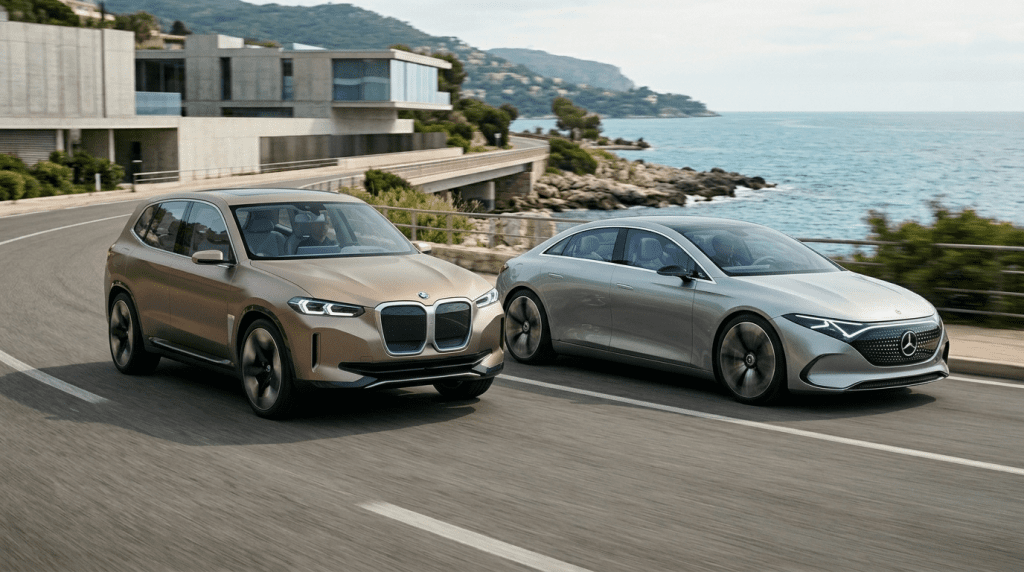
This is the year range anxiety finally started losing its grip. Not because every EV suddenly does 500 miles, but because the cars at the sharp end of the market are now proving what is possible. BMW’s new iX3 is pushing right up to the 500-mile mark. Mercedes has developed a new electric CLA with serious hyper-efficiency credentials. Hyundai continues to show that clever aerodynamics and 800-volt charging can make long journeys feel far less dramatic than many drivers still imagine.
In plain English, the question is changing. It is no longer, “Can an EV go the distance?” It is increasingly, “Why was I still worried in the first place?”
At a glance: why range anxiety is fading
- BMW’s new iX3 is quoted at up to 500 miles WLTP.
- Mercedes’ electric CLA platform points to more than 466 miles WLTP with ultra-efficient design.
- Hyundai’s IONIQ 6 continues to prove how far efficiency and fast charging can take modern EVs.
- 800-volt systems are making rapid charging feel genuinely useful for long-distance drivers.
- The top end of the EV market now makes long journeys feel normal rather than brave.
The 500-mile club is no longer fantasy talk
For years, the magic number in EV discussions was 300 miles. Hit that, and a car felt respectable. Fall short, and somebody would inevitably ask whether it could really cope with “proper” driving. In 2026, the benchmark itself has moved. We are now talking about electric cars that do not just make 300 miles feel achievable, but make it look ordinary.
That is what makes the new wave of long-range EVs so important. They are not niche science projects or distant concept sketches. They are real indicators of where the market is heading. Once manufacturers can credibly talk about figures well beyond 400 miles, and in BMW’s case right up to 500 miles under WLTP, the emotional argument against EV ownership starts to weaken very quickly.
Because most drivers do not need 500 miles every day. What they really need is the confidence that the car can comfortably over-deliver when life demands more.
BMW iX3: the headline-maker
If there is one car that captures the mood of the moment, it is BMW’s new iX3. This is not just another electric SUV with a slightly bigger battery and a fresh press release. It is a statement of intent from the Neue Klasse era, and BMW is not being shy about what it wants the market to hear. Up to 500 miles of WLTP range puts the iX3 firmly into the sort of territory that used to belong to theoretical future cars and wishful forum posts.
What makes that figure especially important is not just the headline number itself. It is what it represents. A car like this moves the public conversation because it tells drivers that long-distance usability is no longer a compromise category. It also shows how battery development, efficiency gains, and smarter vehicle architecture are coming together in ways that feel tangible rather than experimental.
In simple terms, the BMW iX3 is one of the clearest signs yet that range confidence is becoming a built-in feature of premium EV ownership.
Mercedes CLA Electric: the hyper-efficient disruptor
Mercedes has taken a slightly different route, but the destination is the same. Instead of simply chasing a giant battery story, the electric CLA has been framed around ruthless efficiency, slippery aerodynamics, and a next-generation electric drive platform. The headline figure linked to the CLA programme is more than 466 miles WLTP, which is still enough to make traditional range anxiety look a bit last decade.
The really interesting part is how Mercedes couples that range story with charging performance. The brand has spoken about 800-volt architecture and the ability to add up to 248 miles of range in 15 minutes in its CLA concept platform messaging. That is the sort of charging pace that changes behaviour. It means stop times begin to align more naturally with how people already travel, rather than forcing the journey to revolve around the battery.
It also means that even when you do stop, it is no longer a dramatic interruption. It is closer to what drivers already do anyway: stretch your legs, grab a coffee, and carry on.
Why 800-volt charging matters so much
Long range gets the headlines, but charging speed is what finishes the job. The most reassuring EV experience comes when strong range is paired with rapid recovery at the charger.
- It shortens motorway stop times.
- It makes long-distance planning feel simpler.
- It reduces the fear of one awkward charging stop ruining a trip.
- It helps EV journeys fit naturally around real-life breaks.
- It turns charging into a pause, not a problem.
Hyundai IONIQ 6: proof that efficiency is a superpower
Hyundai deserves real credit for helping drag EV conversations away from raw battery size and towards intelligent efficiency. The IONIQ 6 remains one of the clearest examples of what happens when aerodynamic thinking, platform design, and charging tech all work together. It may not be marketed as a 500-mile machine, but it absolutely belongs in this conversation because it shows how modern EVs can go properly long distances without feeling oversized or over-complicated.
Hyundai quotes up to 680 km of range for the latest European IONIQ 6, and the company has also highlighted energy recovery of up to 351 km in 15 minutes under 800-volt ultra-fast charging conditions. That matters because it tackles both sides of the old EV fear in one go. You can go far, and when you do need to stop, you can recover useful range quickly.
For many drivers, that is more psychologically powerful than a single giant headline figure. It makes the whole ownership experience feel calm, credible, and ready for everyday life.
Can you now drive London to Edinburgh without stressing?
This is really the question behind all the range headlines. Drivers are not obsessing over battery figures for sport. They want to know whether an EV can handle a serious UK or Ireland journey without turning into a rolling anxiety exercise. In 2026, the answer is increasingly yes, especially in the upper tier of the market.
A modern long-range EV does not just change how far you can drive. It changes how often you need to think about driving. That is the real breakthrough. The best EVs are starting to feel less like fragile technology choices and more like polished long-distance tools. They are now able to cover substantial mileage with the sort of confidence drivers once assumed only belonged to diesel grand tourers.
Add improving public charging, stronger route planning, and better real-time app support, and the old narrative starts to fall apart very quickly.
The average EV still matters too
It would be easy to read this as a story only about expensive halo cars, but that would miss the point. The importance of the 500-mile club is not that everyone will buy one. It is that these cars reset public expectations across the whole market. Once flagship EVs prove what is possible, confidence filters down fast.
Even outside the headline-grabbing end of the sector, modern EVs are already strong enough for most people’s real lives. Government messaging says the average range of a new electric car is now around 230 miles, while wider industry analysis has already shown average ranges for new BEVs approaching 300 miles. That means the average new EV is already comfortably beyond the day-to-day needs of most drivers, while the best ones are now making proper long-haul motoring feel almost effortless.
In other words, the top end of the market is killing range anxiety, but the wider market is quietly making it irrelevant.
The next challenge is no longer range. It is simplicity.
Once range stops being the dominant fear, the next battleground becomes ease of use. Drivers want confidence not only in the battery, but in the overall charging experience. They want accurate information, simple payment, dependable routing, and an EV journey that feels smooth from start to finish.
That is why practical tools matter so much in 2026. Helpful guides such as how to charge your EV in 4 easy steps, how to find EV charging stations near you in the UK, and five ways ONEEV can help you find and pay for EV charging are becoming more valuable because the modern EV driver is no longer asking whether electric works. They are asking how to make it work brilliantly.
That is a much better problem for the industry to have.
Final word
Range anxiety is not disappearing because people have suddenly become less cautious. It is disappearing because the technology has become harder to doubt. BMW is now talking in genuine 500-mile terms. Mercedes is pairing serious efficiency with rapid charging. Hyundai continues to prove that intelligent design can make long-range electric driving feel beautifully usable.
The result is simple. In 2026, the only thing most long-distance EV drivers should need to panic about is whether the service station still has decent coffee left.