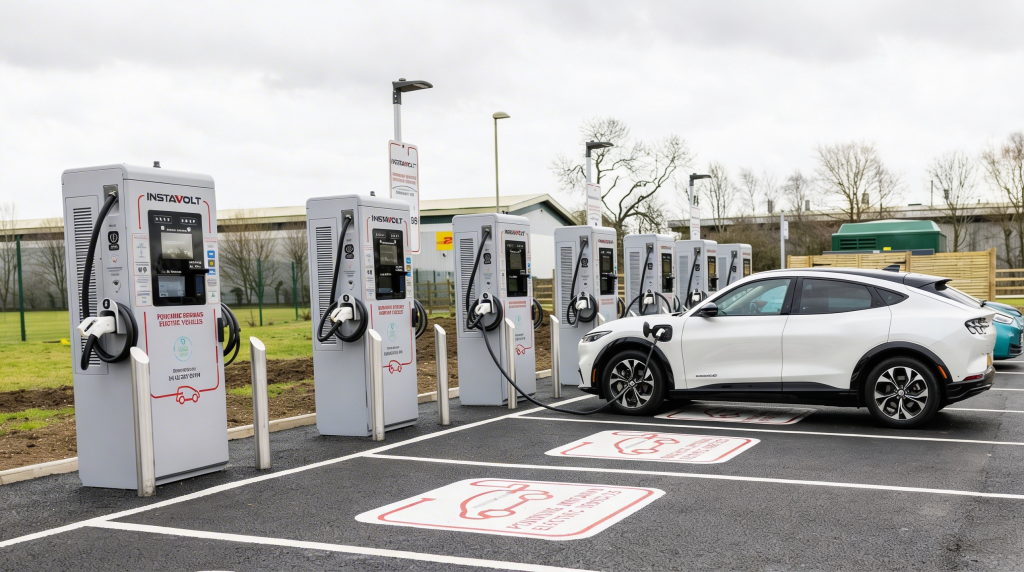
For a long time, the public charging conversation focused on one thing only: more chargers. More chargers in more places. More dots on more maps. That mattered, and it still matters. But in 2026, one of the biggest shifts in the UK EV story is not just that the network has grown. It is that the network has become faster, more capable, and much more useful for real journeys.
That is where ultra-rapid charging changes everything. For many hesitant drivers, especially those still nervous about family road trips, business travel, or longer motorway runs, confidence does not come from simply hearing that there are more chargers somewhere in the country. Confidence comes from knowing that charging can now be quicker, more predictable, and better suited to modern driving.
The infrastructure is not just getting bigger. It is getting better at the jobs drivers actually need it to do.
What ultra-rapid charging actually means
Ultra-rapid charging generally refers to public chargers delivering 150kW or more. In practical terms, these are the chargers designed to add meaningful range in a much shorter stop than older public units. They are built for drivers who need speed, not just access.
That does not mean every EV will always charge at the maximum speed shown on the charger. Real charging speed depends on the vehicle, battery temperature, state of charge, and the car’s own charging capability. But the rise in higher-powered chargers still matters enormously, because it improves the chances of faster en-route charging for a growing number of drivers.
The practical takeaway: ultra-rapid charging is not just about bigger numbers on a screen. It is about making motorway and en-route charging feel more realistic, more routine, and less like a compromise.
The UK network is getting faster, not just larger
One of the most important UK charging trends is the growth in ultra-rapid provision. Thousands of ultra-rapid chargers were added during 2025, and rapid plus ultra-rapid charging now represents the majority of the network’s total capacity despite making up a much smaller share of the overall charger count.
That is a major change in what the network can actually do. A charger count on its own only tells part of the story. Capacity tells the more useful story. It tells you whether the network is becoming more capable of handling real travel demand, shorter dwell times, and the kind of stop-start flexibility drivers expect on longer journeys.
In other words, the UK charging network is not simply adding more infrastructure. It is shifting towards infrastructure that is better aligned with how people actually move around the country.
Why faster charging matters more than just having more chargers
A hundred slow chargers in inconvenient places do not necessarily remove range anxiety. A well-placed hub of higher-powered chargers on a strategic route often does far more to improve real-world confidence.
That is why faster charging matters. It reduces the time penalty that nervous drivers often associate with EV ownership. It makes longer journeys feel more manageable. It lowers the mental barrier around motorway travel, holiday driving, work trips, and back-to-back appointments.
It also changes the rhythm of driving electric. Instead of planning around long charging pauses, more drivers can think in shorter, more practical stops. That does not eliminate planning altogether, but it makes that planning feel much more normal and much less dramatic.
How ultra-rapid charging changes trip planning
For many drivers, the biggest psychological shift comes on the journey itself. Ultra-rapid charging changes how an EV trip feels because it reduces the sense that every longer journey needs military-level preparation.
Motorway and en-route charging is becoming more predictable because the network is adding more high-powered sites and more charging hubs designed specifically for drivers who want to get in, charge efficiently, and move on.
That matters in very human ways. It matters to families who do not want every long trip to revolve around uncertainty. It matters to business users who need confidence between meetings. It matters to new EV drivers who are happy with everyday local use but still feel slightly wary about the annual holiday run, the cross-country weekend, or the unplanned longer journey.
Ultra-rapid charging does not just shorten stops. It gives drivers more confidence that longer journeys can fit into real life without becoming a fuss.
What this means for families
Families often think about charging differently from solo drivers. They are not simply asking how long the car takes to charge. They are thinking about children, breaks, food stops, toilets, and keeping a longer journey moving without unnecessary stress.
That is exactly where faster charging has practical value. A shorter, more efficient charging stop is easier to build into the natural rhythm of a family journey than a long wait in the wrong place. Better still, many newer charging hubs are being developed around the idea that drivers want facilities, space, and simple en-route access, rather than an isolated bay on the edge of nowhere.
This is one of the reasons the EV conversation is changing. The question is no longer simply whether a family can do longer trips in an EV. Increasingly, it is whether the charging stop fits naturally into the trip, and the growing ultra-rapid network makes that much easier to answer with a yes.
What this means for company car drivers and business users
Business users value reliability, time efficiency, and route confidence. The rise of ultra-rapid charging is especially relevant here because business travel often depends on shorter stops and tighter schedules. A charging network that reduces dwell time and improves en-route flexibility is far more useful than one that is merely large on paper.
That is why ultra-rapid growth matters beyond enthusiasts. It supports the everyday driver with places to be, appointments to keep, and time they cannot afford to waste. For company car drivers, consultants, field teams, and regular motorway users, faster public charging is not just a nice extra. It is part of what makes electric motoring feel commercially realistic.
Why this is one of the biggest reasons EV ownership is becoming easier in 2026
There are several reasons EV ownership feels easier in 2026 than it did only a few years ago. Better cars. More public chargers. Better software. Wider model choice. More mature driver habits. But the growth in ultra-rapid charging deserves to be near the top of that list.
It directly addresses one of the most stubborn emotional barriers to switching: the fear that longer journeys will be awkward, slow, or unpredictable. By making motorway and en-route charging more practical, the network helps close the gap between how people imagine EV ownership and how it can actually work in day-to-day life.
The UK network is now developing in a much more useful direction. Not just more posts, but more power. Not just more access, but better journey support. Not just more charging locations, but more strategic confidence.
The smarter message for hesitant drivers
If you are still on the fence about driving electric, this is the shift worth paying attention to. The UK charging story is no longer only about whether chargers exist. It is about whether the right kind of chargers are showing up in the right places.
And increasingly, they are.
That does not mean every route is perfect or every site is equal. It does mean that one of the biggest historic objections to EV ownership is steadily weakening. Because a network that is faster and more predictable changes how people feel about longer journeys, and that changes how possible EV ownership starts to feel.
Ultra-rapid charging is not the only reason the UK drives electric more confidently in 2026. But it is one of the clearest signs that the country is moving from early-adopter infrastructure towards something far more normal, practical, and usable.
That is a big deal. And for many drivers, it may be one of the most reassuring parts of the entire EV story.
To make longer trips easier still, drivers can use the ONEEV app to find suitable chargers, check live information, and pay securely in one place. You can also explore our related guides on how to find EV charging stations near you in the UK and UK public EV charging networks.