Making the switch to an electric vehicle brings a long list of benefits, but for many new drivers the first real question is wonderfully practical: how do I keep it charged without making life complicated? The reassuring answer is that, for most people, EV charging quickly becomes routine.
For drivers with off-street parking, home charging is usually the cheapest, easiest and most convenient way to top up. A professionally installed wall box is typically the safest and fastest way to do that at home, giving you a dependable overnight charging setup that fits around your normal routine rather than disrupting it.
Then, when you are away from home, the public network fills in the rest. That matters more than ever in 2026, because the UK’s public charging infrastructure has now expanded to 118,321 public EV chargers across 45,561 charging locations, giving drivers far more choice than the old “where am I going to charge it?” stereotype suggests.
Your Four Simple Steps to Home Installation
Getting a home charger installed is usually more straightforward than many first-time EV buyers expect. In practical terms, the journey is normally four steps. First, choose your installer or charging provider. If you are buying through a manufacturer or retailer, they may direct you to a preferred installation partner. For example, Land Rover’s UK electrification pages currently reference Pod Point as a recommended home charging partner for certain models.
Second, you complete a suitability check. This usually covers the essentials such as whether you have private off-street parking, where the charger would be placed, and whether your electrical supply is suitable for installation. Third, you agree an installation date that works before or soon after vehicle delivery. Finally, the installer fits the wall box and talks you through safe everyday use, charging speeds and basic setup.
If you are eligible for support, your installer may also guide you through grant-related paperwork. But it is worth being precise here: current UK grant support is targeted, not universal. As things stand, the main household schemes are focused on renters, flat owners and certain homes using cross-pavement solutions, rather than all owner-occupiers with driveways. From 1 April 2026, the maximum support under those household schemes rises to £500 per socket.
Tethered vs Untethered Wall Boxes: Which Is Best?
When choosing a home charger, one of the most common decisions is whether to go tethered or untethered. A tethered wall box has a cable permanently attached. That makes daily charging beautifully simple. You park, grab the cable and plug in. It is quick, tidy in use, and tends to suit drivers who want the least amount of faff on a wet Tuesday evening.
An untethered charger, by contrast, does not have a fixed cable hanging from the unit. It usually looks cleaner on the wall and gives you more flexibility, because you use the cable stored in the car when you need it. For some drivers, that cleaner appearance and broader compatibility is worth the extra step. Neither option is universally better. It simply depends on whether convenience or flexibility matters more in your everyday setup.
The Benefit of Off-Peak Electricity Tariffs
One of the biggest advantages of home charging is not just ease. It is cost control. Charging overnight can unlock lower-rate electricity through EV-friendly tariffs, which can make home charging dramatically cheaper than relying entirely on public rapid charging. That is one reason experienced EV drivers often treat home charging as the default and public charging as the top-up solution for longer journeys and days out.
In simple terms, the ideal pattern for many households is this: do the majority of your charging at home while you sleep, then use the public network only when you genuinely need speed, convenience or extra range. That combination usually delivers the smoothest ownership experience and the best value.
Charging Away from Home
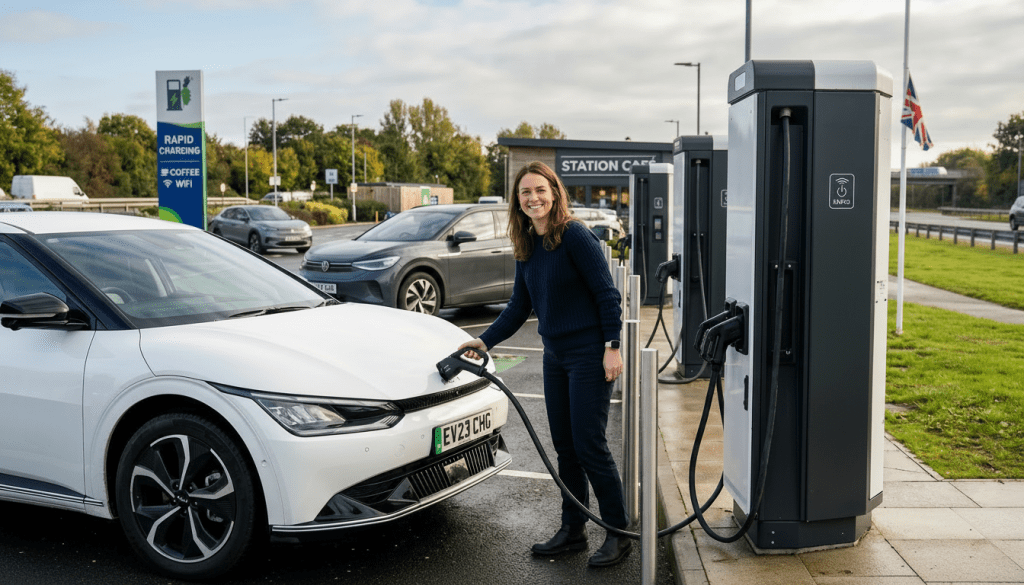
When you are out and about, the UK’s public charging network is now broad enough that topping up on the road is much easier than it used to be. Public charging falls into two familiar categories: AC charging and DC rapid charging. AC points are slower and are commonly found in places where you might stay for a while, such as supermarkets, leisure venues, hotels or town-centre car parks. DC rapid and ultra-rapid chargers are designed for quicker turnaround and are usually found on motorway services, major routes and charging hubs.
AC charging often requires you to use your own cable, especially at untethered public posts. That is very similar to using an untethered home wall box. DC rapid chargers, on the other hand, normally have their own permanently attached cables because of the higher power they deliver. This is the quickest way to charge on a long-distance journey and the most familiar choice when drivers talk about grabbing a fast top-up on the move.
Most modern EVs in the UK use CCS for rapid charging, though some older models and older charging equipment may still reference alternatives such as CHAdeMO. That matters mainly for compatibility when using older infrastructure, not for most newly launched electric vehicles.
How Do I Pay for Public Charging?
This is where many people expect EV ownership to become messy. They imagine a wallet full of RFID cards, endless downloads, multiple accounts and a low-grade sense of administrative despair in a rainy car park. In reality, public charging payment has become much simpler than that, especially if you use a platform that brings charger search, live information and payment together in one place.
That is exactly where the ONEEV app helps. Instead of juggling multiple services, drivers can use ONEEV to search for nearby chargers, check live availability, start supported sessions and pay securely in one place. It is a cleaner, more joined-up way to use the public network and a far better answer than “download every app you can find and hope for the best”.
For new EV drivers especially, this is often the tipping point. Once charging feels easy to find, easy to understand and easy to pay for, the whole switch to electric starts to feel much less like a technological shift and much more like normal life. To go deeper, it is worth reading The ONEEV Beginner’s Guide to Effortless EV Charging, How to Find Fast EV Chargers, and How to Find EV Charging Stations Near You in the UK.
Verdict
The perfect way to charge is not about one magic charger or one single location. It is about having the right setup for the right moment. Home charging gives most drivers their cheapest and easiest routine. Public charging gives flexibility for longer journeys and days when life does not go to plan. And a good app turns the public network from something abstract into something genuinely easy to use.
So if you are new to EVs and wondering whether charging will feel awkward, the honest answer is this: only for about five minutes. After that, it usually becomes one of the simplest parts of owning the car.