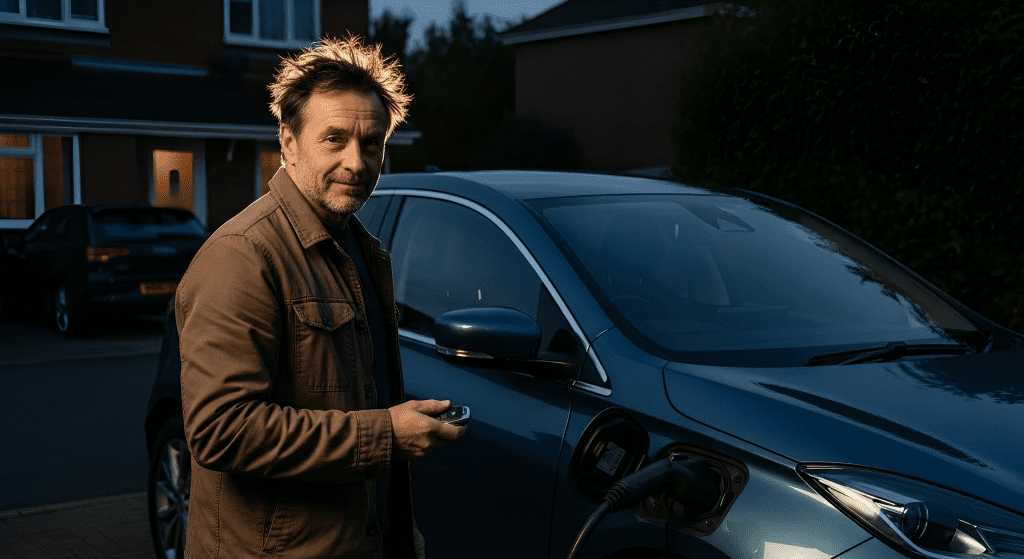
The electric vehicle industry has grown rapidly over the past decade, but misinformation has often travelled just as quickly. As EV adoption accelerates globally, outdated assumptions continue to shape public perception.
Below are the 15 most common electric car myths, examined against current data, real-world usage, and proven technology as of 2026.
1. “EVs have too short a range for daily use”
The average daily commute globally is under 30 miles. Modern electric vehicles typically offer between 250 and 400 miles of real-world range on a single charge. Several premium models now exceed 500 miles.
For the vast majority of drivers, daily charging is neither required nor practical. Most drivers simply top up when convenient, removing the relevance of traditional “range anxiety”.
2. “Electric cars are more likely to catch fire”
Data from emergency services, insurers, and vehicle safety agencies consistently shows that electric vehicles are significantly less likely to catch fire than petrol or diesel vehicles when measured per 100,000 vehicles sold.
While lithium-ion battery fires require different suppression methods, their overall frequency remains substantially lower than internal combustion engine fires.
3. “The power grid will collapse if everyone switches to EVs”
Grid operators have been preparing for electrification for years. Most EV charging occurs overnight during off-peak hours when electricity demand is lowest.
Vehicle-to-Grid technology allows compatible EVs to feed electricity back into the grid during peak demand, turning vehicles into distributed energy assets rather than liabilities.
4. “EVs are dirtier than petrol cars because of manufacturing”
Battery production is carbon-intensive, but the emissions “carbon debt” is typically offset within 11,000 to 15,000 miles of driving. After that point, EVs deliver ongoing emissions savings.
Over a full lifecycle, electric vehicles produce approximately 60 to 70 percent less CO₂ than equivalent petrol vehicles, even when charged using mixed-generation electricity grids.
5. “EV batteries only last a few years”
Modern EV batteries are engineered for longevity. Most manufacturers provide warranties of eight to ten years or up to 100,000 miles.
Real-world fleet data shows many batteries retaining around 90 percent capacity after 150,000 miles, often outlasting the vehicle itself.
6. “Charging takes too long”
Home charging is typically performed overnight, removing any time burden entirely. For long journeys, ultra-rapid DC chargers can now add over 100 miles of range in as little as 10 to 15 minutes.
This aligns closely with natural rest breaks taken during long-distance travel.
7. “There aren’t enough public chargers”
Public charging infrastructure has expanded rapidly across Europe, North America, and Asia. In many regions, there are now more public charging connectors than petrol pumps.
Discovery tools such as :contentReference[oaicite:0]{index=0} and :contentReference[oaicite:1]{index=1} have made locating chargers faster and more reliable than ever before.
8. “EVs don’t work in cold weather”
Cold temperatures can temporarily reduce range by around 20 to 30 percent due to battery chemistry and cabin heating demands.
However, EVs offer instant cabin heat, superior traction due to a low centre of gravity, and predictable winter performance that rivals or exceeds combustion vehicles.
9. “EV batteries end up in landfill”
EV batteries are highly valuable assets. When no longer suitable for automotive use, they are frequently repurposed for stationary energy storage in homes, businesses, and renewable installations.
Recycling processes now recover lithium, nickel, cobalt, and other materials at increasing efficiency levels, supporting a circular battery economy.
10. “Electric cars are too expensive”
While purchase prices can be higher upfront, total cost of ownership is often lower. EVs require less maintenance, have fewer mechanical failures, and use cheaper energy than petrol or diesel vehicles.
By 2026, a growing number of new EV models are available under £20,000, bringing electric driving firmly into the mainstream.
11. “Electric cars are slow and boring”
Electric motors deliver instant torque. Even entry-level EVs often outperform mid-range combustion vehicles in acceleration and responsiveness.
Battery placement also improves handling and stability, resulting in a more controlled and engaging driving experience.
12. “You can’t drive an EV in the rain or through a car wash”
Electric vehicles are fully weatherproof. High-voltage systems are sealed and tested for extreme conditions.
EVs can be driven through deep rain, standing water, and automated car washes with no increased risk compared to conventional vehicles.
13. “EVs create more tyre and brake pollution”
While EVs are heavier, regenerative braking dramatically reduces brake wear and brake dust emissions.
Tyre manufacturers are also developing EV-specific compounds designed to minimise particulate output while handling higher torque loads.
14. “Mining for batteries is worse than oil extraction”
All extraction has environmental impact, but battery technology is evolving rapidly. Cobalt-free lithium iron phosphate batteries are now common, and ethical sourcing standards continue to tighten.
Unlike oil, battery materials are reused, recycled, and reintegrated into new products rather than burned once and lost forever.
15. “Hydrogen or synthetic fuels will replace EVs”
Hydrogen and synthetic fuels may have roles in aviation, shipping, or heavy industry. For passenger vehicles, battery electric cars are approximately three times more energy-efficient.
Synthetic fuels remain costly to produce and still emit pollutants at the tailpipe, limiting their practicality for mass adoption.
Final Thought
Many of the myths surrounding electric vehicles persist because they were once partially true. In 2026, the data tells a very different story.
EVs are no longer experimental, inconvenient, or niche. They are a mature, efficient, and increasingly accessible solution for everyday driving worldwide.