Introduction
As we enter 2026, the UK automotive landscape has shifted. With new road tax rules now in full effect and energy prices stabilizing, many drivers are asking: is it still cheaper to run an EV in 2026? While the “early adopter” days of free tax and ultra-cheap power are evolving, the financial case for electric vehicles remains powerful—if you know how to play the game. In this guide, we answer the 20 most-searched questions about EV ownership to help you decide if switching to ONEEV is the right move for your wallet.
1. Is it actually cheaper to run an EV than a petrol car in 2026?
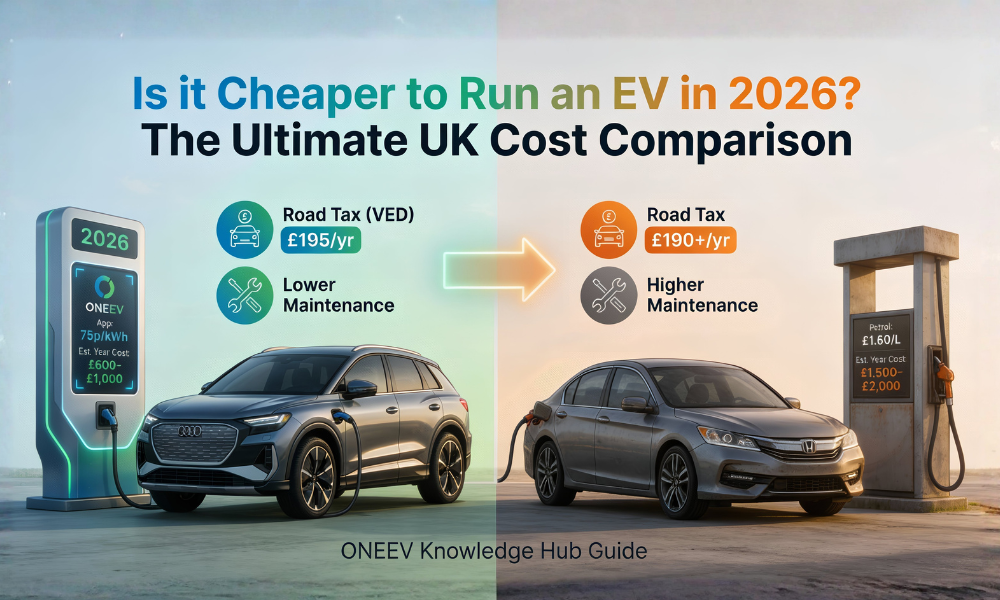
The Answer: Yes. Despite the introduction of VED (Road Tax) for EVs, the average electric driver saves roughly £600 to £1,000 per year compared to petrol.
Expert View: “While the ‘fuel gap’ narrowed during the energy crisis, the efficiency of electric motors—roughly 3x that of internal combustion—means you still get significantly more miles per pound spent.” — ONEEV Data Team.
2. How much does it cost to charge an EV at a public rapid charger?
The Answer: In 2026, public rapid charging averages 75p–85p per kWh. This is the “convenience” rate.
Pro Tip: Use the ONEEV App to find chargers with lower off-peak rates to slash these costs by 30%.
3. Do I have to pay Road Tax (VED) for my electric car in 2026?
The Answer: Yes. As of April 2025, most EVs pay a standard rate of £195 per year. However, new EVs registered after April 1, 2025, pay only £10 for the first year.
4. What is the “Expensive Car Supplement” for EVs in 2026?
The Answer: Good news! The threshold for the “Luxury Car Tax” was increased to £50,000 for EVs in late 2025. If your EV costs less than £50k, you avoid the extra £425 annual surcharge.
5. What are the 2026 Benefit-in-Kind (BiK) rates for company EVs?
The Answer: For the 2025/26 tax year, the BiK rate is 3%, rising to 4% in April 2026. This remains vastly cheaper than the 25–37% rates seen for petrol/diesel equivalents.
6. How much range do EVs lose in the UK winter?
The Answer: Expect a 15–20% drop in range when temperatures hit zero.
7. Can I charge my electric car in the rain?
The Answer: Absolutely. EV charging systems are designed with multiple layers of weatherproofing and grounding. It is 100% safe to charge in a downpour.
8. How long does it actually take to charge from 10% to 80%?
The Answer: On a 150kW ultra-rapid charger, most modern EVs take 20–35 minutes. On a standard home charger, it’s an 8-hour overnight job.
9. What is the difference between Type 2, CCS, and CHAdeMO?
The Answer:
- Type 2: Standard slow/fast home and street charging.
- CCS: The European standard for rapid/ultra-rapid charging (most common).
- CHAdeMO: Used by older Nissan Leafs and some Japanese models.
10. Do I need a special app to pay at every charging station?
The Answer: Technically, no (most now accept contactless), but yes if you want the best rates. Apps like ONEEV provide live status and reward points that you can’t get with a simple credit card tap.
11. How long do EV batteries last before they need replacing?
The Answer: Most batteries are designed to outlast the car. Expect 150,000 to 200,000 miles before seeing significant degradation (dropping below 70–80% capacity).
12. What happens to EV batteries at the end of their life?
The Answer: They are rarely thrown away. They are either “re-purposed” for home energy storage or 95% recycled for their raw materials like lithium and cobalt.
13. Does frequent rapid charging damage the battery?
The Answer: Frequent “DC” rapid charging can cause slightly faster wear.
Expert View: “For maximum longevity, use slow ‘AC’ charging for your daily needs and save rapid chargers for long motorway trips.”
14. What is a “Heat Pump” and do I need one?
The Answer: It’s a high-efficiency heater. If you do a lot of winter driving, a heat pump is essential as it can save you 10–15% of your range in the cold.
15. Can I buy an EV if I don’t have a driveway?
The Answer: Yes. The UK now has over 80,000 public chargers, many of which are integrated into lampposts or curbsides in residential areas.
16. Which electric cars have the longest range in 2026?
The Answer: Models like the Lucid Air and updated Tesla Model S now push past 450 miles, while affordable cars like the Kia EV6 comfortably hit 300+ miles.
17. Can an electric car tow a caravan?
The Answer: Yes, but it heavily impacts range. Many SUVs like the BMW iX or Tesla Model X have towing capacities of 2,000kg+.
18. Are EVs safe in a flood?
The Answer: EVs often perform better than petrol cars in shallow floods because there is no air intake to “choke” the engine. However, you should still avoid deep water to protect the electronics.
19. Will the 2035 petrol ban affect my car’s resale value?
The Answer: Likely yes. As 2035 approaches, the demand for used petrol cars is expected to drop, while the “used EV” market is becoming the new standard.
20. What is “Vehicle-to-Grid” (V2G)?
The Answer: It’s a technology that lets your car sell electricity back to the grid when prices are high. In 2026, some UK homeowners are earning £300–£500 a year just by plugging in their car at home.
Conclusion: Is it time to switch?
The data for 2026 is clear: while the UK government is normalizing taxes for EVs, the operational savings on fuel and maintenance still make electric the superior financial choice for the majority of drivers.
Ready to start saving? Download the ONEEV App today to find the most reliable, cost-effective chargers on the UK network.